
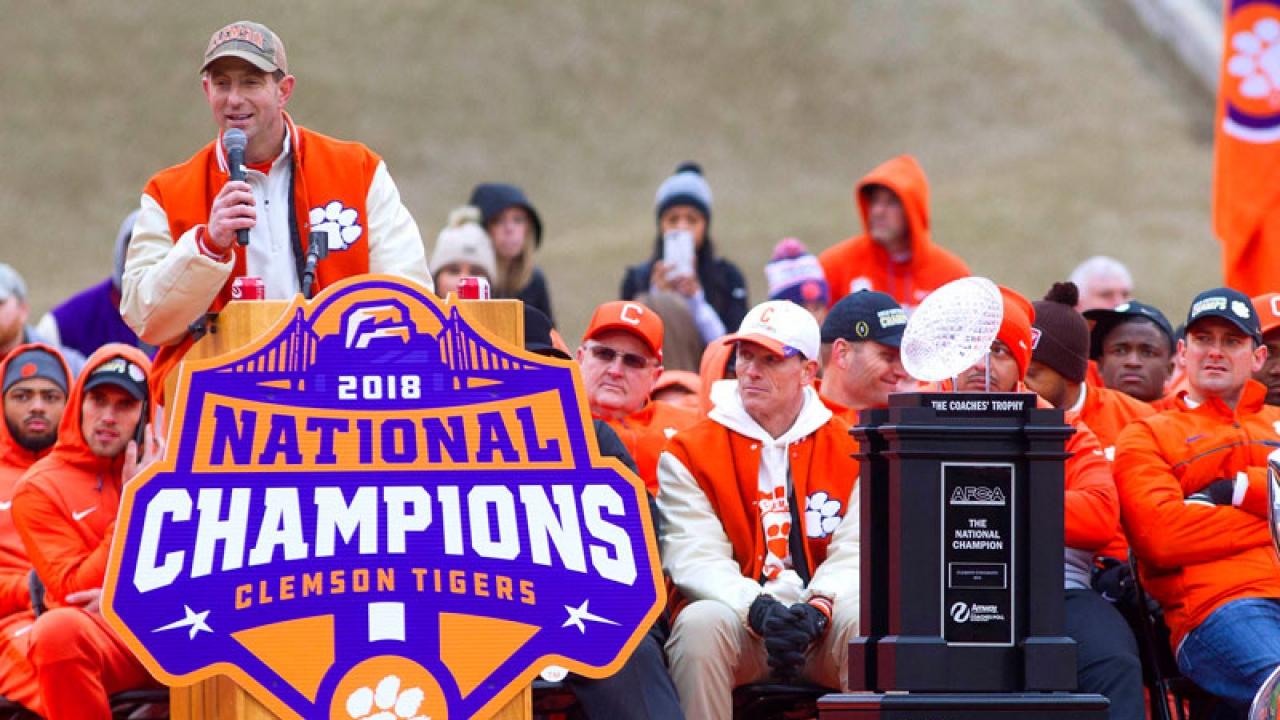
There are many polls to keep track of during the college football season, from the AP Poll and College Football Playoff rankings in the FBS to the FCS and Division II polls. Here’s what you need to know about the major polls — and how college football rankings work.
Some of these polls go back decades. Others, like the College Football Playoff rankings, are much newer.
College football rankings: Every poll explained and how they work
Guide to the College Football Playoff rankings system
Unlike other polls, the College Football Playoff rankings come out only until well into the season. And unlike other polls, it’s the only one that really matters, as it’s for the 12-team playoff. For a decade, the CFP was only a four-team playoff. Starting with the 2024 season, it moved up to 12 teams. The CFP Selection Committee ranks its own top 25, using factors like strength of schedule, results, championships won, common opponents and more.
The 12-team playoff field will be made up of the five conference champions ranked highest by the committee, plus the next seven highest-ranked teams. The four highest-ranked conference champs receive a first-round bye and are seeded one through four. The fifth conference champion ranked the highest will be seeded where it was ranked or at No. 12 if it landed outside the top 12 of the rankings. Any non-conference champion team will be seeded starting at No. 5. Teams seeded 5-12 will play in the first round on campus sites (No. 5 vs. No. 12, No. 6 vs. No. 11, No. 7 vs. No. 10 and No. 8 vs. No. 9). Winners of these games will then play the top four seeds — No. 1 vs. No. 8/9, No. 2 vs. No. 7/10, No. 3 vs. No. 6/11, No. 4 vs. No. 5/12. There will be no re-seeding.
The CFP, which started with the 2014 season, has its committee members meet in person to rank teams.
There is no new CFP rankings after the bowl games or the championship game.
Here is a list of the first No. 1 teams in the College Football Playoff rankings, the final CFP No. 1 team and the eventual national champion for each season of the College Football Playoff rankings:
Year
First CFP No. 1
Final CFP No. 1
National Champion
2014
Mississippi State
Alabama
Ohio State
2015
Clemson
Clemson
Alabama
2016
Alabama
Alabama
Clemson
2017
Georgia
Clemson
Alabama
2018
Alabama
Alabama
Clemson
2019
Ohio State
LSU
LSU
2020
Alabama
Alabama
Alabama
2021
Georgia
Alabama
Georgia
2022
Tennessee
Georgia
Georgia
2023
Ohio State
Michigan
Michigan
2024
Oregon
Oregon
Ohio State
Here are the College Football Playoff Selection Committee members:
Chris Ault (former head coach and athletics director at Nevada)
Chet Gladchuk (athletics director, U.S. Naval Academy)
Jim Grobe (former head coach, Ohio University, Wake Forest and Baylor)
Warde Manuel (chair) (athletics director for Michigan)
Randall McDaniel (College and Pro Football Hall of Fame member and former All-American offensive lineman with Arizona State University)
Gary Pinkel (former head coach, Toledo and Missouri)
Mack Rhoades (athletics director for Baylor)
Mike Riley (former college head coach, Oregon State and Nebraska, as well as head coach in the NFL, CFL, WLAF, AAF and USFL)
David Sayler (athletics director, Miami (Ohio)
Will Shields (College and Pro Football Hall of Fame member and former All-American offensive lineman with Nebraska)
Kelly Whiteside (professor in Sports Media and Journalism, Montclair State; longtime sportswriter, USA Today, Sports Illustrated and Newsday)
Carla Williams (athletics director for Virginia)
Hunter Yurachek (Arkansas athletics director)
Guide to the AP Poll Top 25
Starting with the preseason poll, the Associated Press Poll will rank the top 25 teams each week during the season and after the bowl games and the College Football Playoff.
The sportswriters and broadcasters from throughout the country vote individually. Teams are given points on a scale: No. 1 gets you 25, No. 2 gets you 24, etc. These ballots, which are made public each week, are then combined for one AP Top 25 poll.
Once the season starts, the poll is released each Sunday afternoon (except for after Week 1 due to games throughout Labor Day weekend).
The AP Poll voters are not obligated to rank the CFP winner No. 1. In the 2017 season, undefeated UCF, which beat Auburn in the Peach Bowl, received four No. 1 votes. The last time the AP Poll and the Coaches Poll had different No. 1 teams at the end of the season was in 2003, during the BCS era. That year, LSU beat Oklahoma in the Sugar Bowl to win the BCS National Championship and thus the ESPN/Coaches Poll No. 1 ranking. The AP, however, ranked Southern California No. 1 after the Trojans defeated Michigan in the Rose Bowl.
Alabama has the most season-ending No. 1 rankings in AP Poll history with 12. The Crimson Tide finished No. 1 in 1961, 1964, 1965, 1978, 1979, 1992, 2009, 2011, 2012, 2015, 2017 and 2020. Notre Dame is second with eight, winning most recently in 1988.
Minnesota won the first AP title, ranking No. 1 in 1936. The final AP Poll finally came out after the bowl games for good starting with the 1968 season.
Final AP No. 1 teams since the 2000 season:
2000: Oklahoma
2001: Miami (FL)
2002: Ohio State
2003: Southern California
2004: Southern California
2005: Texas
2006: Florida
2007: LSU
2008: Florida
2009: Alabama
2010: Auburn
2011: Alabama
2012: Alabama
2013: Florida State
2014: Ohio State
2015: Alabama
2016: Clemson
2017: Alabama
2018: Clemson
2019: LSU
2020: Alabama
2021: Georgia
2022: Georgia
2023: Michigan
2024: Ohio State
All FBS teams can earn rankings in the poll, as can FCS programs. In 2007, Appalachian State upset then-No. 5 Michigan, 34-32, prompting the AP Poll to allow voters to rank FCS teams (“Appalachian State Rule)”. In 2016, North Dakota State upset then-No. 11 Iowa and received 74 votes in the AP Poll.
Guide to the college football Coaches Poll
Like the AP Poll, the Coaches Poll starts with a preseason top 25 and continues weekly on Sundays during the season and after the bowl games. The poll gives teams points on a scale from 1 to 25 (25 for ranking a team No. 1, 24 for No. 2, etc.).
Like the AP Poll, the Coaches Poll isn’t obligated to vote the College Football Playoff winner as the national champion, though it’s been awarded to the same team each year.
The Coaches’ Trophy is awarded to the national champion. Before the CFP, this went to the Bowl Championship Series (BCS) winner. The College Football Playoff has its own trophy.
Through the 1973 season, the final Coaches Poll came out at the end of the regular season but before the bowl games.
College Football: Split national titles
Though the College Football Playoff has eliminated (almost) all worries about avoiding a split national champion, there are instances where there are multiple national champions in a single season. Some of that had to do with different national champions for the AP and Coaches Poll.
Here are the years with split national champions, per this list of champions on NCAA.com, since 1970.
Year
Schools (Polls)
2003
LSU (Coaches), Southern California (AP)
1997
Michigan (AP), Nebraska (Coaches)
1991
Miami (FL) (AP), Washington (Coaches)
1990
Colorado (AP), Georgia Tech (Coaches)
1978
Alabama (AP), Southern California (Coaches)
1974
Oklahoma (AP), Southern California (Coaches)
1973
Alabama (Coaches), Notre Dame (AP)
1970
Nebraska (AP, FWAA), Texas (Coaches, NFF), Ohio State (NFF)
How the FCS rankings work
Like in FBS, there is more than one poll for the Football Championship Subdivision. The weekly STATS poll is voted on by the media, while the Coaches Poll is voted on by FCS coaches. Both of these polls release a preseason top 25 and continue to vote weekly through the end of the regular season and again after the conclusion of the 24-team playoff.
How the DII football rankings work
Before 1973, champions for the then “NCAA College Division” were decided by polls at the end of the regular season. Starting with 1973, there has been the DII Football Championship.
There are also regional rankings, which play a major role in deciding the playoff participants. The 28-team playoff is made up of seven teams from each of these four regions. Participants in each region are determined by regional rankings. A conference’s highest-ranked team qualifies automatically if it ranks in the top nine. Other participants are determined by the region rankings.
FBS: Championship History
National Champions
SEASON
CHAMPION
SELECTING ORGANIZATION
2024
Ohio State
CFP
2023
Michigan
CFP
2022
Georgia
CFP
2021
Georgia
CFP
2020
Alabama
CFP
2019
LSU
CFP
2018
Clemson
CFP
2017
Alabama
CFP
2016
Clemson
CFP
2015
Alabama
CFP
2014
Ohio State
CFP
2013
Florida State
BCS
2012
Alabama
BCS
2011
Alabama
BCS
2010
Auburn
BCS
2009
Alabama
BCS
2008
Florida
BCS
2007
Louisiana State
BCS
2006
Florida
BCS
2005
Texas
BCS
2004
Southern California*
BCS
2003
Louisiana State, Southern California
BCS, AP, FWAA
2002
Ohio State
BCS
2001
Miami (Fla.)
BCS
2000
Oklahoma
BCS
1999
Florida State
BCS
1998
Tennessee
BCS
1997
Michigan, Nebraska
AP, FWAA, NFF, USA/ESPN
1996
Florida
AP, FWAA, NFF,USA/CNN
1995
Nebraska
AP, FWAA, NFF, USA/CNN, UPI
1994
Nebraska
AP, FWAA, NFF, USA/CNN, UPI
1993
Florida St.
AP, FWAA,NFF, USA/CNN, UPI
1992
Alabama
AP, FWAA, NFF, USA/CNN, UPI
1991
Washington, Miami (Fla.)
FWAA, NFF, USA/CNN, UPI,AP
1990
Colorado, Georgia Tech
FWAA, NFF, USA/CNN, AP, UPI
1989
Miami (Fla.)
AP, FWAA, NFF, USA/CNN, UPI
1988
Notre Dame
AP, FWAA, NFF, USA/CNN, UPI
1987
Miami (Fla.)
AP, FWAA, NFF, USA/CNN, UPI
1986
Penn St.
AP, FWAA, NFF, USA/CNN, UPI
1985
Oklahoma
AP, FWAA, NFF, USA/CNN, UPI
1984
Brigham Young
AP, FWAA, NFF, USA/CNN, UPI
1983
Miami (Fla.)
AP, FWAA, NFF, USA/CNN, UPI
1982
Penn St.
AP, FWAA, NFF, USA/CNN, UPI
1981
Clemson
AP, FWAA, NFF, UPI
1980
Georgia
AP, FWAA, NFF, UPI
1979
Alabama
AP, FWAA, NFF, UPI
1978
Alabama, Southern California
AP, FWAA, NFF, UPI
1977
Notre Dame
AP, FWAA, NFF, UPI
1976
Pittsburgh
AP, FWAA, NFF, UPI
1975
Oklahoma
AP, FWAA, NFF, UPI
1974
Southern California, Oklahoma
FWAA, NFF, UPI, AP
1973
Notre Dame, Alabama
AP, FWAA, NFF, UPI
1972
Southern California
AP, FWAA, NFF, UPI
1971
Nebraska
AP, FWAA, NFF, UPI
1970
Nebraska, Texas, Ohio St.
AP, FWAA, NFF, UPI, NFF
1969
Texas
AP, FWAA, NFF, UPI
1968
Ohio St.
AP, FWAA, NFF, UPI
1967
Southern California
AP, FWAA, NFF, UPI
1966
Notre Dame, Michigan St.
AP, FWAA, NFF, UPI, NFF
1965
Michigan St., Alabama
FWAA, NFF, UPI, AP
1964
Alabama, Arkansas, Notre Dame
AP, UPI, FWAA, NFF
1963
Texas
AP, FWAA, NFF, UPI
1962
Southern California
AP, FWAA, NFF, UPI
1961
Alabama, Ohio St.
AP, NFF, UPI, FWAA
1960
Minnesota, Mississippi
AP, NFF, UPI, FWAA
1959
Syracuse
AP, FWAA, NFF, UPI
1958
LSU, Iowa
AP, UPI, FWAA
1957
Ohio St., Auburn
FWAA, UPI, AP
1956
Oklahoma
AP, FWAA, UPI
1955
Oklahoma
AP, FWAA, UPI
1954
UCLA, Ohio St.
FWAA, UPI, AP
1953
Maryland
AP, UPI
1952
Michigan St.
AP, UPI
1951
Tennessee
AP, UPI
1950
Oklahoma
AP, UPI
1949
Notre Dame
AP
1948
Michigan
AP
1947
Notre Dame
AP
1946
Notre Dame
AP
1945
Army
AP
1944
Army
AP
1943
Notre Dame
AP
1942
Ohio St.
AP
1941
Minnesota
AP
1940
Minnesota
AP
1939
Texas A&M
AP
1938
Texas Christian
AP
1937
Pittsburgh
AP
1936
Minnesota
AP
1935
Minnesota
CFRA, HAF, NCF
1934
Minnesota
CFRA, HAF, NCF
1933
Michigan
CFRA, HAF, NCF
1932
Southern California
CFRA, HAF, NCF
1931
Southern California
CFRA, HAF, NCF
1930
Alabama, Notre Dame
CFRA, HAF, NCF
1929
Notre Dame
CFRA, HAF, NCF
1928
Georgia Tech.
CFRA, HAF, NCF
1927
Illinois, Yale
HAF, NCF, CFRA
1926
Alabama, Stanford
CFRA, HAF, NCF, HAF
1925
Alabama
CFRA, HAF, NCF
1924
Notre Dame
CFRA, HAF, NCF
1923
Illinois, Michigan
CFRA, HAF, NCF, NCF
1922
California, Cornell, Princeton
NCF, HAF, CFRA, NCF
1921
California, Cornell
CFRA, NCF, HAF
1920
California
CFRA, HAF, NCF
1919
Harvard, Illinois, Notre Dame, Texas A&M
CFRA, HAF, NCF, CFRA, NCF, NCF
1918
Michigan, Pittsburgh
NCF, HAF, NCF
1917
Georgia Tech.
HAF, NCF
1916
Pittsburgh
HAF, NCF
1915
Cornell
HAF, NCF
1914
Army
HAF, NCF
1913
Harvard
HAF, NCF
1912
Harvard, Penn St.
HAF, NCF, NCF
1911
Penn St., Princeton
NCF, HAF, NCF
1910
Harvard, Pittsburgh
HAF, NCF, NCF
1909
Yale
HAF, NCF
1908
LSU, Pennsylvania
NCF, HAF, NCF
1907
Yale
HAF, NCF
1906
Princeton
HAF, NCF
1905
Chicago
HAF, NCF
1904
Michigan, Pennsylvania
NCF, HAF, NCF
1903
Michigan, Princeton
NCF, HAF, NCF
1902
Michigan
HAF, NCF
1901
Michigan
HAF, NCF
1900
Yale
HAF, NCF
1899
Harvard
HAF, NCF
1898
Harvard
HAF, NCF
1897
Pennsylvania
HAF, NCF
1896
Lafayette, Princeton
NCF, HAF, NCF
1895
Pennsylvania
HAF, NCF
1894
Yale
HAF, NCF
1893
Princeton
HAF, NCF
1892
Yale
HAF, NCF
1891
Yale
HAF, NCF
1890
Harvard
HAF, NCF
1889
Princeton
HAF, NCF
1888
Yale
HAF, NCF
1887
Yale
HAF, NCF
1886
Yale
HAF, NCF
1885
Princeton
HAF, NCF
1884
Yale
HAF, NCF
1883
Yale
HAF, NCF
1882
Yale
NCF
1881
Yale
NCF
1880
Princeton, Yale
NCF, NCF
1879
Princeton
NCF
1878
Princeton
NCF
1877
Yale
NCF
1876
Yale
NCF
1875
Harvard
NCF
1874
Yale
NCF
1873
Princeton
NCF
1872
Princeton
NCF
1871
None selected
NCF
1870
Princeton
NCF
1869
Princeton, Rutgers
NCF
* Southern California’s participation in the 2004 championship was vacated by the NCAA Committee on Infractions.
FCS: Championship history
YEAR
CHAMPION
COACH
SCORE
RUNNER-UP
SITE
2024
North Dakota State
Tim Polasek
35-32
Montana State
Frisco, Texas
2023
South Dakota State
Jimmy Rogers
23-3
Montana
Frisco, Texas
2022
South Dakota State
John Stiegelmeier
45-21
North Dakota State
Frisco, Texas
2021
North Dakota State
Matt Entz
38-10
Montana State
Frisco, Texas
2020
Sam Houston
K.C. Keeler
23-21
South Dakota State
Frisco, Texas
2019
North Dakota State
Matt Entz
28-20
James Madison
Frisco, Texas
2018
North Dakota State
Chris Klieman
38-24
Eastern Washington
Frisco, Texas
2017
North Dakota State
Chris Klieman
17-13
James Madison
Frisco, Texas
2016
James Madison
Mike Houston
28-14
Youngstown State
Frisco, Texas
2015
North Dakota State
Chris Klieman
37-10
Jacksonville State
Frisco, Texas
2014
North Dakota State
Chris Klieman
29-27
Illinois State
Frisco, Texas
2013
North Dakota State
Craig Bohl
35-7
Towson
Frisco, Texas
2012
North Dakota State
Craig Bohl
39-13
Sam Houston State
Frisco, Texas
2011
North Dakota State
Craig Bohl
17-6
Sam Houston State
Frisco, Texas
2010
Eastern Washington
Beau Baldwin
20-19
Delaware
Frisco, Texas
2009
Villanova
Andy Talley
23-21
Montana
Chattanooga, Tenn.
2008
Richmond
Mike London
24-7
Montana
Chattanooga, Tenn.
2007
Appalachian State
Jerry Moore
49-21
Delaware
Chattanooga, Tenn.
2006
Appalachian State
Jerry Moore
28-17
Massachusetts
Chattanooga, Tenn.
2005
Appalachian State
Jerry Moore
21-16
UNI
Chattanooga, Tenn.
2004
James Madison
Mickey Matthews
31-21
Montana
Chattanooga, Tenn.
2003
Delaware
K.C. Keeler
40-0
Colgate
Chattanooga, Tenn.
2002
Western Kentucky
Jack Harbaugh
34-14
McNeese State
Chattanooga, Tenn.
2001
Montana
Joe Glenn
13-6
Furman
Chattanooga, Tenn.
2000
Georgia Southern
Paul Johnson
27-25
Montana
Chattanooga, Tenn.
1999
Georgia Southern
Paul Johnson
59-24
Youngstown State
Chattanooga, Tenn.
1998
Massachusetts
Mark Whipple
55-43
Georgia Southern
Chattanooga, Tenn.
1997
Youngstown State
Jim Tressel
10-9
McNeese State
Chattanooga, Tenn.
1996
Marshall
Bob Pruett
49-29
Montana
Huntington, W.Va.
1995
Montana
Don Read
22-20
Marshall
Huntington, W.Va.
1994
Youngstown State
Jim Tressel
28-14
Boise State
Huntington, W.Va.
1993
Youngstown State
Jim Tressel
17-5
Marshall
Huntington, W.Va.
1992
Marshall
Jim Donnan
31-28
Youngstown State
Huntington, W.Va.
1991
Youngstown State
Jim Tressel
25-17
Marshall
Statesboro, Ga.
1990
Georgia Southern
Tim Stowers
36-13
Nevada
Statesboro, Ga.
1989
Georgia Southern
Erk Russell
37-34
Stephen F. Austin *
Statesboro, Ga.
1988
Furman
Jimmy Satterfield
17-12
Georgia Southern
Pocatello, Idaho
1987
Louisiana-Monroe
Pat Collins
43-42
Marshall
Pocatello, Idaho
1986
Georgia Southern
Erk Russell
48-21
Arkansas State
Tacoma, Wash.
1985
Georgia Southern
Erk Russell
44-42
Furman
Tacoma, Wash.
1984
Montana State
Dave Arnold
19-6
Louisiana Tech
Charleston, S.C.
1983
Southern Illinois
Rey Dempsey
43-7
Western Carolina
Charleston, S.C.
1982
Eastern Kentucky
Roy Kidd
17-14
Delaware
Wichita Falls, Texas
1981
Idaho State
Dave Kragthorpe
34-23
Eastern Kentucky
Wichita Falls, Texas
1980
Boise State
Jim Criner
31-29
Eastern Kentucky
Sacramento, Calif.
1979
Eastern Kentucky
Roy Kidd
30-7
Lehigh
Orlando, Fla.
1978
Florida A&M
Ruby Hubbard
35-28
Massachusetts
Wichita Falls, Texas
* — Stephen F. Austin’s participation in 1989 championship was vacated.