
Back to the quarterback, Maye was a net-negative in my grading, with 10 minus plays to six plus plays. Most of the rookie’s downgraded plays were due to him struggling against pressure, either leaving the pocket prematurely or not seeing the field well against the blitz. As we explained above, not every pressure is on the offensive line. Sometimes, the defense brings more rushers than the line can block, so it’s on the quarterback to beat the free runner by throwing “hot” vs. the blitz. Overall, Maye was 1-for-6 for seven yards, two sacks and two scrambles vs. the blitz.
In some ways, Maye’s film this week was reminiscent of Bears QB Caleb Williams’s struggles on Christmas Day. Both highly-drafted rookies are learning how to be efficient vs. the blitz. Rather than beating the blitz by making quick decisions as throwers, the two rookies got themselves in trouble by bailing out of the pocket. Maye and Williams are learning that running away from the pressure might’ve worked in college, but it’s harder to outrun NFL defenses.
To be clear, the offense’s issues aren’t on Drake Maye. It’s much bigger than that. But it’s a copy-cat league, and if defenses sense that Maye isn’t seeing blitzes well, they’ll keep blitzing him until he figures it out. Hopefully, these experiences will benefit him in the long run. Maye is still developing, and as a young quarterback, he has shown that he learns best by playing. Every rep gets downloaded into the computer between Maye’s ears, and he’s better the next time he drops back.
As for the coaching, Van Pelt’s two worst plans recently were against Arizona and LA. In both instances, the Pats tried things that were too complicated for this group. It would be nice to graduate to higher-level schemes, but this unit isn’t there. As is the case everywhere in pro football, every team wants to upgrade when possible. But it would seem odd to scapegoat Van Pelt, who has Maye’s trust with the rookie pointed in the right direction and has very little to work with personnel-wise.
Until the personnel department upgrades his supporting cast, this is what you’re going to get on offense: a flashy quarterback who doesn’t have the tools to be consistent. Get the kid some help.
Quick-Hit Film Notes From Patriots-Chargers After Further Review
– Although he technically started this game, lead-back Rhamondre Stevenson only had two rush attempts on 20 total snaps compared to 12 attempts on 28 snaps for Antonio Gibson. Gibson, who has been the Pats best back of late, has cut into Rhamondre’s workload. Stevenson’s three-lowest snap rates have come in the last five games: Week 12 vs. Miami (42%), Week 16 vs. Buffalo (44%), and this weekend vs. LA (45%).
– Cole Strange didn’t look out of place at center. It was far from perfect, with a jailbreak sack on him for snapping the ball early being the most egregious error. Strange was understandably unsure of his assignments at times, hanging onto a double-team too long on a third-and-1 stuff and allowing a free runner from the second level. Furthermore, since he’ll be uncovered often, he has to be more active looking for work in pass protection. But, overall, Strange’s issues were mostly correctable mental/timing errors. From a long-term viewpoint, I’m still wary of Strange’s ability to dig out bigger DTs in the run game. Some of it was on the ball cutting back when he was leveraging blocks to the outside, but Strange is inconsistent in moving those bigger bodies, and that’s the name of the game as an interior lineman.
– LG Layden Robinson opened the game with a nice run block on outside zone to catch the second-level blitzer and drive him out of frame – showing off his physicality and play strength. However, Robinson gave up two pressures by being late to pick up second-level blitzers, which has been an issue for him, and didn’t ride the backside cut-off long enough on a four-yard run TFL on a pin-pull RPO. Robinson is improving and has good raw power, but the rookie is still a work in progress in pass protection.
– LT Vederian Lowe was competitive for the second consecutive week in 10 one-on-one matchups vs. stud EDGE Khalil Mack. Mack beat Lowe once with power, causing a key incompletion where Bourne was open past the sticks on third down. Those are drive-killers that can’t be ignored. Still, Lowe was clean besides that and has done a nice job since bottoming out in Arizona.
– RT Trey Jacobs mostly saw Chargers veteran edge rusher Joey Bosa. Jacobs allowed a pressure to Bosa and one to Mack when he was over his side. The pressure by Bosa came on the Douglas TD, where Jacobs was late off the ball (the rest of the line wasn’t). Jacobs’s issues getting initial depth in his kick-slide and playing with proper pad level show up every week.
– Mike Onwenu has settled in at right guard in recent weeks. He allowed a hurry when Morgan Fox got too deep into the pocket with power. But, on the whole, Onwenu won his assignments, and the lack of movement in the run game to his side is primarily due to those around him. Onwenu should be the starting right guard moving forward. The tackle experiment needs to be over. Draft/sign a starting right tackle and leave him be, please.
– Rookie RT Caedan Wallace played 14 snaps in garbage time. He had a terrific two-for-one block on a 20-yard run by Gibson and turned out the backside on a four-yard run. However, Wallace also had a rough rep vs. Bud Dupree’s power rush, where he ended up on the ground and whiffed on a second-level climb. I’m not going to look too much into 14 snaps in mop-up duty. I’d like to see Wallace start next week.
– WR Kendrick Bourne was open multiple times on this film, with his two catches for 22 yards not doing him justice. Bourne was open for a big play on two vertical routes, one on James’s first sack and another on a double move where Maye didn’t have enough time in the pocket. Bourne still has occasional mental lapses, but his separation ability is on this tape.
– WR Kayshon Boutte finished through some contact on his four grabs on hitches/slants/unders. However, he continues to let Maye down by giving up on his vertical routes. The Pats dialed up a shot play for Boutte on a double move, where Boutte was supposed to sell a break (dig) and then get vertical. Boutte seemed to slow on the route while the ball was in the air, nearly leading to an interception. This isn’t the first time where Boutte hasn’t finished his route.
– WR DeMario Douglas made a terrific adjustment back to the ball on his 36-yard touchdown and separated on the first third-down attempt, but Maye wasn’t looking his way before leaving the pocket. It would be interesting to see Douglas in an offense where he was complemented by outside receivers who can draw coverage away from the middle of the field.
– The same goes for vet TEs Hunter Henry and Austin Hooper. Defenses are sitting all over their stick routes and keying on Henry on third downs. The Pats TE duo has become the focal point of opposing defense’s game plans.
– QB Pressures allowed: Maye (two sacks), Strange (sack), Gibson (sack), Robinson (four hurries), Jacobs (two hurries), Lowe (QB hit), Onwenu (hurry), Wallace (hurry), Stevenson (hurry).
– Watched the McConkey touchdown several times, and to be honest, it’s unclear exactly what the coverage was. It’s zone, so I was wrong in game observations about it being a bracket call (mea culpa). My best guess is cloud coverage (cover-six), where Jones has the deep quarter or is at least supposed to match a vertical from the slot. Dugger’s eyes were in the backfield the entire time in his zone drop, so I don’t put that on him. Here’s how I see the assignments: Bolden (deep-fourth), Jones (deep-fourth), Tavai (curl/flat), Dugger (hook). Jones just got beat.
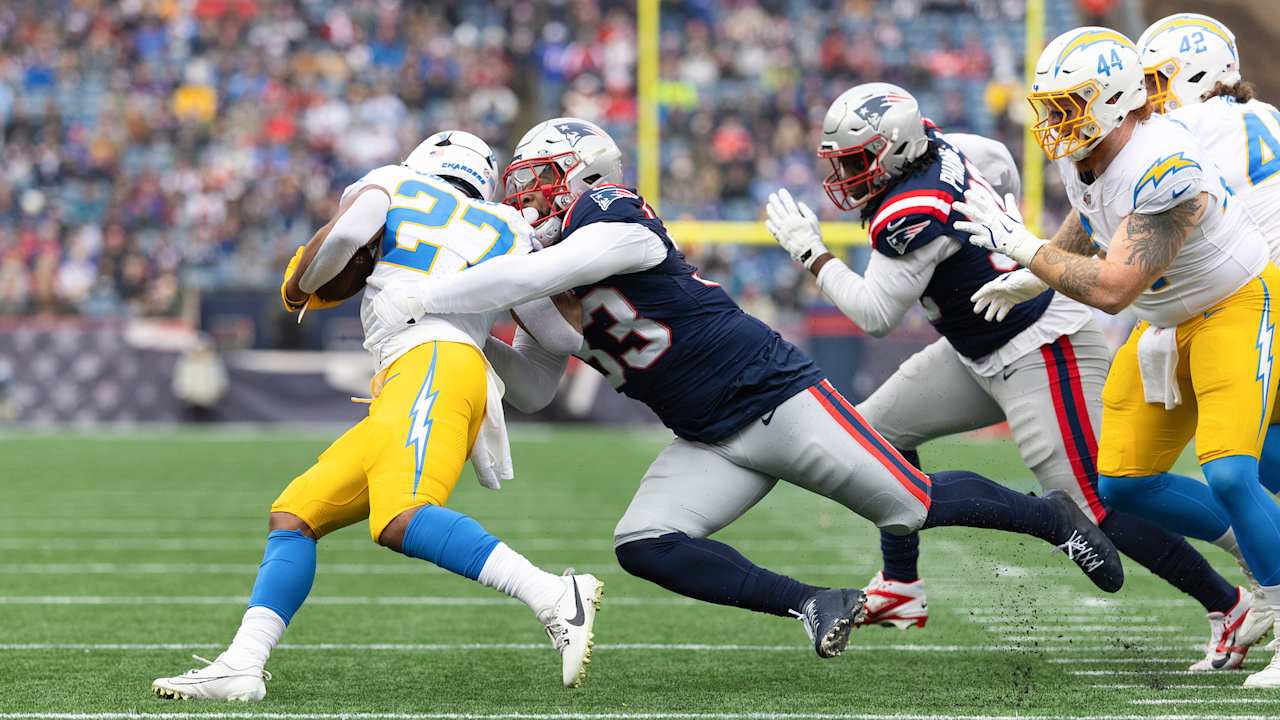
– The Patriots run defense was more competitive through three quarters. Besides a few third-and-short mishaps, where they were in pass personnel on third-and-3 conversions, the players seemed to take on the challenge of facing a “tough” run game. New England allowed only one explosive run for the game and held the Chargers to 3.75 yards per rush in the first three quarters. There were some run-fit nitpicks from the second level, with LBs again ending up in the same gaps and opening cutback lanes, but on the whole, it was sufficient run defense.