
Welcome back to the Dynasty Countdown, where we strive to answer the big questions. We’re here to name the greatest dynasty of all time, sure, but along the way, we can ask one more thing – which is the best franchise of all time?
Part V of the dynasty countdown sees the debut of both the Chicago Bears and Green Bay Packers, and both arrive with a bang – they take up a full half of the entries today, with each team putting up the worst two of their league-leading five runs on this countdown. The Packers and Bears also lead in total number of seasons covered – 38 for Green Bay, 27 for Chicago. The fact that both franchises joined in the 1920s certainly helps with racking up plenty of memorable seasons, but it’s certainly not a guarantee – see the lack of gushing recaps of Cardinals history for case in point. The Packers-Bears rivalry isn’t just great because it’s old, it’s because they have the longest and most impressive track records of success… assuming you take the entire history of the league into account.
The Packers’ five dynasties start in five different decades; they have spread their success out fairly evenly over their entire history, all things considered. That means that more generations of Packers fans can point to one of the great Green Bay teams as their great Green Bay team, even if it also means those eras tend to leave significant lulls in between them. The Bears achieved four of their five dynasties before free substitution and the platoon system came in in 1950. They were the football team in the pre-war era, and have graciously let their rivals in Green Bay catch up over the last 60 years. There is no NFL without the success of the early Bears; getting them to come to your place kept franchises alive and kept the league afloat during the early tumultuous period. Is that enough to make up for the lack of sustained success since television went to color? That depends on what you’re looking for in your all-time greatest franchise.
And if you’re tired of hearing debates about which NFC North team has the shiniest legacy, we have other, fresher topics! Like whether Tim Tebow was any good, or listening to Aaron Rodgers, or how impressive it is that the 1972 Dolphins went undefeated, or who really should have been MVP last season! You know, fresh, exciting topics to help keep discourse moving along.
Previous Lists:
Introduction
Part I (57-60)
Part II (49-56)
Part III (41-48)
Part IV (33-40)
No. 32: 2011-2015 Denver Broncos
Peak Dynasty Points: 16
Average DVOA: 20.6%. Top-Five DVOA: 20.6%
Championships: 1. Record: 58-22 (.725)
Head Coach: John Fox, Gary Kubiak
Key Players: QB Peyton Manning, WR Demaryius Thomas, TE Julius Thomas, T Ryan Clady, DE Demarcus Ware, LB Von Miller, LB Elvis Dumervil, CB Champ Bailey, CB Chris Harris, CB Aqib Talib, S T.J. Ward
Z-Score: -1.16
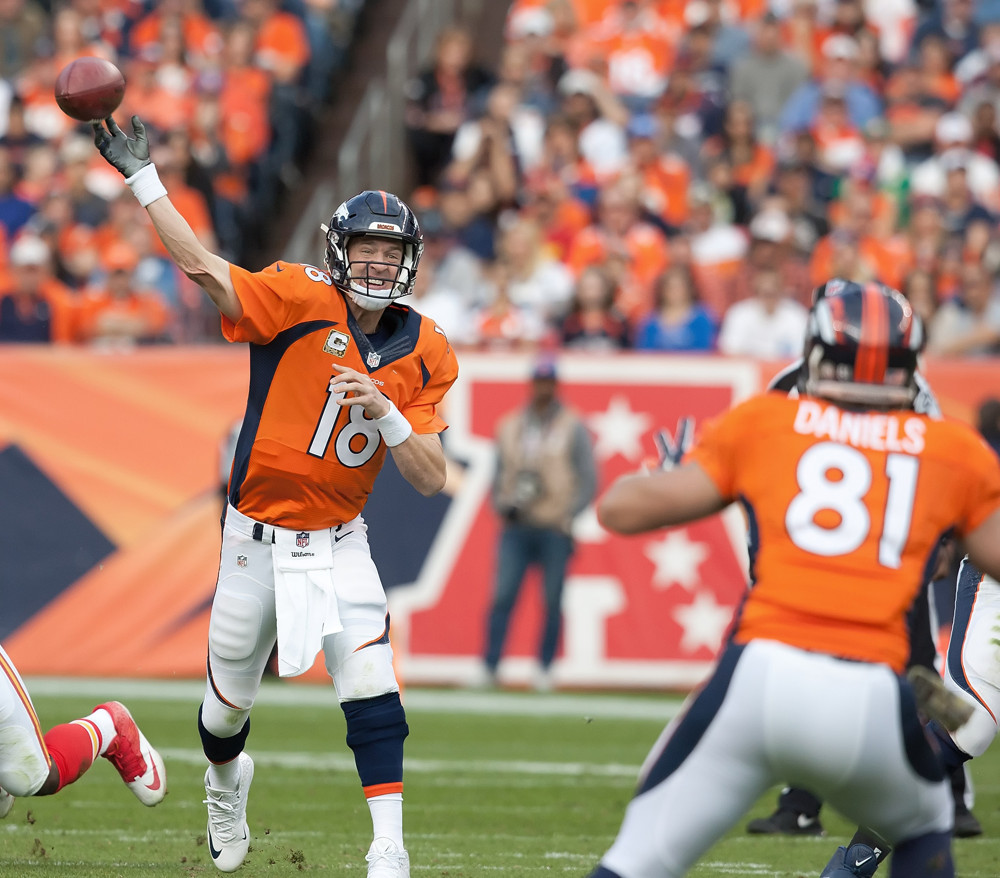 Nov. 15, 2015 – Denver, Colorado, U.S – Broncos QB PEYTON MANNING, left, readies to throw a pass to TE OWEN DANIELS, right, during the 1st. Half at Sports Authority Field at Mile High Sunday afternoon. Chiefs beat the Broncos 29-13 (Photo by Hector Acevedo/Zuma Press/Icon Sportswire)
Seeing 2011 tacked on to this Broncos era feels very, very weird. Peyton Manning arrived in 2012, and it is his teams that put up 14 of the Broncos’ 16 dynasty points from this era. And yet, there’s Tim Tebow’s 8-8 AFC West winners, hanging out there in front. I suppose it’s fitting that the run both begins and ends with terrible quarterback play — and, for the record, Tebow’s -22.8% passing DVOA in 2011 beats out Manning’s -25.8% passing DVOA in 2015. Still, that 2011 Broncos team had an -11.1% DVOA in 2011; it was a fluke divisional title that would in all likelihood not have started anything of note had Manning not come around.
Still, 2011 is an obvious major turning point for the Broncos franchise, even if the year itself wasn’t super-great. Out went Josh McDaniels and Brian Xanders, in came John Fox and John Elway. Von Miller arrived with the second pick in the draft, which leads to some really interesting hypotheticals. Miller was obviously in retrospect the correct choice (you could make an argument for J.J. Watt, but you’re splitting hairs there), but the new administration was clearly not particularly in love with either Tebow or Kyle Orton, holdovers from previous unsuccessful teams. What if the Panthers hadn’t taken Cam Newton with the first overall pick? Or what if Elway’s well-documented love of tall quarterbacks had led him to take 6-foot-4 Blaine Gabbert, a top-10 pick in 2011, as the Broncos quarterback of the future? Imagine the Broncos of the early 2010s without Manning or Miller. One shudders to think.
But no, they drafted the right guy, and then one legendary quarterback recruited another. Manning broke Elway’s franchise record for quarterback DYAR in 2012, broke that record in 2013, and came darn close to doing it again in 2014. The 2013 Broncos’ 29.9% offensive DVOA is a top-20 all-time unit when you add in 1950-1977 historical estimates, and their 56.3% passing offense climbs to just outside the top 15. Just a bit of a whiplash from the Tebow era.
But, of course, the Broncos weren’t just an offense. The 2012 team is, by DVOA, the best squad in franchise history. In 2014 the defense really kicked things into gear, which was good because Manning fell off a cliff in his last pro season and had to be carried … by a defense that ends up in the 40 best of all time at -21.8% DVOA thanks to the emergence of the No Fly Zone.
There’s no shame in losing Super Bowl XLVIII to the Seahawks, who savvy readers will have noticed have not yet shown up on this countdown. There’s a little shame in losing 43-8, but just consider that the modern Broncos paying tribute to the classic Broncos teams of the 1980s. Winning Super Bowl 50 does help bolster their ranking significantly, even if that ended up being the worst of the Manning Broncos teams by a significant margin; I’d take that Super Bowl-losing squad of 2013 over the winners of 2015 any day of the week. Broncos fans can truly state that, with Manning, Miller, and the rest of that defense, they had one of the best teams of all time and the Lombardi Trophy to back it up. They just don’t have to go on to admit that those things happened in different years.
Further Viewing:
No. 31: 1932-1934 Chicago Bears
Peak Dynasty Points: 14
Average DVOA: 25.8%. Top-Five DVOA: 15.5%
Championships: 2. Record: 30-3-7 (.838)
Head Coach: Ralph Jones, George Halas
Key Players: HB Red Grange, FB Bronko Nagurski, E Bill Hewitt, T Link Lyman, G Joe Kopcha, G Zuck Carlson, C Ookie Miller
Z-Score: -1.13
This is the first time we’ll see George Halas and the Bears pop up on this list. It certainly will not be the last. The Bears and the Packers share the mark of having the most entries in the dynasty rankings, with five apiece. Some of that comes with the territory of being successful in the early days of the league, which featured both massive turnover and fewer opportunities for notable success. It’s fitting, however, that the two oldest successful teams in the league, and rivals for a full century, would share the honors of being the most lauded clubs in NFL history.
If you’re familiar with the Bears’ history, or even just “Bear Down, Chicago Bears,” these early-1930s teams would look very strange to you. The Bears had experimented with thrilling the nation with their T-Formation by this time, but with the duo of NFL legends Bronko Nagurski and Red Grange in the backfield (and the 1934 addition of Beattie Feathers behind them), Chicago had more or less abandoned it in favor of a single-wing attack to showcase their talents. Grange was getting up there at this point, but Nagurski was in his prime; bowling people over and earning a reputation as one of the hardest-nosed players to every play the game. You certainly can’t say it didn’t work, as their 30-3-7 record and three championship game appearances would indicate.
In the early 1930s, the NFL was still kind of winging how the rules of the league should work, and these Bears did a very good job keeping up with the times. Take the 1932 season, for example. The Bears finished their slate at 6-1-6 (opening the season with three scoreless ties and a 2-0 loss; thrilling!), while the Portsmouth Spartans finished at 6-1-4. By today’s rules, the Spartans would be champions, with a .727 winning percentage beating Chicago’s .692, right? (And, while we’re at it, shouldn’t the 10-3-1 Packers be ahead of both of them?) Well, at the time, ties simply did not count, so the two teams were tied at 6-1. To make matters worse, the NFL’s only tiebreaker was point differential in head-to-head matches (rather than just wins and losses), and the Bears and Spartans had played in 13-13 and 7-7 ties earlier in the year. The solution? An impromptu championship game, the first of its kind. And because of a massive winter storm, the game had to be moved from Wrigley Field to Chicago Stadium, which featured an 80-yard dirt field with undersized end zones. The field was so small, the goal posts had to be moved to the goal lines from the back of the end zone — a change which persisted until 1973. That’s right, a series of random problems led to the playing of the first-ever NFL Championship Game and altered how the field of play would look for two generations.
And that wasn’t even the only long-lasting rule changed caused by a shrug! At the time, passing rules required a player to be 5 yards behind the line of scrimmage to throw the ball, which made passing all the more dangerous. But late in the fourth quarter, with the score still tied at zero, the Bears were facing fourth-and-goal from the 1-yard line. Nagurski had been stuffed on the previous three downs, but took the ball intending to plow into the line one more time. But, as he did so, he saw Grange all alone in the end zone, and leaped and threw him the ball. Touchdown, Bears lead, Bears win — only there was no way Nagurski was 5 yards behind the line of scrimmage when he threw the ball. The Spartans complained, the referees counted the score anyway, and the NFL made passing legal anywhere behind the line of scrimmage legal in the ensuing offseason, under the precedent of “holy cow that was the coolest thing I’ve ever seen.” The 1930s NFL: Winging it!
The Bears’ championship teams in 1932 and 1933 were solid, but not altogether special. 1934 was different. By our SRS-to-DVOA conversion, they would have clocked in with a 38.3% DVOA as they stormed through the league and completed the first ever undefeated regular season — or, at least, the first to do so without ties. They outscored their opponents 286-86 on their way to a 13-0 record. Feathers became the first 1,000 yard-rusher in NFL history (allegedly — there’s some debate as to whether some kick return yardage got mixed in there, because record keeping was not pristine at this point in time). No one else would duplicate that feat until 1946. Nagurski added 586 more yards of his own, sixth-best in league history at the time. The Bears cruised through the first half of November, toughed out some close games against the Lions and Giants late in the season, and entered the 1934 Championship Game against the Giants as the heavy, heavy favorites. But we’ve covered the 1934 title game already, back when we looked at the Giants of this era: that was the Sneakers Game, where the Polo Grounds was covered in ice, and no one could get any footing. The Bears were without Feathers, and also without access to proper footwear, whereas the local Giants raided the lockers, found some sneakers, and roared to victory in the second half. If the far superior Bears team had won (the Giants’ SRS-to-DVOA estimate is a paltry 10.4%), then maybe we would have been spared the 1972 Dolphins popping champagne every season. Instead, the underdog Giants stopped a dominant team from completing a perfect season. History repeats itself, doesn’t it?
Further Viewing:
No. 30: 2009-2016 Green Bay Packers
Peak Dynasty Points: 17
Average DVOA: 17.0%. Top-Five DVOA: 23.4%
Championships: 1. Record: 87-40-1 (.684)
Head Coach: Mike McCarthy
Key Players: QB Aaron Rodgers, WR Greg Jennings, WR Jordy Nelson, G Josh Sitton, G T.J. Lang, LB Clay Matthews, DB Charles Woodson, DB Nick Collins
Z-Score: -1.11
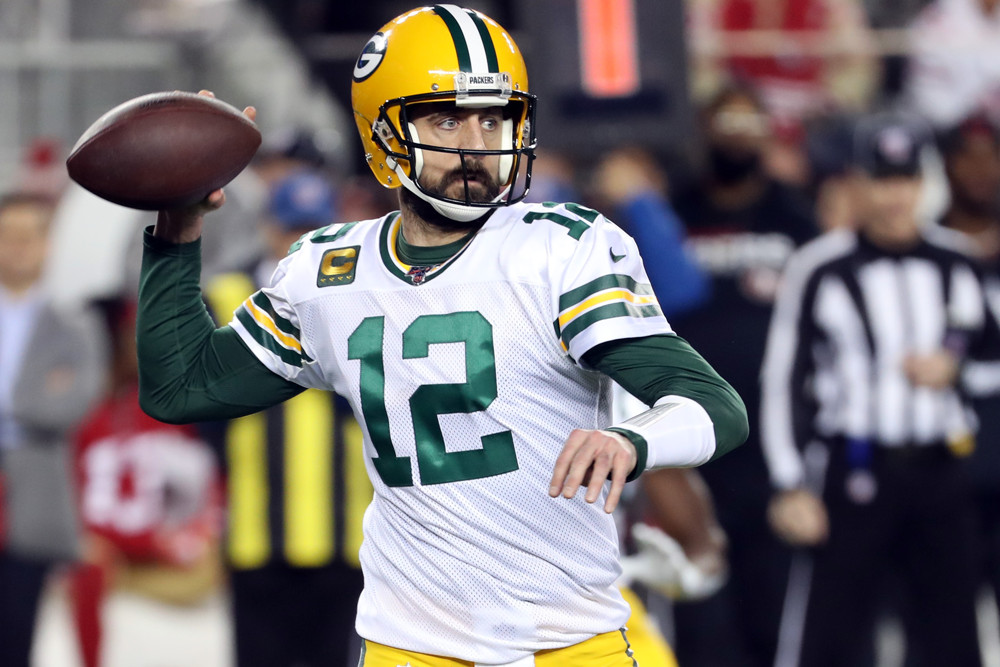 SANTA CLARA, CA – JANUARY 19: Green Bay Packers Quarterback Aaron Rodgers (12) throws a pass during an NFC Conference Championship game between the San Francisco 49ers and the Green Bay Packers on January 19, 2020, at Levi’s Stadium in Santa Clara, California. (Photo by Kiyoshi Mio/Icon Sportswire)
Consider the race to the top joined! The Packers and Bears share the honor of being on this list five times apiece. Part of that, of course, is the fact that they’re over 100 years old and have had plenty of opportunities to be great. But hell, the Cardinals are older than the NFL itself and have yet to have a single dynasty, so more power to the kings of the NFC North … or NFC Central … or NFL Western, depending on how old you want to get. Place your bets now for which of the two long-time rivals will end up higher on the eventual list.
The Packers are arguably the more interesting of the two, because they’re so spread out. While four of the five Bears dynasties can be described as “because George Halas,” the Packers have four different generations represented on the list, including this very recent one. The worst Packers dynasty only definitively could be declared dead in 2018, and while it’s beginning to fade into our rear-view mirrors, its quarterback is still well in the news to this day. As much as we sometimes wish he was not.
Moving on from a Hall of Fame quarterback is never easy, and the Packers knew that when they drafted Aaron Rodgers in 2005 while Brett Favre was … well, not in his prime anymore, but still a very productive passer. You can’t blame the Packers for looking for a backup; there had been rumors that Favre was going to retire as early as 2002, and Rodgers was a candidate for the top pick; his slide down the draft board was a once-in-a-generation event. Still, bringing in a first-round pick while a franchise legend is still going strong is a ballsy move – one the Packers ended up sort of repeating in 2020, bringing Jordan Love in while Rodgers was still putting up MVP-caliber seasons. History rhymes.
The Aaron Rodgers Packers never quite hit truly all-time great levels of success; they never hit 30.0% in DVOA, even in their Super Bowl XLV-winning season or their 15-1 season in 2011. They were more of a very, very good team that could always be counted on to be in the mix rather than a dominant favorite. Their eight straight playoff appearances is a franchise record, which is both impressive and misleading for a franchise with this much history (no Wild Card games for the Lombardi units!), but they ended up falling in the postseason earlier than you would expect for truly great teams.
They did have one truly incredible offensive season in 2011; that was Rodgers’ MVP year, when he had a franchise-record 2,121 DYAR while throwing for 45 touchdowns, and when Jordy Nelson set the franchise record for receiving DYAR. Green Bay’s 29.6% offensive DVOA still ranks 16th in our database, stretching back to 1978. Their 62.5% passing DVOA slips into the top 10; Rodgers was walking on rarified air that year. But that was also the year the defense collapsed, ranking 25th in the league, and the Packers washed out of the playoffs. If you could combine that offense — with Nelson and a healthy Greg Jennings catching passes and Ryan Grant and James Starks splitting the running workload — with the Packers defenses of 2009 or 2010, you’d have an argument for the best Packers team of all time. Instead, the closest the Packers offenses and defenses of this era came to synching up was at the very end of 2010, in their wild-card run to a Super Bowl victory.
You can come close to pinpointing the exact moment this Packers’ run ended: With Rodgers breaking his collarbone in 2017. Before the injury, Rodgers averaged a passing DVOA of 20.6%. The remainder of his Green Bay career saw that drop to 15.8%, even including the two renaissance seasons in 2020-2021, and he was a below-average quarterback as a Jet. This era’s Rodgers was able to elevate the Randall Cobbs and James Joneses of the world into top-quality starters; he was never again capable of doing that on a regular basis. But it’s good to remember just how transcendent Rodgers was in his peak, and those are better memories than him plugging ayahuasca on Pat McAfee’s show. Remember the good times, Green Bay.
Further Viewing
No. 29: 1984-1991 Chicago Bears
Peak Dynasty Points: 15
Average DVOA: 17.8%. Top-Five DVOA: 24.7%
Championships: 1. Record: 90-37 (.709)
Head Coach: Mike Ditka
Key Players: RB Walter Payton, RB Neal Anderson, T Jimbo Covert, G Mike Bortz, C Jay Hilgenberg, DE Richard Dent, DT Steve McMichael, DT Dan Hampton, LB Mike Singletary, LB Wilbur Marshall, S Dave Duerson, S Mark Carrier
Z-Score: -0.75
Bill Walsh called it “the most singular innovation in defensive football in the last 20 years.” The Shufflin’ Crew called it “so bad, you know it’s good.” Whatever you call it, the Bears’ 46 defense was like nothing we’ve ever seen in the Super Bowl era. The 1985 and 1986 defenses rank third and fourth on the all-time defensive DVOA leaderboards and are two of only seven teams to allow fewer than 200 points in a 16-game season. The one year they were able to roll out an offense even approaching the defense’s skill level, they produced arguably the greatest team of all time — No. 3 on your all-time DVOA leaderboards, No. 2 in weighted DVOA, and No. 1 in Bill Swerski’s cholesterol-laden heart, the 1985 Bears.
Buddy Ryan’s 46 defense was never going to last forever. With eight men in the box, you can shred it with multiple-receiver formations. Even standard sets can beat it if you have impeccable timing on your passes and receivers who can win in one-on-one coverage; see Dan Marino and the Dolphins giving the 1985 Bears their one loss. But a) that wasn’t immediately obvious right off the bat, b) most teams didn’t have a Marino to throw at the Bears, and c) 1980s offensive football was mostly out of two-back, two-wide formations anyway. Ryan was going to send pressure at you over and over again, and dare you to respond; most teams simply couldn’t. If you can sack Joe Montana seven times in one game, you can beat anyone.
It wouldn’t have worked without studs, however. The Bears already had Mike Singletary and Dan Hampton when Mike Ditka arrived in 1982, and his ensuing draft classes brought in Richard Dent, Dave Duerson, Wilber Marshall and most of the rest of the 1985 team. In the back half of the 1980s, the Bears defense boasted three Hall of Famers, two more first-team All-Pros, and five more Pro Bowlers. That’s basically an entire starting lineup of lauded players; you could have a group that talented run basic vanilla defenses year in and year out and they’d find a way to stand out.
The offenses weren’t quite as strong, of course. Walter Payton was still around at the beginning, but he was approaching the end of his career. They added Jimbo Covert and Mike Bortz on the offensive line, so they were sturdy enough there. The problem, as has been the case with every Bears team since the mid-1950s, was at quarterback. Jim McMahon was the Punky QB in question, and he’s the real What If? here — 1985 was the last time he started at least 10 games for the Bears, and was the only time in this run where they had an offensive DVOA over 10.0%. It’s no surprise this was the one Super Bowl win this team put up. Give this defense an offense on par with some of their contemporaries, and the team of the 1980s may have been located in Soldier Field.
But no, the Bears weren’t the team of the 1980s. They lost six playoff games during this run, and five of them came to teams in the midst of their own dynasty runs — two to the 49ers, two to the Redskins, and one to the Cowboys. Had they been an AFC team, they might well have made three or four Super Bowls. Instead, they mostly played bridesmaids to the rest of the loaded NFC in the 1980s, except for that one glorious shuffling year.
Further Viewing:
No. 28: 1925-1930 New York Giants
Peak Dynasty Points: 12
Average DVOA: 20.1%. Top-Five DVOA: 25.0%
Championships: 1. Record: 57-21-5 (.717)
Head Coach: Bob Folwell, Doc Alexander, Earl Potteiger, Roy Andrews, Benny Friedman, Steve Owen
Key Players: TB Benny Friedman, FB Jack McBride, B Jack Hagerty, T Steve Owen, C Joe Wostoupal, C Mickey Murtagh
Z-Score: -0.46
2025 sees the New York Giants celebrating the 100th anniversary of their inaugural season, and the first year of their second century in existence. They don’t find themselves in a very good spot, unfortunately, with losing records in 10 of the last 12 seasons. Rebuilding a team in the post-Eli Manning era has proven to be quite difficult. Wouldn’t it be a lot easier if they could just grab, say, the Detroit Lions, slap a fresh coat of paint on their helmets, and call them a new team? And that brings us to the 1920s New York Football Giants.
The NFL had tried to put a team in New York before 1925, to limited success. The New York Giants baseball team had tried, but folded before playing a game. The New York Brickley Giants (sometimes known as the Brooklyn Giants, and sometimes as Brooklyn’s Brickley Giants — brand identity was somewhat spotty in the 1920s!) left the league after just two games. So, when the league turned to Tim Mara to kickstart football in the Big Apple in 1925, it was a real risk of his $500 investment. And indeed, that first year was a struggle — not on the field, where they went 8-4 (albeit with an SRS-to-DVOA conversion of -0.1%), but in the financial department. It wasn’t until a home-and-home series with the famous and popular Chicago Bears that the Giants got into the black. Halas’ boys drew over 70,000 fans to the Polo Grounds, more than quadrupling New York’s average attendance. You can thank the Bears for professional football succeeding in New York.
The Giants improved in our estimated DVOA in 1926, but 1927 is the season they really were put on the map. They won the league championship that year, going 11-1-1 and allowing just 20 points all season long, including 10 shutouts. Yes, offensive football was worse in the 20s, with teams scoring just 9.1 points per game, and the nature of teams coming and going gave any squad that had a bit of money and stability an advantage, but ten shutouts is still an incredibly impressive number; it would be the equivalent of allowing 62 points in a season in 2024’s offensive environment. They key behind this defensive juggernaut? Money! Tackle Cal Hubbard was brought in for the astronomical price of $150 per game; paired with Steve Owen, New York had easily the best defensive line in the league.
And that should be where this story ends. Hubbard didn’t like the big city and ended up being traded away. The Giants fell to 4-7-2 and a -4.2% estimated DVOA in 1928, and things looked bleak. Mara knew what he needed to get his team back to competitiveness again, however — tailback Benny Friedman, who led the league in both passing and rushing touchdowns. Unfortunately, he was a member of the Detroit Wolverines, who had finished third in the league. Bringing him to New York wouldn’t be easy.
So Mara just bought the Wolverines. Straight-out bought them, and disbanded them. He then cut his own worst players and replaced them with Wolverines stars like Friedman, Joe Wostoupal, Bill Owen and Tiny Feather. The newly Wolverized Giants went 26-5-1 over the next two years with these outside ringers, with estimated DVOAs over 35.0% and two second-place finishes, pulling themselves across the 10-dynasty point line, all thanks to the power of the pocketbook.
The NFL of the 1920s was like that; not quite a joke, but certainly not a respected league either, where a few talented players drawn to one location by deep pockets could dominate. Amateur football was where it was at; those players played with more intensity and integrity than their professional counterparts, or so it was said. It’s worth finishing this capsule by noting that public opinion really started swinging around in 1930, when a team of Notre Dame legends, coached by Knute Rockne with the Four Horsemen in the backfield, came to the Polo Grounds for a charity game. Everyone thought it would be a blowout, and it was — in favor of the Giants; a 22-0 stomp that led Rockne to call the Giants the greatest football machine he had ever seen. If you had to put one pin in a moment where public opinion began to feel that professional football was a legitimate thing and not a sideshow, that would be it.
Additional Viewing:
No. 27: 1993-1998 Green Bay Packers
Peak Dynasty Points: 15
Average DVOA: 21.8%. Top-Five DVOA: 24.0%
Championships: 1. Record: 66-30 (.688)
Head Coach: Mike Holmgren
Key Players: QB Brett Favre, WR Sterling Sharpe, TE Mark Chmura, C Frank Winters, DE Reggie White, S LeRoy Butler
Z-Score: -0.36
Score one point for Brett Favre over his successor; his Packers teams end up with a higher score than the 2010s edition.
It’s close, mind you — a matter of very tiny nits here and there. Rodgers’ Packers had a longer run of success, lasting eight years to Favre’s six. Four of Rodgers’ teams managed to top a 20.0% DVOA, compared to just two of Favre’s. Both teams won only one Super Bowl, though Favre’s Packers do get a bonus from not only winning Super Bowl XXXI, but also reaching Super Bowl XXXII the next year. But it’s average DVOA that puts Favre’s Packers over the top. Unlike the 2010s editions, the 1990s Packers did produce an all-time great team.
This was Ron Wolf’s baby. Wolf was hired as general manager in late 1991, taking over a franchise which had hit the skids pretty hard since the Lombardi era. You could see the potential in Wolf’s first full season as he hired Mike Holmgren from San Francisco and traded for some backup Falcons quarterback named Favre and immediately saw a five-win swing on the field. But 1993 brought with a new tool for Wolf — free agency.
Free agency as we know it only started in 1993 after years of restrictions and limitations and owner’s control. The idea that a superstar like Reggie White would be able to just leave his team without them getting anything in return was unthinkable. The thought that White would choose Green Bay, a team which had just two playoff appearances since 1968, over their fellow finalist 49ers was considered crazy. But Wolf and Holmgren wined him, dined him, and convinced him that Green Bay was the best place for him, both on and off the field. (After White say he would go where God wanted him to go, Holmgren left him a voicemail saying “Reggie, this is God. Come to Green Bay.”) A larger check than San Francisco could offer didn’t hurt, either.
White’s addition opened the floodgates. At the time, Green Bay did not have a reputation as a city where African-American players felt welcome. The addition of White, however, enticed names such as Santana Dotson and Sean Jones to join the team, building a top-ten defense practically overnight. Nowadays, we’re used to teams bringing in a bunch of free agents to push themselves into contention, but this was a new idea in the mid-1990s! The Packers were the first free-agency dynasty.
Favre didn’t become Brett Favre until 1994; his first couple of Pro Bowl berths were not the most deserved nods in the history of the game. But Favre managed over 1,000 DYAR each year from 1994 to 1997 — one of only two quarterbacks to pull off that feat for four straight years in the 1990s. While all of Favre’s franchise highs in our stats were eventually taken down by Rodgers, that’s due in part to the fact that teams throw more than they did 25 years ago; Favre was putting up huge numbers in a relatively run-heavy environment. There’s a reason he’s the only man to win back-to-back-to-back MVP awards.
And, because Favre’s peak coincided with the peak of White and the defense, the 1996 Super Bowl team remains one of the best of all time. Their 39.7% DVOA is the 10th best since 1950, and the third-best Super Bowl-winner ever. They remain the only team in the salary cap era to both score the most points and allow the fewest in the regular season. They were an astonishingly good team, and one that maybe doesn’t get the sort of historical acknowledgement of some other greats because of their relative lack of follow-up success. For most franchises, a team as good as the 1996 Packers would be the best in their history, even if it was an outlier amid some other seasons only very good.
The Packers are not most franchises, of course.
Further Viewing:
No. 26: 1970-1974 Miami Dolphins
Peak Dynasty Points: 18
Average DVOA: 21.1%. Top-Five DVOA: 21.1%
Championships: 2. Record: 57-12 (.826)
Head Coach: Don Shula
Key Players: QB Bob Griese, FB Larry Csonka, RB Mercury Morris, WR Paul Warfield, T Norm Evans, G Larry Little, G Jim Langer, DE Bill Stanfill, LB Nick Buoniconti, S Dick Anderson, S Jake Scott
Z-Score: 0.04
I know they’ve kept it very quiet, but the 1972 Dolphins are the only team to ever pull off the perfect season in NFL history. It’s not something they like to talk about very much, preferring to stay modest and let their record speak for itself, but it’s true!
You don’t get any bonus dynasty points for completing a perfect season, and estimated DVOA actually ranks the 1973 squad as the best of the Dolphins teams of the early 1970s. As a matter of fact, the 1972 Dolphins’ estimated regular-season DVOA of 37.0%, while very, very good, is actually the worst of any of the four teams to have completed a perfect regular season in the NFL, though we do have them above the undefeated 1948 AAFC champion Browns. To which point I’m sure Larry Csonka will thumb his nose, point to his Super Bowl ring, laugh at the other three teams for losing their respective championship games, and pop open a bottle of champagne.
You can hardly blame Dolphins fans for still loving those early 1970s teams. Before coach Don Shula arrived in 1970, the Dolphins had been sitting on a historical record of 15-39-2. Shula got them to the playoffs in one year, and to contender status in two. The Dolphins were actually docked a first-round pick for tampering when they signed Shula, who was the Baltimore Colts’ coach at the time — they had started negotiating when the AFL and NFL were two separate leagues, and teams stole big names from the other league all the time, but the actual move happened post-merger, and that’s a big no-no. Considering the immediate success the Dolphins had with Shula, losing out on Don McCauley in the 1971 draft was probably worth it.
The accepted wisdom is that the 1970s Dolphins won thanks to their power football; with Csonka, Jim Kiick and Mercury Morris running behind a who’s who of offensive lines. That certainly isn’t wrong, mind you — Csonka and Morris became the first teammates to each run for 1,000 yards in the 1972 perfect season, and all three Dolphins Super Bowl teams of this era ranked in the top five in estimated run DVOA. But they also ranked in the top five in passing DVOA in those three seasons, no matter whether it was Griese or Earl Morrall under center. The Dolphins traded a first-round pick to bring Paul Warfield over for a reason; they were certainly a run-heavy team, but they were an efficient passing offense when they had to be, too.
The big difference between the Super Bowl VI loss and the Super Bowl VII and VIII wins was the defense. The so-called “No Name” Defense ended up first in estimated DVOA in 1972 and fifth the year after, sandwiched between a pair of below-average seasons. Shula’s offense was basically great throughout the 1970s until Griese suffered a career-ending shoulder injury in 1980; it was the rise and fall of the No Namers that took the Dolphins to the top of the mountain and then down into the three-year hole between this and the late 1970s/early 1980s dynasty we covered back down at No. 40.
Put a top-five defense with a top-five running attack and a top-five passing attack, and you have one of the NFL’s best all-time teams. The 1972 Dolphins have the sixth-highest (estimated) DVOA of any Super Bowl champion. The 1973 Dolphins are even better, up at No. 4 thanks in no small part to a full season from Griese. At least when it comes to championships, the best team of the 1970s wasn’t a Steel Curtain special or America’s Team in Dallas — it was Shula’s Dolphins.
For the record, had the defense not struggled in the mid-1970s, and you were able to draw a straight dynastic line from Shula arriving in 1970 to the early Dan Marino years, the Dolphins would be knocking on the door of the top 10.
Further Viewing:
The 1971 Divisional game between the Chiefs and Dolphins. Still the longest game in NFL history at 82 minutes and 40 seconds, with Garo Yepremian finally sending us home midway through the sixth quarter.
The Perfect Season. Three guesses which season that Dolphins Yearbook covers.
The NFL Top 100 countdown on Paul Warfield, who always seems to get forgotten when talking about the all-time great wideouts.
No. 25: 2019-2024 Buffalo Bills
Peak Dynasty Points: 13
Average DVOA: 23.4%. Top-Five DVOA: 28.0%
Championships: 0. Record: 71-28 (.717)
Head Coach: Sean McDermott
Key Players: QB Josh Allen, RB James Cook, WR Stefon Diggs, T Dion Dawkins, LB Tremaine Edmunds, CB Tre’Davious White
Z-Score: 0.05
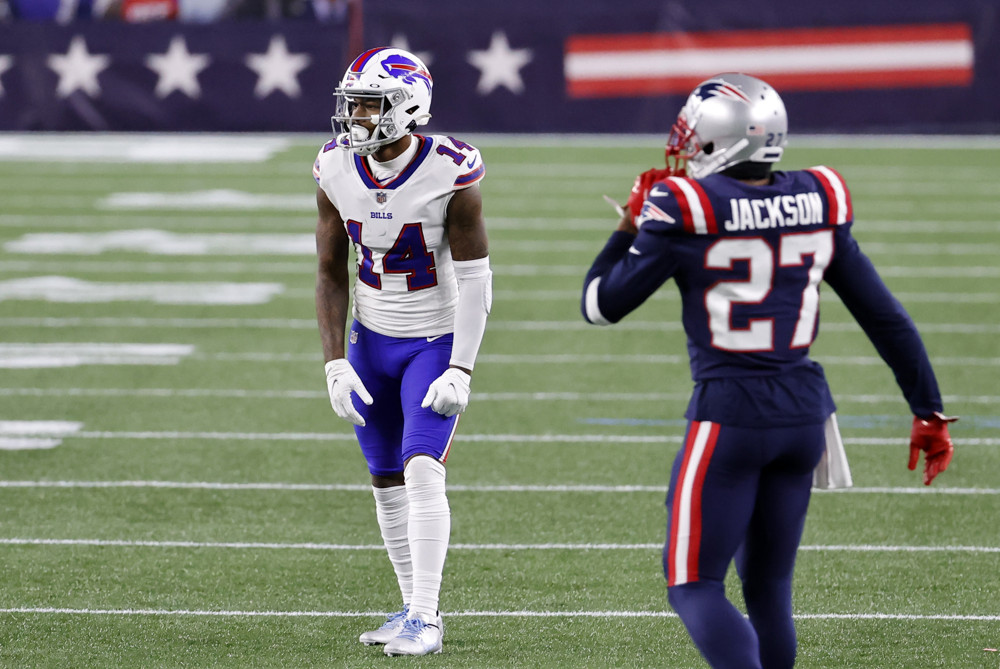 FOXBOROUGH, MA – DECEMBER 28: Buffalo Bills wide receiver Stefon Diggs (14) gets set for a snap with New England Patriots defensive back J.C. Jackson (27) during a game between the New England Patriots and the Buffalo Bills on December 28, 2020, at Gillette Stadium in Foxborough, Massachusetts. (Photo by Fred Kfoury III/Icon Sportswire)
The Bills are one of the new entries to this list for the 2025 update, and perhaps one of the more controversially high teams. There are four entries in the list who never won their conference and never got to the Super Bowl. We’ve passed the Marty Schottenheimer entries of the 1990s Chiefs and 2000s Chargers way, way back in the ’40s and ’50s. But now we’re hobnobbing with teams with perfect seasons and world titles. How can you be one of the greatest teams of all time if you can’t even win your conference?
It’s not the Bills’ fault that the play in the tougher conference. The difference between this Bills run and the 1990s version which made four Super Bowls is simply the AFC/NFC power dynamic. If the Cowboys and 49ers had played in the AFC, it’s likely that Jim Kelly’s team would have been stopped before they reached the Super Bowl. If the Chiefs were in the NFC, Josh Allen’s team may well have multiple Super Bowl appearances by now. The average Super Bowl champion has a DVOA of around 25.0%. The Bills were above that mark every year from 2020 to 2022, and have been above 20% in 2023 and 2024. In four of those years, they lost to Patrick Mahomes – and it’s not like Joe Burrow’s Bengals, who took them down in 2022, are exactly pushovers, either. Their kingdom to play in a conference where Jared Goff might be their toughest quarterback competition, yeah?
There’s no sense beating about the bush, however – the Bills are this high solely because of their DVOA. Of the six categories that make up the Z-Score to determine the rankings, the Bills are above average in only average DVOA and top-five-season DVOA, while being below average in length of run, peak dynasty points, championships, and quality seasons. They’re not the only team to be resting on their DVOA laurels – we’ve seen the Brett Favre Packers already, the late-Drew Brees Saints are right around the corner, and the Legion of Boom Seahawks are dining with some of the all-time greats near the top of the list. But his this is one of the first teams who rank highly in our table because our numbers say they’re good, despite the lack of trophies in their cabinet. There’s a bit of circular reasoning going on here; our numbers say the Bills are good because our numbers say the Bills are good, and so we go around and around and around, all while they’ve failed in reality to cash these great years into anything meaningful.
And yet, our numbers do think they’re really good, as do our eyes and our gasps of breath when Allen does something crazy that really shouldn’t work but ends up succeeding. The best five Bills seasons in this run have an average DVOA of 28.0%, the 15th-highest mark in the countdown, and better than anyone we’ve seen so far. To put that into context, the best five seasons the current Chiefs dynasty has average to a DVOA of 28.1%. They are notably better than some teams with multiple Super Bowl titles, with the Raiders and Redskins of the 1980s each clocking in at around 18%.
It is very unusual for a team to be this successful for this long without ever reaching the Super Bowl. DVOA proper goes back to 1978, and in that time, the Bills five-year streak with a DVOA greater than 20% and no title is the record. Most of the other teams to be this good for this long do eventually get there. The 49ers were Super Bowl-less from 1991-1993 and 1995-1998, all with DVOAs over 20%, but they sandwiched a Super Bowl run in there. The 2008-2010 Ravens had a three-year streak, eventually breaking through in 2012, and the 2003-2005 Colts won their title the next year. Before DVOA, the Los Angeles Rams were consistently winning double-digit games from 1972 to 1978 before finally making it to a Super Bowl in 1979. Keep getting bites at the apple, and eventually you’ll break through.
Or you could be like the 2017-2020 Saints, one of the most dominant regular-season teams of all time who could never quite get it done in January. This is about as high as teams like this can possibly go; all the great advanced statistics in the world only push you so far. The Bills can’t realistically boost their DVOA numbers higher than this. They need to win some titles if they want to rise up. Every team in the Dynasty Rankings top 20 has at least been in a championship game, and only one never actually won a league title of any description. Buffalo needs some quantity to go with their quality to get the respect their year-in, year-out great performances really deserve. Our projections for the Bills this year have them once again among the favorites, and one of these years, surely, they’ll break through. Right?
Until then, we’ll just have to keep them this high as a reminder that we once called Josh Allen a parody of a quarterback prospect. Consider us thoroughly and utterly rebuked.
Further Viewing: