
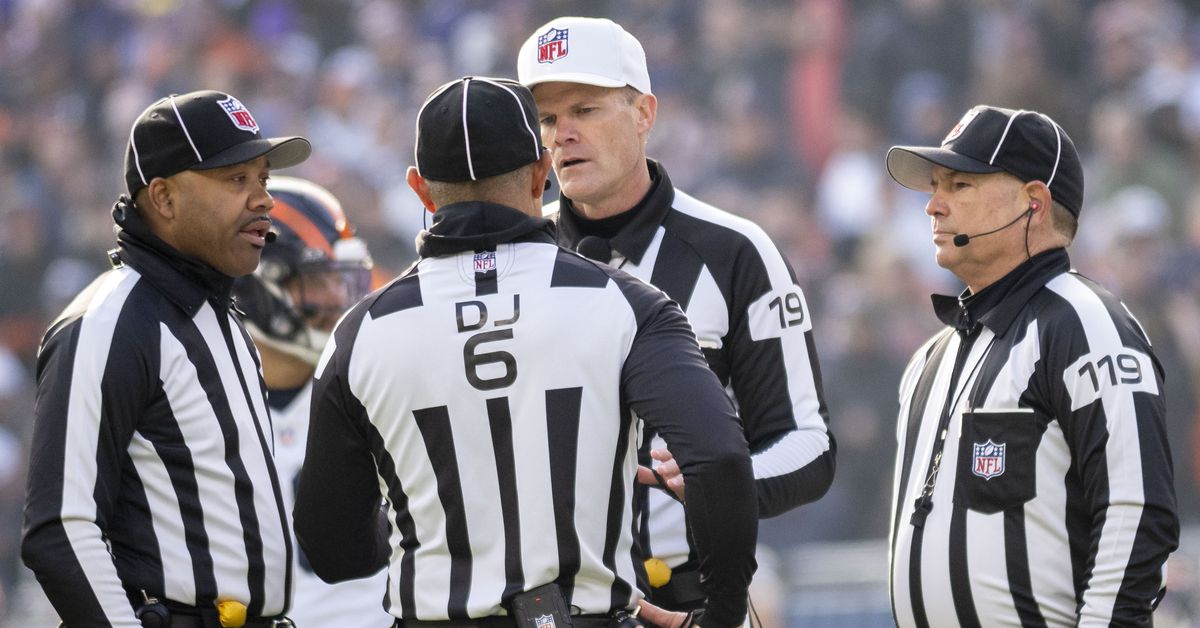
There were eight accepted penalties and one booth initiated replay review inside of two minutes as the Denver Broncos were swept by the Los Angeles Chargers. One obscure ruling, and a total unwillingness to throw flags against the Chargers were defining themes from the officials.
Officiating for Rookies
This game brought me back to being a new official. When I first started officiating, we would spend hours going through the rulebook. Section by section reading it, discussing it, being quizzed on it. Fair-catch kicks are something that almost any decent football official knows very well about and has probably answered tens or hundreds of exam questions about, even though I went my entire career without seeing one.
But there are other issues for rookie officials as you get out of the classroom and start officiating games. One of these is learning to focus broadly. The egregiously missed pass interference call from field judge Dave Hawkshaw was one of these type of plays. He is focused on getting down field, and probably tunnel visions on Marvin Mims shoulder and right arm. This is the easiest place to make a call, but it missed the less likely but equally important pass interference against Mims’ left arm. He should have known better.
Another rookie issue is to learn to continue to officiate after throwing a flag. This is harder than it sounds. You see a foul and immediately need to remember the player number, foul, and any surrounding circumstances. If it is a spot foul you need to make sure your flag is accurate (well used to – now at the NFL replay handles this). It is really easy to forget to equally officiate the rest of the play. We saw this happen on the second play of the fourth quarter, where line judge Daniel Gallagher called Zach Allen offsides at the snap. When Rashawn Slater absolutely mauls Nik Bonitto in the back right in front of Gallagher several seconds later, he completely missed the block in the back. Its an easy mistake to miss, but not a forgivable one.
The End of the Second Quarter
The last play of the second quarter ended up rather exotic. I want to both explain the rule, and the validity of the situation. First, if Payton had managed the clock better, the Broncos would probably have not been in that situation. Second, on the punt, I feel really bad for Tremon Smith. He is a phenomenal player having a quietly great season on special teams, and I do not really know what he should have done here. Derius Davis calls for the fair catch and runs up to catch the ball. After a fair catch has been called, the individual who has called for it has two special protections. They have the right of way – they cannot be obstructed on their path to the ball. They also are immune from contact. The challenge with this is that it is really hard to know exactly where that player is going so as to avoid being in his way. Returners frequently make dramatic changes to their position to attempt to make this harder, as happened with Davis. Smith also made minimal contact, and I am not sure if Smith caused Davis to fall over, or if Davis flopped. Technically this does not matter, but it showcases a weakness in the rule.
After the fair catch there was one untimed down. By rule, a team may attempt a fair catch kick after a fair catch. Because of the penalty, LA could choose to also run a scrimmage play.
A fair catch kick is similar to the more common free kick in several ways. The defensive team (called receivers by officials) must line up ten yards down field (like kickoffs used to be). Once the ball is kicked, it is a free ball. It differs in several ways as well: If it goes through the uprights, it is a field goal, otherwise, it is a loose ball and whoever recovers it first gains possession of the ball. Also, on fair catch kicks no tee is permitted for use.
So why are fair catch kicks not used more often? Unless time has expired at the end of the half, its almost never worth doing so. To use a fair catch kick, the team gives up possession of the ball to eliminate the possibility of the defense blocking the field goal attempt. There are arguments for the value in certain other situations (offensive injuries that prevented a team from fielding a full offensive line, or losing every quarterback, or something like this combined with extreme snow). Modern kickers have insane range, so I would not be surprised to see the scenario happen again.
Could the Broncos have done something different to prevent the possibility? They could have tried to have Bo Nix run around in the pocket for nearly eight seconds and then throw the ball as high and far as he could. The disadvantage of this would be that any penalty would have given a free three points, and its pretty hard to block a pass rush for five seconds without holding. Honestly, there is a real danger to being backed up at your goal at the end of a half, and by far the best outcome is normally to punt the ball and trust your coverage team.
Illegal Formation
The officials of Clay Martin’s crew had a very clear philosophy on Illegal formations in the game. They were not going to call it. Most officials let it slide from when backs are too close to the line this year (and yes that’s not an illegal formation and is legal for a running play), but Martin and crew wouldn’t call it on linemen. I counted three bad illegal formations that went uncalled by linemen (McGlinchy twice and Slater), alongside several that could have been called. But the biggest issue I had was with a back. In the second quarter, LAC converted a third down pass on a mesh concept to Stone Smartt, putting them in field goal range. This route concept only worked because he was lined up illegally – if he had been lined up as a back, there would not have been the space to screen Justin Strnad and complete the concept. While I sympathize with not wanting to call ticky-tacky ineligible downfield penalties, in this case there was no choice – it was a pivotal play built around having the officials not call a foul.
Horse Collar on Jonathon Cooper
The first play of the 4th quarter saw Jonathan Cooper flagged for a horse collar tackle on Justin Herbert. This play is a great example of plausibly good officiating that is actually horrible. Horse collar tackles are dangerous, and its good to bring them out of football. But in this case, there are multiple mitigating factors. First, Coopers tackle would have been legal in the pocket. He makes contact with Herbert approximately one yard outside of the pocket. Second, to consider this a horse collar, Cooper has to buckle Herberts knees, and while its somewhat close, he probably does meet that standard. Third, Herbert is not allowed to grab Coopers facemask but does. This does not get penalized (the close line play exception necessarily cannot apply, as if that was the case there could be no horse collar). We do not call illegal use of hands on runners often, but that does not mean they are allowed to go for defenders heads. Fourth, this play had a clearly illegal formation by Los Angeles go uncalled, though the officials just decided not to call those this game, so it was even but unfair. Add that all up, and you can get plenty pissed as a Denver fan.
Payton/Nix Delay of Game Watch
This has been a recurring issue this year, and so for the rest of the year I will specifically chart and comment on it. There were two plays in the game where the Broncos offense was not ready for the snap as the play clock expired and it impacted them noticeably (a time out in the second quarter and a false start in the first quarter). There were at least two other plays where Denver got the play off but it was close and a mess.
Official Evaluation
This was brilliant officiating. Clay Martin and his crew should be proud of their hard work. It was an important, high leverage game, and they rose to the occasion and clearly demonstrated they are ready to watch the playoffs from their couches at home
The spotting of the ball was inconsistent and very shaky. They had a big miss that replay corrected, but plenty of other plays with mediocre or poor spotting. They flagged Quinn Meinerz for ineligible man downfield correctly, and then unbelievably picked up the flag. Sometimes officials miss things, but to doubt yourself after getting it right is a uniquely awful thing. They missed big and small things and made a lot of rookie mistakes. I charted five bad calls and six questionable calls in the game (five questionable calls benefited Los Angeles, as did four bad calls). That’s not up to the level of professional officiating. Clay Martin does deserve specific credit for handling the end of the first half reasonably well. He did know the rules and administrated the obscure situation correctly.
Feel free to ask questions in the comments or to send me an email. While I rarely make unsolicited comments on non-Broncos games, if you have any rules questions from other games I am happy to either reply in the comments or if the matter is of enough concern in next weeks column.