
Lastly, Vegas also had success with quick-game concepts. Here, the Dolphins run a five-man pass rush like they did in the Brissett example, except with zone coverage in the secondary. With a six-man zone distribution, the running back’s route moves the short zone defender to open the curl window, and Minshew takes the easy money.
Bowers had a monster performance with 13 catches for 126 yards and a touchdown. Furthermore, Miami ranks 26th in drop-back success rate on throws between the numbers (61.1%). On paper, this is a solid matchup for the Patriots, who can use tight ends Hunter Henry and Austin Hooper like Bowers and have inside receivers like DeMario Douglas to run into the voids that are typically there in the Dolphins coverages.
Again, this game then comes down to the chess match between Van Pelt and Weaver: will Weaver play his brand of defense or challenge the Patriots to beat him deep? The film and stats suggest the Dolphins should do the latter, but time will tell if they’re savvy enough to adjust.
Patriots Defense vs. Dolphins Offense: Beware of Repeat Plays, Motion and Speed
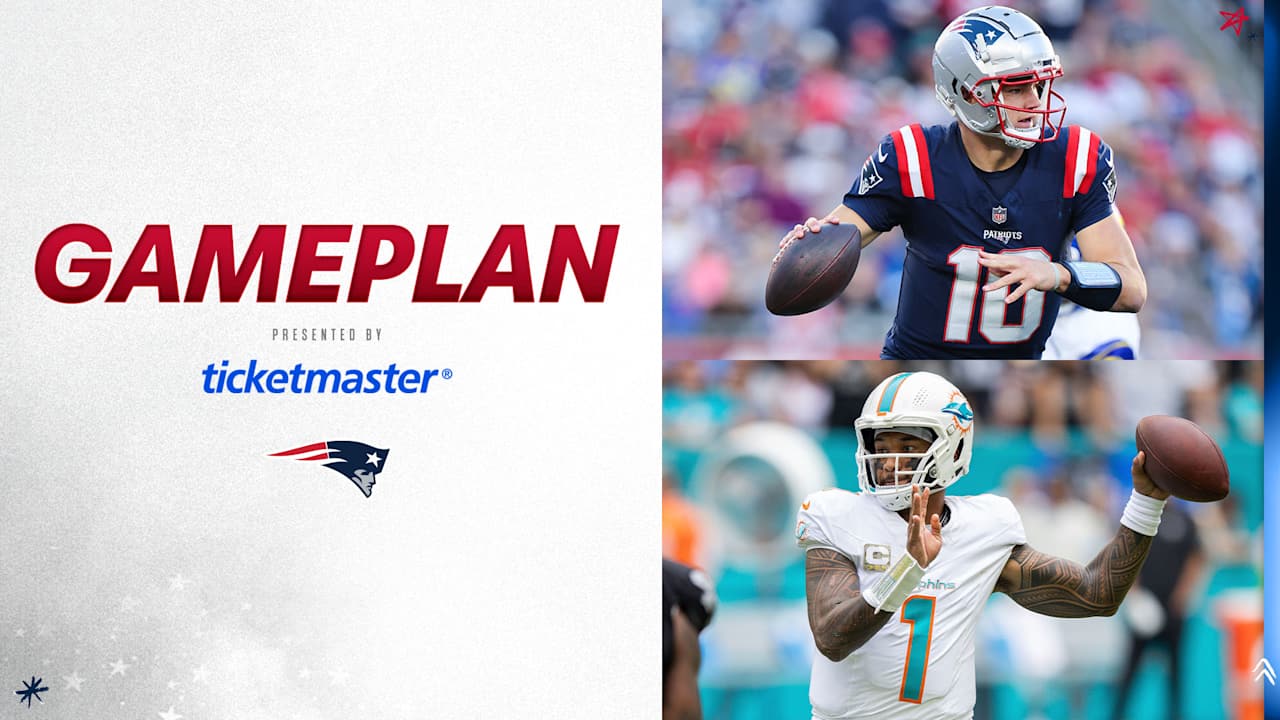
Moving over to the other side of the ball, the Dolphins offense is a different beast when Tagovailoa is at quarterback, both against the league as a whole and vs. the Patriots.
In three games since 2022, Tagovailoa has completed 68.5% of his passes with five touchdowns to two interceptions while adding +0.22 expected points vs. the Patriots. The Pats haven’t had any answers against the Dolphins offense when Tua, Tyreek Hill, and head coach Mike McDaniel are all participating. So, what do they do this time?
Under McDaniel, Miami runs a highly nuanced scheme, which is the main reason it has only worked with Tua. The Dolphins motion at a league-high rate (82.7%) and major in condensed formations (45.6%, sixth). They also run their offense out of heavy personnel groupings, only playing three receivers on 37.2% of their plays (30th). Instead, Miami toggles between two-back formations and two-tight end sets, much like McDaniel’s mentor, Kyle Shanahan, rather than McVay’s three-reciever heavy offense.
My biggest fear in this matchup is that the Patriots will match the Dolphins heavy grouping with base defense, which they’ve done this season: they cannot do that. The main reason they can’t play base is, of course, Miami’s team speed on offense. You cannot put an extra linebacker on the field against Hill, Waddle, Achane, Washington, etc. Last week, New England played base defense on 49% of the Rams offensive plays, allowing 10.3 yards per play on 25 snaps in base packages. McVay got the Pats in base defense and threw the ball, averaging 18.1 yards per pass play on 12 attempts. On the season, the Pats are 30th in yards per play in base defense (6.3) while playing 43.8% base defense rate (second-highest in the NFL).
The other element to this matchup is that the Patriots must have a better plan this week against motion. The Rams averaged 9.2 yards per play when they motioned, compared to a 4.5-yard average when there wasn’t any motion on the play. Despite their high motion rate, New England looked unprepared for LA’s motion concepts, and guess what, the Dolphins are about to do the exact same thing on Sunday.
As we get into Miami’s scheme, it’s also worth noting that their offense has evolved from thriving in the deep passing game with Hill and Waddle to a more quick-strike attack built around yards after the catch. This shift is because defenses play two-high safeties vs. Miami, forcing them to nickel and dime down the field rather than throw bombs. The Dolphins see two-high safety structures on 67.2% of their offensive plays, the highest rate in the NFL, while only 7.3% of Tua’s passes have traveled over 20 air yards. Tua’s average target depth is 5.6 yards, the league’s lowest air yards per attempt.
Rather than the vertical passing game we’re accustomed to seeing with this offense, it’s been more about the run game and yards after the catch, with De’Von Achane and old friend Jonnu Smith emerging defenses keying on the two receivers.