
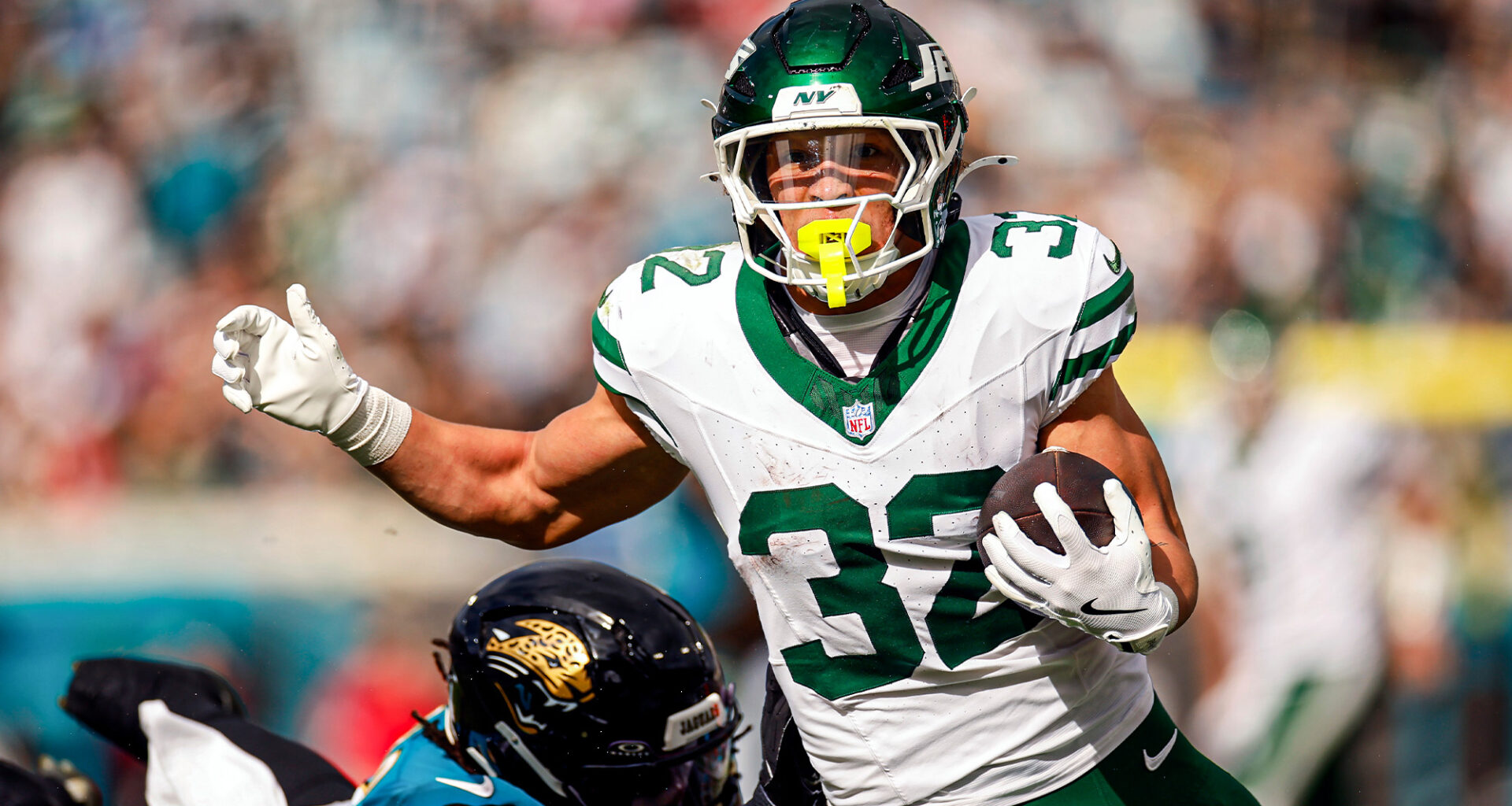
You’ve heard it all offseason: The New York Jets plan to use a committee approach at the running back position in 2025.
That means fewer carries for Breece Hall and an uptick for 235-pound mauler Braelon Allen.
Or at least, that is what the media seems to think.
While the national conversation is focused on Hall and Allen, it would be silly to forget about the unit’s dark horse: Isaiah Davis.
If the Jets are wise, their move to a committee backfield should not solely aim to replicate the Detroit Lions’ one-two punch with Jahmyr Gibbs and David Montgomery. The Jets’ best approach is to create a three-headed monster by adding Davis to the mix.
Isaiah Davis’s impressive rookie season
The South Dakota State product did not play much in his rookie year, but he made his opportunities count.
Davis only played 10.3% of the Jets’ offensive snaps on the season. Across 17 games, he participated in 110 plays, which is about 6.5 per game.
That was all he needed to make his mark.
On just 30 carries, Davis racked up 178 yards, giving him an outstanding 5.8 yards per carry. It was the fifth-best mark in the league among 91 running backs with at least 30 carries.
While a player’s YPC on a small volume can be very misleading, what makes Davis’s average seem more sustainable is that he did not inflate it with one or two home-run plays. His longest run of the season went for only 20 yards.
Davis earned his 5.8 YPC with his consistency from play to play. It suggests his performance may not have been a complete fluke.
On 18 of his 30 carries, Davis gained at least four yards, an astonishing 60% rate. The 2024 NFL average was 46.2%. In the same Jets offense, Braelon Allen and Breece Hall had rates of 46.7% and 43.5%, respectively.
Overall, 19 of Davis’s 30 rush attempts were deemed “successful.” His 63.3% rushing success rate was second-best among the 91 running backs with at least 30 carries. A “successful” rush gains at least 40% of the required yardage on first down, 60% on second down, and 100% on third or fourth down.
Simply put, Davis was very consistent at keeping the ball moving downfield on his limited sample size of chances. He did not display any semblance of home-run-hitting upside – which will never be his game, considering his 4.57 forty time – but he is the type of guy who can be counted on to keep the chains moving.
There’s a place for that type of runner in any offense.
Davis’s lack of big-play potential prevents him from being an ideal bell-cow. But as a second or third option in the backfield, he is the perfect player to keep the offense on schedule for a series or two while the starter catches a breath.
Adding to Davis’s appeal is his ability to fight through contact. He averaged an outstanding 4.2 yards after contact per carry, placing second at the position. A whopping 72% of his rushing yards came after contact. This is yet another aspect of Davis’s game that suggests his rookie-year performance was an indicator of legitimate ability, rather than a mere small-sample fluke.
Still, these numbers should be taken with a grain of salt. It’s just 30 carries, after all. Some running backs will have that many attempts in one game. Davis must continue thriving throughout training camp, the preseason, and the regular season to prove he is a legitimate weapon in the league.
With that being said, Davis’s potential is exciting. As the Jets prioritize a youth movement that centers around players with untapped potential, they would be remiss to exclude him from their offensive vision.
Where does Isaiah Davis fit?
Breece Hall is the Jets’ resident home-run hitter and pass catcher. It’s the downhill running game where he has struggled.
That’s where Davis can provide an upgrade. The catch is, Braelon Allen thrives in the same area. Davis and Allen both project as runners who can run for a high success rate despite lacking home-run potential.
However, Allen and Davis bring very different running styles to the table. Even if they deliver similar results, their process to get there is distinct. It would prove valuable to keep defenses on their toes by throwing them stylistic curveballs in the backfield.
Allen is a human bowling ball who knows how to maximize his 235-pound frame. He sticks his foot in the dirt, explodes vertically, puts his head down, and simply plows over defenders to get an easy chunk of positive yards and keep the chains moving. There isn’t too much nuance to his running style, and there doesn’t have to be when you have such an enormous physical advantage.
What a play by Braelon Allen on this 3rd & 1 wildcat. Leaps to grab the snap, has to make a quick cut to evade an unblocked defender, then plows through the hole and trucks a 335-pound DT (Benito Jones) to get the yard he needs. Knocks Jones’ helmet off. pic.twitter.com/fWJY6IQ08X
— Michael Nania (@Michael_Nania) December 11, 2024
Davis might not be Allen’s size, but he is a formidable presence in his own right, boasting a 220-pound frame. He also has excellent short-area quickness and flexibility for his size, which he uses to sift through traffic and get skinny through the hole.
Davis is a patient runner who initially lets things develop and then hits the hole hard when he sees it. He gets north-south, finishes with physicality, and usually finds a way to fall or spin forward for that extra yard or two. He has a knack for turning 2-3 yard gains into 4-5 yard gains, which can tilt the fate of a drive.
Isaiah Davis is a very underrated part of the #Jets‘ RB committee. Showed a lot in his limited action last year.
– 30 carries for 174 yards (5.8 YPC)
– Gained 4+ yards on 60% of carries
– 4.2 yards after contact per carry
– 6 missed tackles forced
– 0 drops or fumbles pic.twitter.com/ESBzQ1JQUK
— Michael Nania (@Michael_Nania) July 9, 2025
The cherry on top of Davis’s game is his ball security. He did not have any drops or fumbles in his rookie season. While it was too small a sample size to be considered an overly impressive feat, it was a continuation of what he did in college. Across 730 career touches in college, Davis fumbled the ball just three times.
This is an area where Davis has an advantage over Allen, who fumbled nine times on 645 career touches in college. That’s more than triple the rate of Davis. Hall has similar totals in the NFL, fumbling nine times on 664 touches, including six on 266 in 2024.
Promisingly, Allen avoided any fumbles on 111 touches in his rookie season, but Davis still has the better track record overall. He also feels like a safer bet to secure the rock than Hall after the latter’s issues in 2024. It is something that builds Davis’s case as a valuable part of the offense.
How should the Jets utilize Isaiah Davis?
Even if the Jets switch to a “committee” approach, Hall will still be the leader in the clubhouse by a sizable margin. He is the unit’s most talented player.
He just won’t have as large a slice of the pie as he did in the last two seasons. A sizable chunk of Hall’s touches should be vacated, and Davis is poised to eat most of them up.
Hall started each of the Jets’ first 12 games until he missed a game in Week 14. He returned for the final four games, but his touches were reduced as he fought through an injury.
Through Week 13 (the stretch with all three running backs healthy), this is how the Jets distributed their running back touches:
Breece Hall: 210 (70%)
Braelon Allen: 79 (27%)
Isaiah Davis: 9 (3%)
It would be shocking if a 70/27/3 split occurred under Tanner Engstrand and Aaron Glenn.
For perspective, let’s take a look at how the Lions split up their running back touches in 2024 with Engstrand and Glenn on the staff. Here is how it looked from Weeks 1-15 (14 games with Jahmyr Gibbs and David Montgomery both active):
Jahmyr Gibbs: 225 (48%)
David Montgomery: 221 (48%)
Craig Reynolds: 12 (3%)
Sione Vaki: 7 (2%)
For all intents and purposes, it was a 50-50 split between Gibbs and Montgomery. We can use this to map out a plan for the Jets.
It would make sense if the Jets cut Hall down to a 50% touch share, equaling one half of the Gibbs-Montgomery duo. This would leave another 50% to be shared between Allen and Davis.
The Jets could just give Allen the other half, forming a one-for-one replica of Montgomery and Gibbs’ thunder-and-lightning 50-50 split. But given what we know about Davis’s upside, the Jets would be foolish to leave him out of the picture.
So, why not split the other half equally between Allen and Davis?
That would give the Jets a 50/25/25 split between Hall, Allen, and Davis. It keeps Hall as the clear-cut RB1, while lightening his workload enough to keep him fresher and opening ample opportunities for both of the Jets’ other young running backs.
There will be plenty of drives when Hall carries the load by himself. He also projects as the primary third-down back, considering his extensive production as a receiver.
One potential plan for the Jets could work as follows: On every other drive, they give Hall a rest, rotating between Allen and Davis on the non-Hall drives. Their downhill running styles are ideal for keeping the Jets on schedule with positive gains while Hall sits, allowing him to keep his legs fresh and come back in with the energy to unleash home runs. In addition, the changeup between Allen, Hall, and Davis’s differing styles will disrupt the rhythm of opposing tacklers.
A rotation like this could work perfectly to get everyone involved:
Opening drive: Hall
Second drive: Allen
Third drive: Hall
Fourth drive: Davis
It wouldn’t have to be a strict rotation, either. While using this rotation as their baseline, the Jets could make adjustments for certain situations. As previously mentioned, Hall will likely be the favorite for passing situations. Allen is the best option for short-yardage situations; he was nearly automatic on those plays last year.
That leaves a niche role for Davis. He projects as the best option to handle longer stretches of first and second down carries when needed. If Hall and/or Allen need an extended rest (or are struggling), or if the Jets are trying to milk the clock, Davis is arguably their best option to assume an extended chain of carries.
With his consistency and ball security, Davis is a great backup for handling entire drives on his own. You can hand him the ball 5+ times on a drive and trust that he will keep the chains moving – and the ball secure. This is especially true in a role where he will not be carrying a heavy workload throughout the game, which will keep him fresh for gritty drives and late-game situations.
Don’t sleep on Isaiah Davis’s role in the Jets’ offense.