
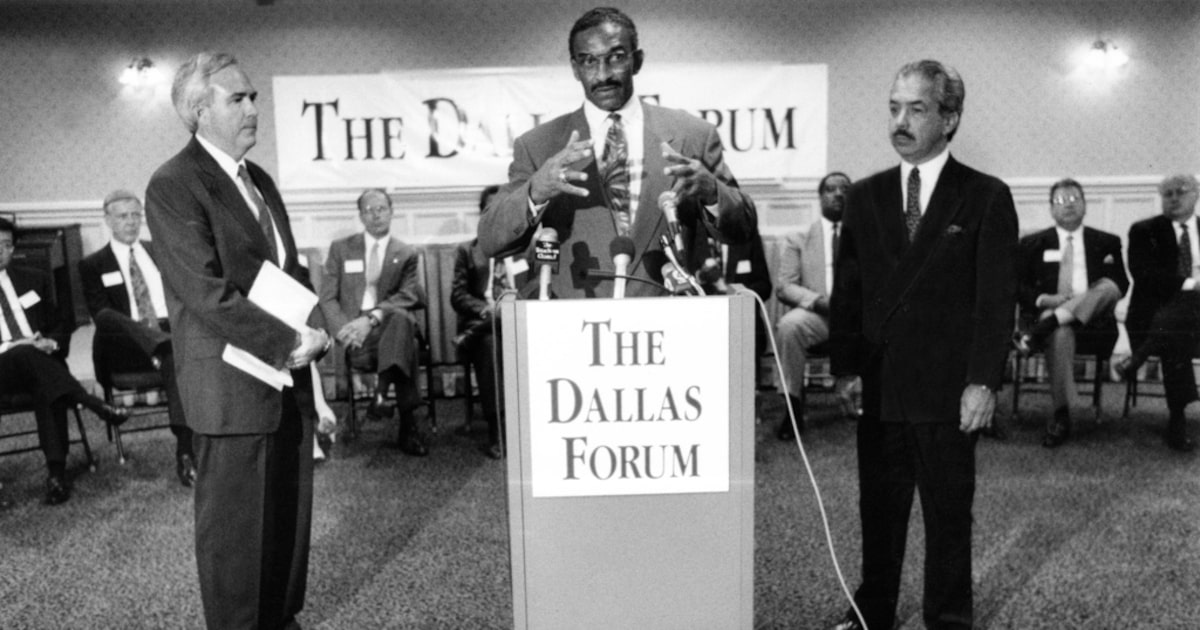
 Rev. Peter Johnson
With sadness and gratitude, I am thinking of the life and experiences of my friend Pettis Norman, who died Monday. Statuesque in height, in spirit and soul, Pettis wasn’t just a former Dallas Cowboys great. He was a business leader, a fearless civil rights organizer, and a brother with whom I stood in the trenches for over 50 years.
Pettis and I first got to know each other during the tumult of the 1960s, when America was being pushed to grapple with its soul. I had been assigned to Dallas by Ralph Abernathy and the Southern Christian Leadership Conference to create a movement in the South that would last long after the demonstrations stopped. Pettis was already here — strong, bold, unapologetically Black in a world that too often tried to diminish men like him. He wasn’t just catching passes on the field; he was seeing the vision for a more just and equal society.
There is a lot we know about Pettis, the Cowboys and San Diego Chargers tight end, including one surprising thing that few people talk about: how he used his platform for justice. At a time when athletes were frequently advised to “shut up and play,” Pettis would not be silenced. He was a battler for racial fairness in housing, in education, in employment, right here in Dallas. He saw that civil rights were not just in the headlines, but in board rooms and classrooms and neighborhoods of ordinary Americans.
One of the most distinctive characteristics about Pettis was his quiet bravery. He never had to shout to be heard in a room. He was just hungry to bring integrity and truth wherever he went, whether he was challenging racist hiring practices or advocating for Black businesses, mentoring the next generation of leaders, enlightening with his wisdom, or showing up with his heart. Pettis showed up with integrity, wisdom and a whole lot of heart.
Opinion
Pettis and I crossed arms in so many battles. We came out, we organized, and we took on powerful institutions together. But most important, we prayed. We laughed together. We wept for our people and rejoiced for every step we took forward, inch by inch.
Ours was not a friendship based on celebrity or status, but on brotherly love. We were there for one another in times of need. When we wanted to protest against Dallas City Hall, he was there. He was told by the Cowboys’ organization not to participate in protests with the Southern Christian Leadership Conference. He didn’t hesitate. He knew the risk. He knew the cost. But he also appreciated the power of a righteous cause.
He was traded to the San Diego Chargers immediately after that protest. I truly believe to this day his trade was due to his involvement with protests against the city. He knew the price. He paid it.
When Pettis exited the NFL, he didn’t leave behind his sense of mission. He would go on to become a successful entrepreneur, starting a number of businesses that became a model for Black economic self-sufficiency. But wealth never changed Pettis. He stayed grounded, attentive and generous. He had a powerful moral sense of giving back, of lifting others, and of using what the good Lord had given him to build a better world.
Thanks be to God for Pettis Norman. Our friendship of 50-plus years was a blessing that I will cherish for the rest of my days. He showed me that courage can be gentle, that strength can be subtle, that powerful men don’t oppress the powerless, and that true greatness is not what a man achieves, it’s what a man gives away.
In a time of cultural polarization and political upheaval, we need more men like Pettis Norman, men who aren’t afraid to stand up to those in power, who leverage their resources to raise the least of these and who know that the love of community is the highest form of patriotism.
As I grieve his passing, I also celebrate his legacy. He is survived by a Dallas made stronger by his presence, a movement enriched by his contributions, and a generation of leaders who walked a path he helped to pave. Rest well, my brother. You fought the good fight. You kept the faith. And your light will never dim.