
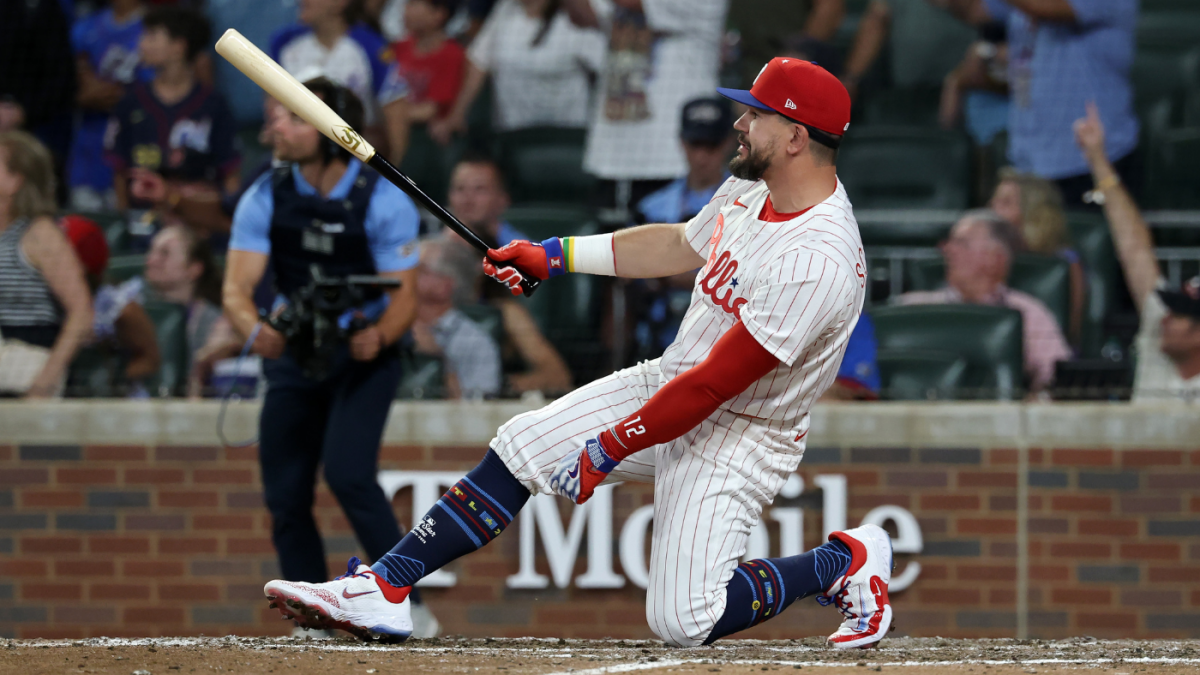
The National League prevailed over the American League in the 2025 All-Star Game on Tuesday night, and for the first time ever the game — tied after nine innings — was decided by a Home Run Derby-style swing-off. Such an ending was the result of the AL’s furious comeback from a 6-0 deficit going into the seventh inning.
With the score 6-6, three hitters from each side took three swings each. American League sluggers Brent Rooker, Randy Arozarena, and Jonathan Aranda combined for three home runs, but Kyle Stowers and Kyle Schwaber on the NL side outdid them with four homers. Schwarber’s three home runs on three swings gave the NL the lead for good and the win. Pete Alonso would have been the third hitter for the NL to take swings, but when Aranda failed to tie it up on his turn, the swing-off ended. The Rays All-Star, though, came mere feet from sending it to Alonso:
And the clincher:
Schwarber was named Most Valuable Player of the game despite going 0 for 2 with a walk during the game itself. His swing-off heroics, however, made him the first Phillies player to win All-Star Game MVP since Johnny Callison in 1964 and the first non-pitcher to ever win the award while going hitless.
As for the meandering journey that took the two teams to the undiscovered territory of the swing-off, it started early. After NL starter Paul Skenes worked a perfect top of the first with a pair of strikeouts, leadoff hitter Shohei Ohtani dumped a softly hit single into center, and then Ronald Acuña Jr. notched an even more softly hit infield hit to put two runners on for No. 3 hitter Ketel Marte. Marte came through with a well-struck double down the line to give the senior circuit that early 2-0 lead. In that one inning and with that one hit, Skenes received more run support in the All-Star Game than he did in his last three starts for the Pirates combined.
In the sixth, Pete Alonso of the Mets gave the NL and manager Dave Roberts some breathing room with this three-run, opposite-field homer off Royals lefty Kris Bubic:
Later that same frame, the Diamondbacks’ Corbin Carroll added a solo home run off Casey Mize of the Tigers to push it to 6-0.
NL pitchers suffocated the AL lineup until the seventh, when Brent Rooker of the A’s halved the lead with a three-run home run of his own. That meant All-Star Game history was made:
By the end of the frame, the NL’s advantage was down to 6-4. NL relievers stanched any further damage until the ninth. That’s when Padres closer and current MLB saves leader Robert Suarez allowed back-to-back one-out doubles to Byron Buxton and Bobby Witt Jr., which cut the lead to 6-5. Roberts then called upon Mets closer Edwin Díaz, who recorded the second out thanks to a sparkling play at first base by Matt Olson of the host Braves. Then, however, Steven Kwan notched an infield single that brought Witt Jr. home from third with the tying run. Aroldis Chapman of the Red Sox worked a perfect bottom of the ninth to send the game to the Home Run Derby-style tiebreaker.
Now for some additional takeaways from an All-Star Game the likes of which we’ve seen before.
The All-Star uniforms were as they should be
Straightaway you may have noticed that All-Stars were outfitted in keeping with all that is good and proper. By that we mean they were wearing their teams’ primary uniforms and not some one-off All-Star uniform. Please admire:
This was how things used to be until 2019, when MLB — presumably in an effort to move more merch — introduced All-Star-specific uniforms and thus willfully sullied the aesthetics of the Midsummer Classic. Now, though, sanity, taste, and basic human decency have been restored, at least in this one very specific regard.
All-time series is getting tight again
The outcome of this, the 95th All-Star Game means that the NL has whittled the AL’s all-time edge in the series down to 48-45-2. The NL has now won two of the last three All-Star Games. However, those two wins are all the NL has to their credit in the last 12 Midsummer Classics. Next year, the NL will try for back-to-back wins in the All-Star Game for the first time since 2011-12.
Misiorowski pitched a pressure inning
While Milwaukee Brewers rookie right-hander Jacob Misiorowski wasn’t the star of the show on Tuesday night, he was a bit of a co-star. That flows from his controversial selection to the National League roster, named as a late-hour replacement for Matthew Boyd of the Cubs, who opted out of his selection as many pitchers do. Because the top five starting pitchers and top three relievers as determined by player voting were either already in or had opted out, commissioner Rob Manfred was able to hand-pick the replacement. So what’s the problem? While the (very) hard-throwing Misiorowski has been quite good this season and dominant at times, he landed an All-Star selection after just five career starts. This was a source of fairly widespread consternation, particularly among some members of the Philadelphia Phillies.
Even so, NL manager Dave Roberts on Monday said he would call on Misiorowski to pitch out of the bullpen, and that’s precisely what happened in the eighth inning. At the time, the NL held a tenuous two-run lead. As promised, the Brewers rookie regularly hit triple digits in what turned out to be a scoreless high-leverage outing. Randy Arozarena took Misiorowski to the warning track, but the park held it. He didn’t strike out a batter and allowed a single to Jonathan Aranda. “The Miz” did, however, preserve the NL lead.
ABS was used (and it worked)
MLB commissioner Rob Manfred wants to implement the Automated Ball-Strike (ABS) challenge system in time for the 2026 regular season. It’s been in place for multiple seasons in the minors and in the most recent spring training. Tuesday night, though, occasioned its most notable rollout, as batters and catchers (on behalf of their pitchers) were allowed to challenge a particular called ball or strike and have it adjudicated by the review system. We didn’t have to wait long to see it in action, as AL catcher Cal Raleigh on behalf of Tarik Skubal dialed up a challenge on what would’ve been strike three to Manny Machado. It went a little something like this:
And so plate ump Dan Iassogna’s called ball one became strike three. Jacob Wilson of the A’s also flipped a strike call to a ball with his appeal in the fifth inning. In the ninth, Aroldis Chapman won a challenge at the expense of Brendan Donovan. So while the AL lost the game, they won the battle of officious pedantry. Speaking of which, the NL went 0-1 on ball-strike challenges. Kyle Stowers tapped his head at a called strike three in the eighth, but the call was upheld on replay.
As you can see, it’s about as seamless and prompt as such a system can be, and it’s probably a matter of when not if it becomes a permanent presence in MLB.
Kershaw rocked the mic
Clayton Kershaw, the 37-year-old future Hall of Famer, is no longer at the peak of his skills, but it’s his superlative body of work that earned him his 11th career All-Star selection, this time as a legacy pick by Manfred. Kershaw retired both batters he faced on Tuesday night — thanks in part to nifty snare by Kyle Tucker out in left — and the venerable lefty was even better in performing his “mic’d up” duties and obligations. Here’s a look and listen:
He doesn’t throw a cutter, in case you were wondering.
MLB and the Braves made a moving tribute to Henry Aaron
Aaron is of course an inner-circle great and a baseball hero for the way he handled the pressures, death threats, and racial hatred that encumbered his chase of Babe Ruth’s career home run record. The 25-time All-Star spent almost his entire career with the Braves, and he remains the singular franchise icon. So in the late innings, fans at the game and at home were treated to this tribute to Aaron and home run No. 715:
Moving indeed:
Regular-season baseball resumes on Friday.