
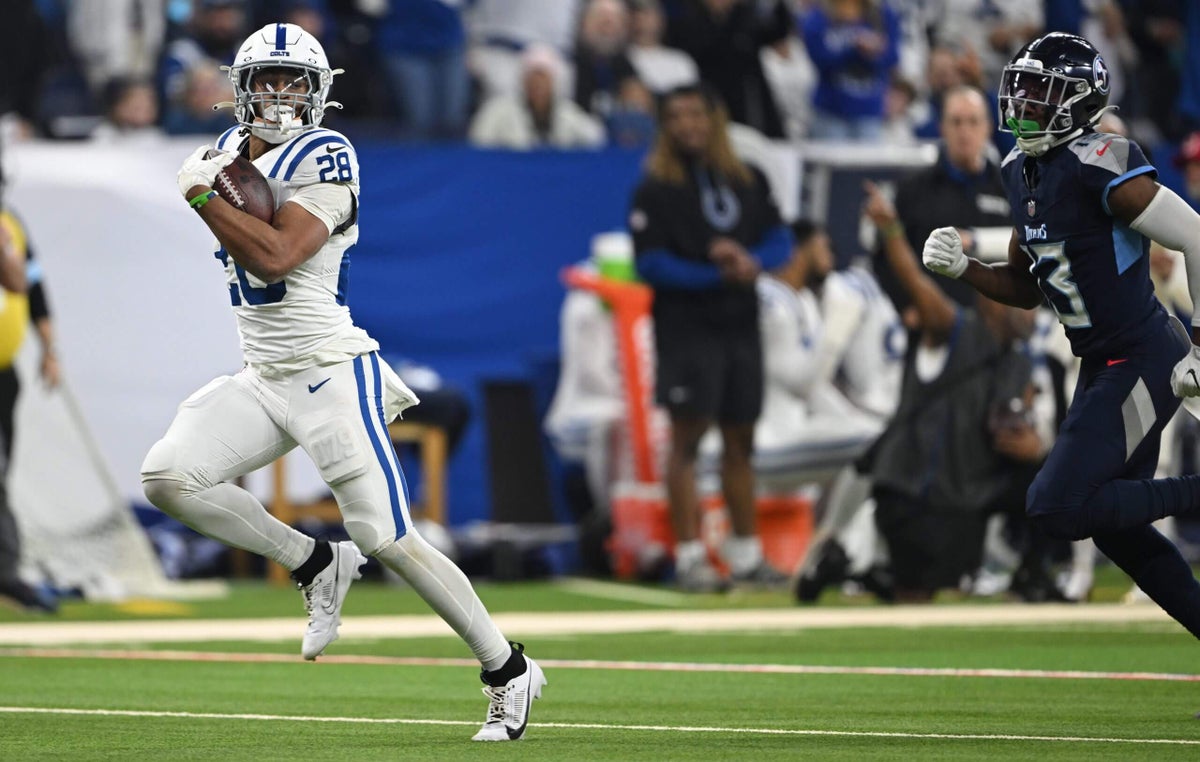
As we continue our look at big drops in player value based on my 2025 positional projections, cliffs we’re labeling “Draft Chasms of Doom,” we get an early glimpse of which draft strategies might be particularly en vogue this year. And those strategies involve selecting running backs.
With NFL teams evolving their approach to the position, fantasy managers have responded by leaning into playbooks like “Zero RB” (waiting until late to select your first running back) or “Hero RB” (pouncing on a star RB then stocking up elsewhere before returning to the position later in the draft). Take one look at the graphs below, which illustrate my Value Over Replacement Player projections (VORP), and you’ll see a very distinct early drop off. But before we discuss the perils of that particular chasm, we must address the projections for one of the most vexing players in fantasy: Christian McCaffrey.
McCaffrey’s projection (314.1 fantasy points, more than 30 clear of No. 2 Jahmyr Gibbs) doesn’t even give him the workload he had in 2023 or was on pace for last year. It’s crazy the value he brings if healthy.
For my tiers in the rankings, Bijan Robinson, Gibbs, and Saquon Barkley make up the top group, with McCaffrey positioned below, given his injury risk. Several of the Tier 2 projection RBs could reach Tier 1 with higher workloads or improved offenses (ahem, Raiders).
Tier 3 in the projections is significantly larger than the rankings. In fact, RB25 (Kaleb Johnson) ends Tier 4 in the rankings, as many involve risky split backfields. That’s true for everyone in the projections from RJ Harvey to J.K. Dobbins. More specifically, Tier 4 consists of running backs in timeshares, and those who aren’t are high-end backups with RB2+ upside if the lead gets hurt.
For my drafts, I’m aiming to leave the first two rounds with a running back from either Tier 1 (in my projections) or Tiers 1-2 ( in my rankings). This year’s NFL draft had a ton of talent. As you can see in the projections and rankings, that led to about half the league starting Week 1 with shared touches. Even if I wasn’t a proponent of drafting an early running back, I’d lean more into it this year.
You can also see — and will again when the wide receivers come out — that a “Hero RB” approach is a smart move this year. Taking one stud, loading up with wide receivers, and even adding an early QB or TE will still allow you to grab timeshare RBs, who could have similar value to those drafted rounds earlier. Heck, they might even outperform them.
As mentioned above, the graphs illustrate the advantage and strategy of going Hero RB this year, so don’t overlook that first drop-off. But then you can see how it might become a slow kiss of death.
While I am on board with Hero RB, I’m not going to ignore running back value if it’s there in Rounds 3-6. If you wait too long, reasoning (correctly!) that there is minimal drop-off for the next few running backs, you’ll never be wrong. However, defer for too many rounds and you’ll ultimately look up and find yourself drafting near-replacement-level players as your RB2. Yes, that could still work, but Hero RB doesn’t mean you have to wait forever if the better team build is staring you in the face.
(Photo of Jonathan Taylor: Marc Lebryk / Imagn Images)