

Dylan Samberg’s emergence as a shutdown defenceman was one of the Winnipeg Jets’ best storylines last season. Gabriel Vilardi’s work on the power play helped the Jets finish first in the NHL.
Now, Winnipeg is working to sign both restricted free agents before their arbitration hearings, which could take place as soon as July 20. The NHLPA will announce specific arbitration dates for each player in the coming days, even as the Jets work to avoid those hearings — as they did with Morgan Barron, signing him to a two-year, $1.85 million AAV contract earlier this week.
I believe there is a strong appetite to avoid arbitration with Samberg and Vilardi.
Samberg, 26, is eligible for unrestricted free agency as soon as next season, giving him more leverage than most defencemen with one year of top-four excellence on their resume. Winnipeg will look to buy as many UFA years as possible, perhaps getting Samberg to commit to as many as six or seven years in the heart of his career. Samberg is committed to the Jets and fills an important role on the PK and alongside Neal Pionk on the second pair. I’d expect a long-term deal to exceed the $4.5 million projected by Evolving-Hockey or $4.8 million projected by AFP Analytics.
Vilardi, 25, is two seasons away from unrestricted free agency. This gives Winnipeg a little bit more wiggle room — a one-year arbitration award would still allow for a long-term extension next summer — although the range of options is wide. There may be more of an appetite for a four- or five-year contract, given Vilardi’s injury history, with the player potentially benefiting from a rising cap and his productive role on the Jets’ power play. Evolving-Hockey projects a $7.5 million AAV for Vilardi on a four-year term, while AFP Analytics projects four years at $6.6 million AAV.
As the Jets’ roster crystallizes, here are the biggest stories and questions on and off the ice facing Winnipeg’s projected roster — up front, on defence and in net.
Forwards
LWCRW
Kyle Connor
Mark Scheifele
Gabriel Vilardi (RFA)
Cole Perfetti
Jonathan Toews
Gustav Nyquist
Nino Niederreiter
Adam Lowry (IR)
Alex Iafallo
Morgan Barron
Vladislav Namestnikov
Cole Koepke
Tanner Pearson
David Gustafsson
Walker Duehr
Jaret Anderson-Dolan
Mason Shaw
Parker Ford (RFA)
Blue shading denotes projected opening-night roster.
The biggest changes: Nikolaj Ehlers is out, Jonathan Toews and Gustav Nyquist are in, and Adam Lowry is recovering from hip surgery.
The story: Winnipeg’s forward group gives us the opportunity to answer an age-old question about how to win hockey games. Is it more effective to have the best individual player — or to not have the worst player? The Jets’ top-end talent — Mark Scheifele, Kyle Connor, Gabriel Vilardi and Cole Perfetti with another year of improvement under his belt — will fall short of Connor McDavid, Nathan MacKinnon, Jack Eichel and their linemates on the West’s presumed top teams. With Ehlers out, there’s one more top-end gamebreaker missing, even though Toews and Nyquist have had productive seasons earlier in their careers.
Winnipeg’s depth is excellent, though. Once everybody is healthy, one of Toews or Lowry will be the team’s third-line centre. If the Jets use the lines we’ve projected, then all of Lowry, Barron, Nino Niederreiter, Alex Iafallo, and Vladislav Namestnikov will have viable cases to be used higher up the lineup. In most cases, they’ve been used higher up the lineup — and to great success, especially when the Niederreiter/Lowry duo’s shutdown assignments have turned them into Winnipeg’s de facto second line.
This is a team with a high floor. If it can replicate last season’s Presidents’ Trophy success — or surpass its second-round playoff performance — it will be a testament, in part, to its phenomenal depth. If it fails, it will be because its power play cratered, Toews was unable to perform at a middle-six level, or the group struggles too much against speed.
The biggest on-ice question: Do the Winnipeg Jets need to change how they play?
The Jets are going to be a slower team than 2024-25. Recall that when Kevin Cheveldayoff brushed aside those concerns at the Toews press conference, referencing Brad Lambert’s skating, he used the word “hopefully.” As in: Hopefully Lambert makes the team. Cheveldayoff also pointed to team play, though, saying, “It’s also playing fast. I think that’s what a coach tries to do within their systems.”
One of Winnipeg’s strengths is an abundance of hockey IQ. When Scott Arniel preaches defending between the dots, Winnipeg’s forwards are a good bet to understand their responsibilities, make their reads and make it difficult for opposing teams to make plays in the middle of the ice. Kyle Connor and Mark Scheifele made strides in this regard last season, while Winnipeg’s other veteran players — Toews, Lowry, Niederreiter, Iafallo, Namestnikov and company — aren’t going to short a backcheck or miss assignments.
It’s possible Arniel adapts in unexpected ways. Barron, a fourth-line forward, is one of Winnipeg’s fastest players and did play down the middle at times last season. He could find himself pushed up the lineup out of respect for his foot speed and ability to drive the puck up the walls. It seems more likely that Winnipeg’s forwards defend well, lose some transition scoring, and continue to depend on Connor, Scheifele and an elite power play to generate their offence.
The biggest off-ice question: Will Connor re-sign with Winnipeg or follow Ehlers’ path in unrestricted free agency?
My offseason projection is that Connor signs a big-ticket, long-term contract with Winnipeg. I expect him to become the highest-paid player in franchise history. It may be a difficult contract to live up to, given the 28-year-old is coming off of 97 points and the best all-around performance of his career. Still, I expect the interest in an extension is mutual.
Defence
LDRD
Josh Morrissey
Dylan DeMelo
Dylan Samberg (RFA)
Neal Pionk
Haydn Fleury
Colin Miller
Logan Stanley
Luke Schenn
Ville Heinola
The story: Josh Morrissey and Dylan Samberg give the Jets a strong foundation. Dylan DeMelo struggled at times last season and Neal Pionk’s results have wavered at times, too, but the Jets have given up the fewest goals against in the NHL for two straight seasons. The concept of team defence is working in Winnipeg. Morrissey and Pionk also generate plenty of offence — Morrissey with his speed, power-play skill and blue-line feints, and Pionk with his shot and ability to find teammates for deflections. It’s a talented group that could use more Morrissey-like dynamism or Samberg-like defensive prowess.
We’ve also watched Morrissey miss games due to injury in two of the past three playoffs. Winnipeg’s defence corps has often been bullied in front of the net regardless of size. Logan Stanley and Luke Schenn gave up the most five-on-five goals per minute among Jets defencemen during the playoffs, while Morrissey and DeMelo were also outscored.
The biggest on-ice question: Are they strong enough to handle playoff opponents?
Have you seen the Paul Maurice clip where he screams at his Panthers team to forget making plays and just pound Boston’s defencemen “so in Game 7, they’ve got nothing left?” The Jets may have beaten the Blues in seven games, but Morrissey was hurt (and Scheifele before him) while Winnipeg gave up more goals due to screens, deflections, or both than any other team during Round 1.
A team’s defensive numbers should be worse in the playoffs than they were during the regular season. That’s what happens when you take away the 16 worst opponents. (Even Florida gave up more postseason scoring chances than they did through their first 82 games.) In Winnipeg’s case, though, the drop-off was precipitous. The Jets’ goals-against numbers were about more than goaltending — it’s a function of what’s happening in front of the net — and we’ve watched Winnipeg struggle in consecutive playoffs. It’s fair to question team defence when the net-front chances soar, just as it’s fair to question the goaltender when the goals go pouring in.
The biggest off-ice question: Who’s headed to waivers?
Winnipeg is headed towards training camp with nine NHL-caliber defencemen, all of whom require waivers to be assigned to the Moose. A disproportionate number of those players would be best suited to a third-pairing or press-box role, creating a series of difficult decisions for defence coach Dean Chynoweth. We’ve listed Haydn Fleury and Colin Miller as the third pairing here, but the Jets could realistically pair any of their bottom five defencemen together, give them sheltered minutes and get away with it.
The sheer volume of defencemen provides an insurance policy heading into training camp. Players can and do get hurt all of the time and this season’s schedule will be densely packed with games, owing in part to the Olympics. Winnipeg would do fine to hold on to everybody for now, let them battle it out for jobs, and defer its decision-making to the end of camp. Winnipeg has also lost Johnathan Kovacevic and Declan Chisholm to waivers in recent seasons. Ville Heinola appears to be at risk of following them — and even then, the Jets would need to move someone else or carry eight defencemen if everyone stays healthy.
Heinola’s foot injury and ensuing infection ended his last two training camps early. If he shows up healthy and at his best, he could force the Jets to make a difficult decision about the veterans in front of him.
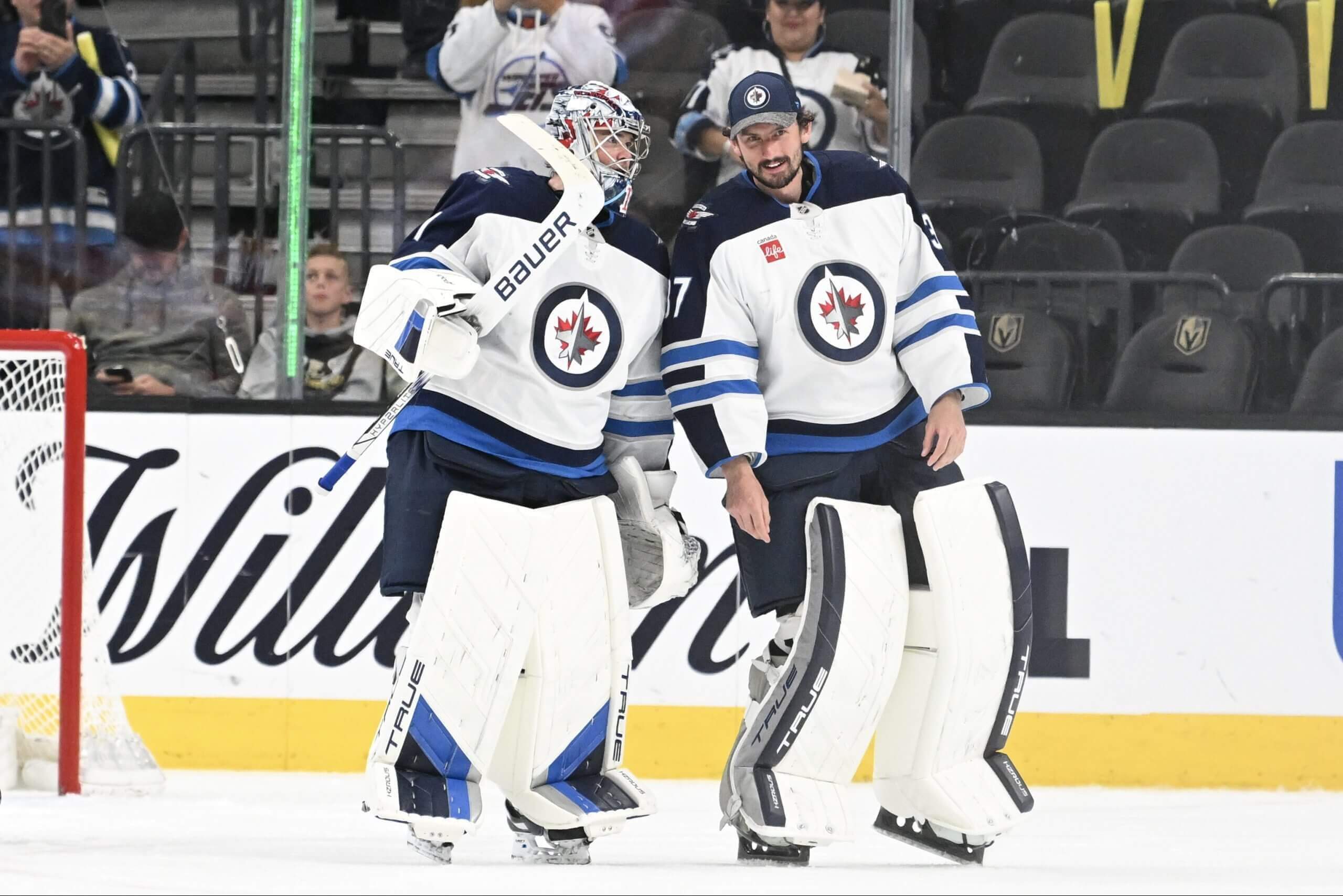
The Jets have the best goaltender on the planet in Connor Hellebuyck and a backup who has been excellent in Eric Comrie. (Candice Ward / Getty Images)Goaltending
G
Connor Hellebuyck
Eric Comrie
The story: Winnipeg has the best goaltender on the planet and a backup who has been excellent in Winnipeg. There is also a non-zero group of readers who scoffed at that sentence because of Connor Hellebuyck’s playoff performance.
The biggest on-ice question: Can Hellebuyck bring his best self to the postseason?
Hellebuyck’s regular-season legacy is settled, with three Vezina Trophy wins and the 2025 Hart Trophy as the NHL’s most valuable player. His playoff legacy is in jeopardy, with a pair of shutouts against Dallas offering a glimmer of hope after St. Louis shelled him and Colorado seemed to crush his spirit. No matter how well he plays during the regular season, there will be a sense of “Will he get it done when it matters?” until Hellebuyck delivers in the playoffs.
There is nuance, however. The Jets gave up too many screened shots and didn’t protect their net front as well as they needed to during the playoffs. Hellebuyck was brilliant against Edmonton in 2021. But this generation of Jets — the one that leads the league in regular season wins since 2022-23 — will be defined by their playoff success. Even if you ascribe some of Hellebuyck’s poor postseason numbers to screens, bounces and poor defending, his game has changed, too, and he’s acknowledged that he’s tried to overcorrect his own play.
The biggest off-ice question: Will Eric Comrie come back?
Comrie has been an ideal backup in Winnipeg, posting a .914 save percentage in 20 games last season and embracing his support role. He’s one of Hellebuyck’s biggest supporters and even made this cameo when Hellebuyck won the Hart Trophy this season. He spends extra time with Jets shooters at the end of most practices and is an outspoken advocate for Winnipeg as a hockey market.
Comrie also signed in Buffalo when the Jets made him a free agent in 2022. It was a decision made in search of a bigger role; another strong season in Winnipeg could earn him offers to play more than his career high of 20 GP.
(Top photo of Mark Scheifele, Neal Pionk, Kyle Connor, Gabriel Vilardi and Dylan Samberg: Jerome Miron / Imagn Images)