
The Washington Commanders entered the 2025 NFL draft with some clear needs. You could argue that adding another wide receiver wasn’t one of the top needs, but a closer look would reveal that the Commanders needed another playmaker at wide receiver.
Washington’s top two wide receivers, Terry McLaurin and Deebo Samuel, will be free agents after the upcoming season. Noah Brown, Michael Gallup, and K.J. Osborn will also be free agents. That means that before the draft, only the unproven Luke McCaffrey was under contract beyond the 2025 season. Of course, you should expect the Commanders and McLaurin to reach a new deal. Washington loves McLaurin and understands his importance on and off the field. McLaurin feels the same about the only organization he’s ever known. If Samuel has a great year, he, too, could be brought back.
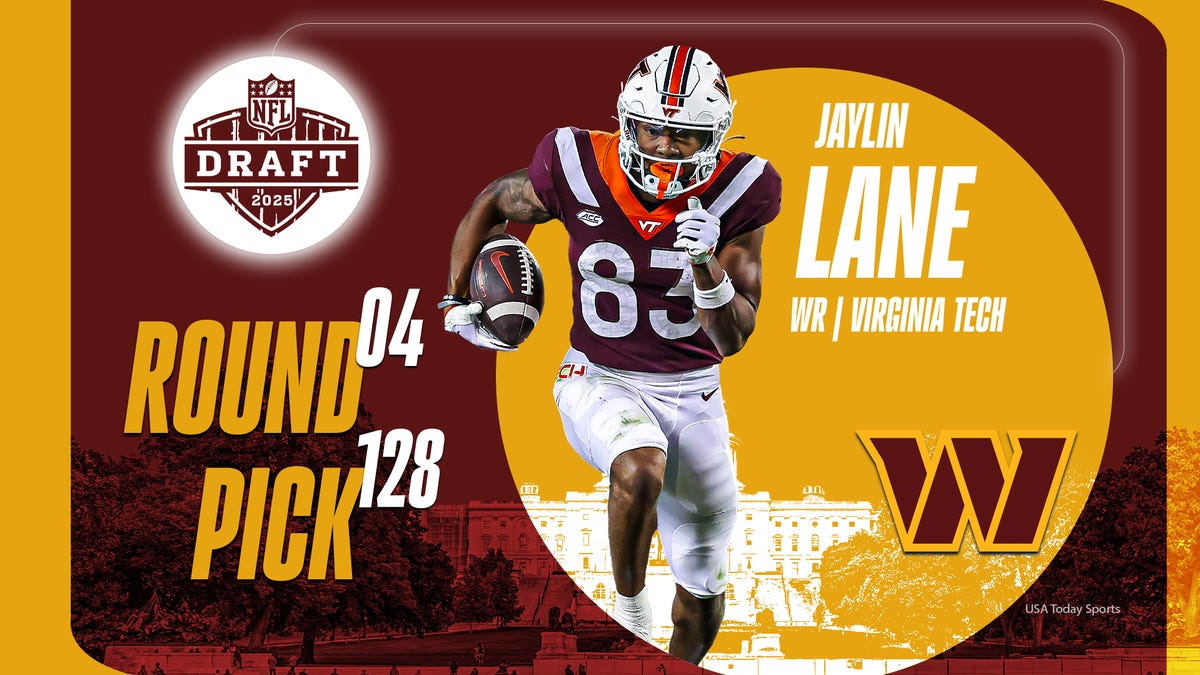
General manager Adam Peters wisely gave quarterback Jayden Daniels another receiver. In the fourth round, Washington selected Jaylin Lane of Virginia Tech. Lane is a versatile speedster who can play outside or in the slot. He is also a dangerous return man. How will he factor into Washington’s 2025 plans?
Here’s what some expert draft analysts had to say about Lane during the pre-draft process and what Commanders fans can expect to see:
“A two-year starter at Virginia Tech, Lane was primarily the slot receiver in former offensive coordinator Tyler Bowen’s balanced scheme (also saw Z and backfield snaps). After three seasons at Middle Tennessee, he posted moderate receiving production in his two seasons in Blacksburg and scored six touchdowns in 2024 (in four different ways: two receiving, two rushing, one passing, one punt return). Lane was a productive punt returner in college and shined on offense with screens, jets, etc., when he could throttle his speed, follow blocks and motor through fly-by tackles.
He is capable of stretching the field vertically (dynamic on slot posts), although he needs work in the intermediate part of the field to better set up defenders, win body position and finish crowded catch points. Overall, Lane is missing the well-rounded effectiveness that teams want in a starter, but his balance and acceleration — especially with the ball in his hands — will give him a chance to impress an NFL coaching staff in camp. His value as a punt returner should boost his chances of securing a roster spot and getting on the field.”
“Semi-versatile slot option with legitimate long speed and talent to add yardage with the ball in his hands. Lane can stretch defenses from the slot with his build-up speed and is a viable option in catch-and-run packages near the line of scrimmage. He gives too many clues as a route runner and needs to work on running repeatable, fluid routes as a pro. While he’s tough as a runner, he can’t muster the play strength or ball skills to win the contested-catch game. Lane’s best qualities give him a chance to stick on a roster, but he might need to earn his keep as a return man early on.”
“Jaylin Lane is a versatile offensive chess piece who will earn touches in a variety of ways at the NFL level due to his short-area quickness and creativity after the catch.
Lane primarily aligns in the slot but is constantly moved around the formation to exploit matchups and space. When aligned stagnant, Lane showcases excellent foot quickness to get off the line and into open grass. Highly utilized in the shallow to intermediate areas of the offense where much of Lane’s route tree consists of crossers, overs, digs, sit-routes, swing passes, and angle routes out of the backfield. He’s also highly utilized on designated touches via screens and reverses. Has not faced a ton of man coverage where he’s asked to stack and separate downfield. Rather, he has been largely granted free releases for teams to keep everything underneath. He often is in motion at the snap, forcing defenses to communicate and push defenders to his new location. It’s a credit to Virginia Tech’s offensive staff in adjusting their scheme to what Lane does best as an after-the-catch weapon.
Lane has good speed, not elite. He has short, choppy strides that can change direction quickly. Excellent contact balance that showcases as a return man and downfield on designated touches. Good vision in the open field to ID space. Strong hands but would like to see more consistency in hauling in passes away from his frame, or passes that force him to break stride and decelerate. Competitive in tight areas but is not a player to classify as one that plays bigger than his frame.
Concerns remain about his overall route tree and inconsistent releases against more physical corners. While Lane has succeeded as a common target on designated touches, winning in isolated scenarios at different depths is currently vacant in his profile and a trait that could limit his impact at the next level for teams that do not prioritize volume in shallow areas or an architecture with limited creativity.
Overall, Lane projects as a versatile multi-phase contributor (punt return TD vs. Marshall) at the next level whose short-area acceleration and creativity after the catch will be valued highly by teams with creative offensive structures and diversified personnel packages.”