
Let’s get something straight: Ben Johnson didn’t just design a top-tier offense in Detroit. He rewrote the damn manual. At 33 points per game in 2025, the Lions led the league in scoring and ranked fourth in yards per play. And the key ingredient? 12-Personnel — one running back, two tight ends, and a whole lot of headaches for defensive coordinators.
Johnson used it more than 33% of the time. That’s 108 plays with standard 12, plus 21 in what he calls “Jumbo 12,” featuring an extra lineman and two TEs. That’s over 2.5 standard deviations above the NFL average, per Sumer Sports.
While most teams play checkers with formation packages, Johnson’s out here playing fourth-dimensional chess. So let’s take a deep dive into his offensive mind and see how he can replicate his success in Chicago.
The Data Breakdown
According to Sumer Sports:
Subscribe to the BFR Youtube channel and ride shotgun with Dave and Ficky as they break down Bears football like nobody else.
11 personnel (3 WR sets) accounted for 46% of Detroit’s offense
12 personnel: 108 plays
Jumbo 12: 21 plays
Total 12-personnel usage: ~33%
 Top 5 NFL Teams by 12 Personnel Usage: 2024-25 Season
EPA (Expected Points Added):
12 Personnel Pass: Highest EPA of any Detroit formation
12 Jumbo Rush: Top 10 EPA among run concepts
Pass/Run Balance:
11 Personnel: 62% pass / 38% run
12 Personnel: 46% pass / 54% run
12 Jumbo: Heavily run-focused
In other words, Johnson isn’t predictable even when you think he’s tipping run.
Formations That Murdered Defenses
Now that we’ve seen how 12-personnel thrived under Johnson’s system, it’s time to unpack exactly how he arranged his chess pieces. These weren’t just basic alignments — each formation was a calculated trap, designed to lure defenses into tendencies before flipping the script. Let’s break down the core alignments that turned Detroit’s offense into a matchup nightmare.
Ace Formation (2×2 Spread)
Classic misdirection bait:
Two TEs off the LOS, wideouts split wide
Often used to probe base defenses
Motion triggers LB movement
Play-action setups that punish overcommitting

Singleback Ace Formation, per madden-school.com
Broken Bunch Formation (3×1 Variation)
Offset tight end sets
Stretch runs with counter cutbacks
Elite space for RBs like Gibbs

Singleback Bunch Formation, per madden-school.com
Trey Formation
Both TEs on one side with WR solo opposite
Looks run-heavy, hits with PA drag or under/over TE leaks
Forces defensive overreaction to strong-side power
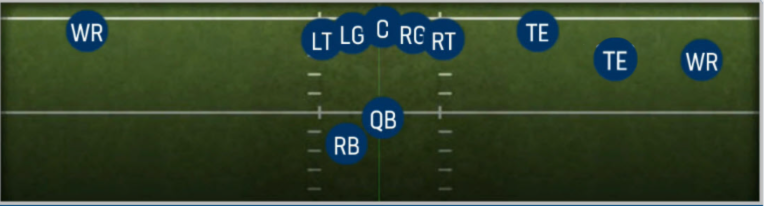
Shotgun Trey Formation, per madden-school.com
The “Star Concept”
you’ve seen this in high-leverage moments:
Seam-Go by WR
Dig by the opposite side
Flat release by RB
Stress test for linebackers and safeties. Either you cover the dig or get torched by the RB leak.
The Ben Johnson Philosophy
Before we dive into how Johnson will fit his system in Chicago, it’s important to understand the underlying principles that made his Detroit offense such a nightmare to defend. These aren’t just play calls. They’re calculated setups built to disorient and dismantle even the smartest defensive units.
Bait & Switch: Show one thing, do another
Formation Variance: Recycle looks but invert strength or motion
Maximizing Matchups: LaPorta draws coverage, Wright gets the throw
No Tell-Motion: Confuse post-snap reads
Strategic Chaos: Make defenses react, never initiate
This is not plug-and-play. It’s engineering.
Now: What Happens in Chicago?
So Johnson takes over in Chicago, a franchise historically allergic to competent offense. Now he gets a roster with:
Cole Kmet & Colston Loveland at TE
DJ Moore, Rome Odunze, Luther Burden III at WR
D’Andre Swift & Roschon Johnson in the backfield
Caleb Williams at QB
Here’s how Johnson can import the 12-Personnel chaos to the Bears:
Tight End Room: Building Blocks
Detroit had LaPorta (TE1) and Wright (inline bruiser). In Chicago:
Kmet = Wright role, inline blocking + RZ target
Colston Loveland = LaPorta role, Motion-capable TE with receiving upside, capable of flexing into slot or acting as H-back weapon
TE room is “good enough,” and they may have found their LaPorta clone by drafting Colston Loveland with their first pick in the first round
With Colston Loveland taken in the first round, Chicago signaled they’re going all-in on replicating the Detroit model. He’s not just a pick — he’s the centerpiece of their 12-Personnel ambitions, giving Johnson the LaPorta-like weapon his scheme demands.
QB Fit: Goff vs. Williams
This ain’t Jared Goff anymore. In Detroit, Johnson had a rhythm passer who excelled inside a defined pocket with tight timing throws. The entire scheme hummed off Goff’s ability to read pre-snap indicators and execute play-action with mechanical precision. Now in Chicago, Johnson has to recalibrate. He’s got Caleb Williams — a dynamic, improvisational quarterback whose skillset leans more Mahomes than Manning. The challenge? Translating a structured, sequence-based offense into something that still supports timing while unleashing Williams’ spontaneous playmaking.
Goff = timing, structure, precision
Williams = off-platform wizard with elite vision
Johnson will adjust the offense, not force it. Expect:
More boot-action
Zone-read RPOs from 12-Personnel
More misdirection packages or motion-triggered RPO looks
The added QB mobility actually unlocks more trickery from these formations.
RB Usage: Sonic & Knuckles 2.0?
Detroit had thunder-and-lightning with Montgomery & Gibbs.
Chicago has:
Roschon Johnson = downhill punch
D’Andre Swift = outside zone burst
Don’t be shocked when Johnson installs the exact same cutback-heavy zone system. Expect:
Motion TE across, insert trap run
Pull backside guard, bait edge to wrong shoulder
Hit gaps with Herbert or go power with Roschon
Motion Packages: DJ Moore as St. Brown?
Motion is the soul of Ben Johnson’s offense. It’s how he forces linebackers into panic attacks, disguises intentions, and gets your best player the ball in space. In Chicago, he inherits serious tools to keep that motion magic alive.
Moore gives Johnson his ace slot/blocker/route-slayer hybrid
Rome Odunze is the high-IQ possession receiver with contested catch skills and route refinement well beyond his years
Luther Burden III = Jameson-lite (stretch speed, big YAC guy)
Expect:
Stacked formations
Split-flow misdirection
Moore in motion to flip strength pre-snap
Motion isn’t just eye candy in this offense. It’s control.
The Chessboard Is Set
If you give Johnson:
A functional OL
Two serviceable TEs
Two dynamic backs
A QB with processing or mobility
Then boom — he’s going to recreate the same defensive brain-melter he built in Detroit. The 12-Personnel foundation isn’t going away. It’s just getting meaner.
Final Verdict
Ben Johnson’s 12-Personnel system changed the game in Detroit. And now he’s rebooting it in Chicago. If he drafts the right TE, tweaks the offense for his QB’s mobility, and keeps hammering motion variance and play-action disguise?
The Bears won’t just be competent. They’ll be a f*cking problem.
And every NFC North coach knows it.