
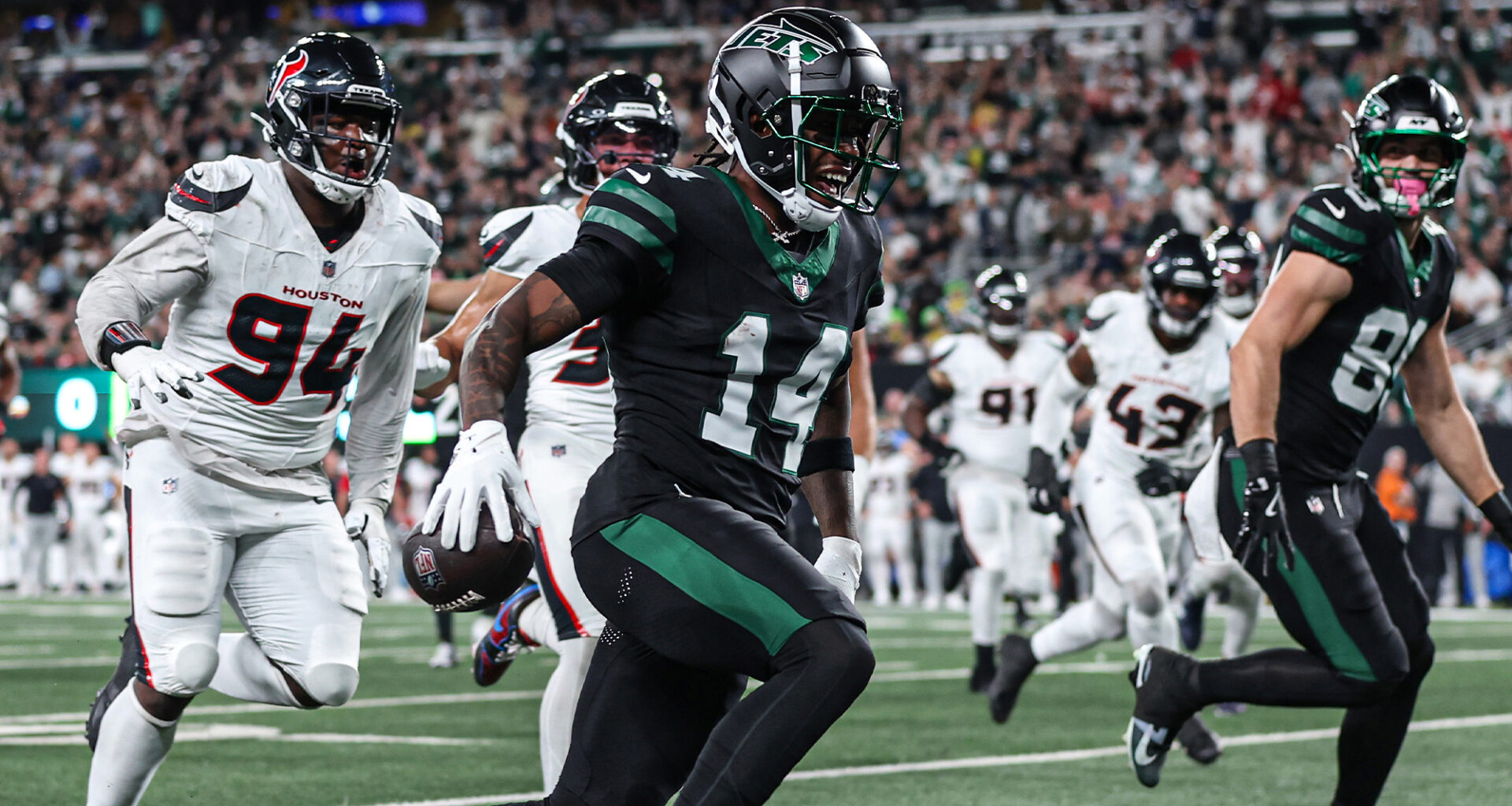
Malachi Corley remains one of the biggest mysteries on the New York Jets’ roster.
Drafted with the first pick of the third round in 2024, Corley arrived in Florham Park with expectations of carving out a key role in New York’s offense. Some even floated his name as a candidate for Offensive Rookie of the Year.
Whoa. Pump the brakes.
Corley played just 83 offensive snaps as a rookie, catching three of six targets for only 16 yards. He was a healthy scratch in multiple games, and questions about his work ethic persisted throughout the season.
His most notable moment, a breakaway end-around that should have gone for his first career touchdown, ended in embarrassment when he dropped the ball before crossing the goal line.
With training camp approaching, Corley has been listed as a player on the hot seat, with some speculating the second-year wideout isn’t guaranteed a roster spot in 2025.
While it’s fair to expect Corley to prove he deserves a meaningful role in the offense, the idea of releasing him outright if he struggles this summer seems shortsighted.
Yes, his rookie campaign fell well below expectations. But context matters.
Last season’s offensive staff, led by Nathaniel Hackett and Todd Downing, failed to build a modern, adaptable system. Expecting that group to properly deploy a motion-heavy playmaker like Corley was a tall order from the start.
More importantly, cutting ties now wouldn’t offer the Jets any real benefit. Corley is still on a rookie deal and doesn’t carry a significant cap burden.
In what feels like a transitional year, the Jets should prioritize developing young talent with upside. Corley, despite a rocky start, still fits that mold and deserves the chance to show it.
Most importantly, if there’s any coordinator equipped to maximize Corley’s skill set, it might be new Jets offensive play-caller Tanner Engstrand.
As the Detroit Lions’ passing game coordinator last season, Engstrand’s offense used pre-snap motion on 74.5% of plays, the fifth-highest rate in the league. The Jets, by comparison, ranked near the bottom at 25th, deploying motion just 54.3% of the time.
That disparity could be the key.
Corley thrives when he’s on the move, whether it’s jet sweeps, quick screens, or designed touches in space. Under Hackett, New York’s stagnant scheme failed to consistently create those opportunities, leaving the rookie buried behind more traditional concepts.
If Engstrand brings the same creativity he used with Jameson Williams in Detroit, mixing in motion-heavy looks, RPOs, and gadget plays, Corley could finally become a factor.
Corley may not have lived up to expectations during his rookie season, but with a new offensive vision in place, his story in New York is far from written.