
The FTN Football Almanac 2025 is out now! For over two decades, it’s been the definitive guide to the NFL, with our trademark blend of rigorous analysis, detailed film study and sharp commentary, and this year’s edition is as good as ever. With over 450 pages of stats and writing, it remains your best tool for getting ready for the upcoming season.
If you’re new to the Almanac, and want to know what it’s like, we have the San Francisco 49ers’ chapter currently available as a free preview. In it, we talk about the 49ers’ high DVOA despite their 11-loss season in 2024, the fate of their defense with Robert Saleh returning, and how the loss of talent this offseason mostly leaves them thin at depth, rather than affecting how they’ll play when fully healthy. It’s certainly worth a read!
But, as it turns out, there are 31 teams not named the San Francisco 49ers who will be playing in 2025 as well, and the Almanac covers them, too. Today, we’re going to feature a few of our favorite tidbits from this year’s Almanac, thanks to our crack team of writers and the charting stats we have access to here at FTN.
And remember – these are facts that our experts pulled out from our data from this past season. If you don’t want to wait for 2026’s Almanac to find out what’s going on in the 2025 season, you can sign up for a Stats subscription! Our Stats Core tier features access to all of our advanced stats, DVOA and our proprietary tools like StatsHub, while the StatsPro package adds on our vast array of fantasy resources, so you can use the same tools we use to break down the season as it happens, as well as have access to all of the in-season articles, data and analysis you’ve come to expect from FTN’s experts.
Philadelphia Eagles Say Running Backs (Sort Of) Matter
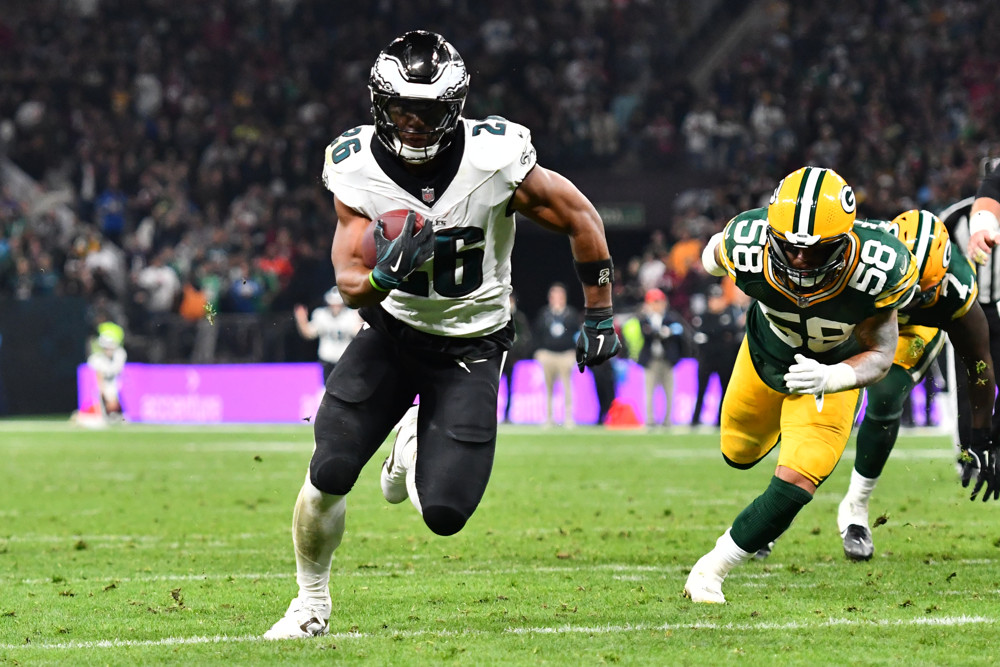
The Eagles weren’t near the top of the league in any one offensive statistic in 2024. They ranked just 13th in offensive DVOA and 14th in passing DVOA. Even their rushing attack ranked just sixth, despite the presence of Offensive Player of the Year Saquon Barkley. Barkley also didn’t lead our individual stats, ranking fourth in rushing DYAR and 10th in DVOA. But a deeper dive into the data shows just how well each part of Philadelphia’s offense worked together, and how much Barkley was the key to opening things up.
Barkley has always been a boom-or-bust rusher, and that continued in 2024, with him stuffed on 17.1% of his rush attempts. But he more than made up for it with explosive runs. Barkley’s 46 runs of 10 or more yards led the league, as did his 1,072 rushing yards on such runs. His presence flipped the math of what is expected from a run game and how the Eagles had previously approached offense. In 2023, a stacked box meant an easy pre-snap call to throw the ball to the outside – and defenses knew it, and could adjust accordingly. Instead. Barkley was still stuffed on 22.6% of runs with a stacked box, but he also averaged 5.7 yards per carry. That mark was 8.1 yards per carry and 43.0% DVOA on those runs in the fourth quarter. That threat – and the near-inevitability of that threat – forced defenses to put an extra body in the box to try to limit Barkley’s lead-leading 3.04 yards before contact, which in turn led the passing game to face the most single-high coverage in football. And Jalen Hurts? He ranked fifth in DVOA facing Cover 1, jumping from a 0.2% DVOA against two-high to a 10.1% mark against single-high. Analytics would advise against giving most running backs massive contract extensions at age 28. Saquon Barkley is not most running backs.
Los Angeles Chargers’ Red Zone Woes
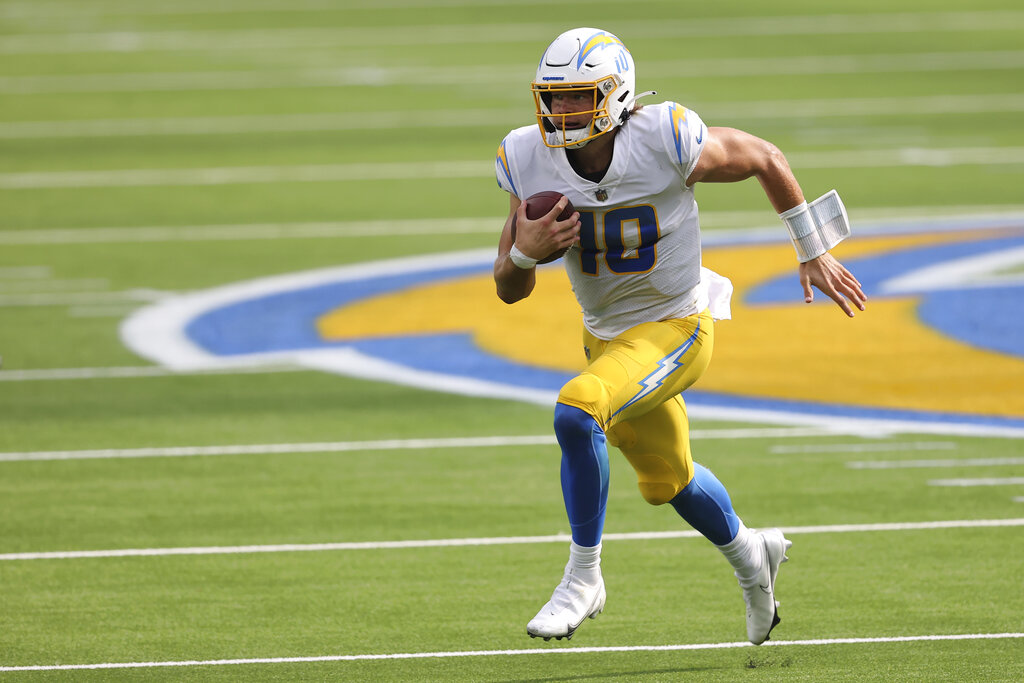 Los Angeles Chargers quarterback Justin Herbert (10) runs with the ball during an NFL football game against the Carolina Panthers, Sunday, Sept. 27, 2020, in Inglewood, Calif. (AP Photo/Peter Joneleit)
Close only counts in horseshoes and hand grenades, as the Chargers learned to their chagrin in 2024. Los Angeles’ pass attack was phenomenal last season … through the first 80 yards. Their DVOA of 39.4% ranked fourth in the league. Once they got to the red zone, however, and Justin Herbert and company suddenly ran out of gas. Inside the 20, their passing DVOA fell to -5.1% — 23rd in the league, and that 44.6% drop was the largest in the league by a significant margin. Only three teams scored fewer than Los Angeles’ 13 passing touchdowns in the red zone, and that’s how you get held to 17 points or fewer seven times.
Joshua Palmer had the lowest red zone DVOA of anyone in the league with at least 10 targets at -70.2%, with Will Dissly (-69.6%) and J.K. Dobbins (-38.4%) not far behind them. Ladd McConkey and Quentin Johnston were more serviceable, but neither is exactly a big-bodied short-yardage threat. Part of the planned solution for this was bringing Mike Williams back to win contested catches, now two years removed from his ACL tear, but he abruptly retired Thursday, leaving the Chargers somewhat in the lurch. That leaves new addition Tyler Conklin as their best new addition for close-quarters passing, and that’s less than ideal. Figuring out how to move the ball inside the red zone is going to be a major priority for Los Angeles going forward, and one they’ll need to solve if they want to make a playoff run.
Pittsburgh Steelers Go for the Complete Offensive Reset
Russell Wilson is in New York, keeping the seat warm until Jaxson Dart is ready to go. Najee Harris is a Charger, or at least he is at the moment while he remains in limbo after a fireworks-related eye injury. George Pickens is, at least for the moment, content to be a Dallas Cowboy. That makes the Steelers the 14th team in the DVOA era to lose their top passer, rusher and receiver from the year before – and only the second to do so after having a winning record, joining the 2002 Ravens.
How did those previous 13 teams fair? Not so well. They finished the next season with an average offensive DVOA of just -13.6% and a combined winning percentage of .364. The only team with a positive DVOA – and, for that matter, the only one to hit 10 wins? The 2006 Saints, thanks to bringing in Drew Brees. A soon-to-be 42-year-old Aaron Rodgers is not prime Drew Brees, but the Steelers also aren’t the typical team jettisoning their top triplets in one go, either. The previous teams in this situation had an average offensive DVOA of -14.3% the year before they lost everyone, while the Steelers were at a more robust -5.0%. A focus on building through the offensive line, a run-heavy game plan, and the addition of DK Metcalf gives Pittsburgh a solid chance for at least minimizing the damage on offense.