

Think there are already a lot of college football awards? Then it’s time to learn about one of the newer ones. The Pony Express Award, presented by the Pony Express Huddle Foundation, is in for a second year to honor the most outstanding tandem.
If Pony Express has particular meaning to you, it should. The award is founded by SMU’s legendary tandem of Eric Dickerson and Craig James. Dickerson ran for 3,000 yards in his last two years at SMU (1981-82). James contributed another 2,000 rushing yards those same two years.
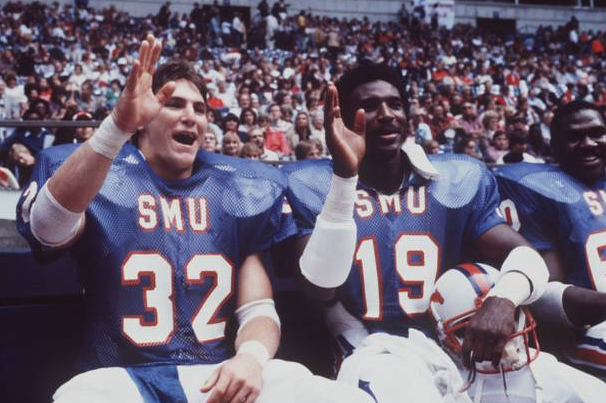 Photo courtesy: Pro Players Business Network
We met one-on-one with James at ACC media days in Charlotte this week, where he was in town to promote the award (Dickerson was busy in his new job with the Rams). He told Last Word that the award is intended to be unique in that it goes to a tandem, regardless of position. It can be a couple of defensive backs, a couple of linebackers, a pair of receivers, or even a couple of running backs. In 2024, the reinvention year of the award, Colorado quarterback Shedeur Sanders and receiver Travis Hunter won the award.
James told us that being part of a running back tandem was the impetus for the award. “We marveled that everyone wanted to talk not about us (as individuals) but the Pony Express. And it has stayed that way all these years,” he said. “It’s a ‘we’ award.”
One of the differences with this award is that a panel of current players will be the ones voting on the finalists and the ultimate winners. There is no watch list with pre-season favorites. The foundation hierarchy will start getting to a candidate list after week one and then start talking to current players. The formal vote comes at the end of the season.
The game has changed since the days of Dickerson and James. There are very few running back tandems in college football anymore. Thus, the idea is to merge different positions that complement each other into a tandem.
Still, James said, the fundamentals of a sound offense are the same for the high-end programs. “The spread initially came along for schools with inferior talent,” he said. “The teams that are great; the Ohio State, Georgia, Alabama, Penn State, Michigan, Texas- are all big and strong, and they can run the football. The game has not really changed the 19-whatever. You’ve got to run and block, and you’ve got to have big guys up front.”
Of course, no conversation with James is complete without a conversation of current-day NIL and the old Pony Express. If NIL and collectives were legal and allowed back in the day of James and Dickerson, the possibilities could have been financially endless. “Yeah, I think about it. Can you imagine how much money we would have made? He (Dickerson) would have had multiple gold Trans Ams,” he said with a full laugh.”
The Pony Express and SMU, of course, had their own version of NIL and collectives. It cost the school years of football after they got the NCAA death penalty in 1987. James said there is no comparison to what he and Dickerson got back in the mid-80s to what players can legally get now. “I was getting enough cash to go out to a Mexican restaurant after the game on a Saturday night,” James said when commenting on the hundreds of thousands of dollars, even millions, available to college athletes now.
He made it clear he does not begrudge the athletes their money now. “I think it’s totally appropriate. The schools have benefited all these years. This is good for them (the players).”