
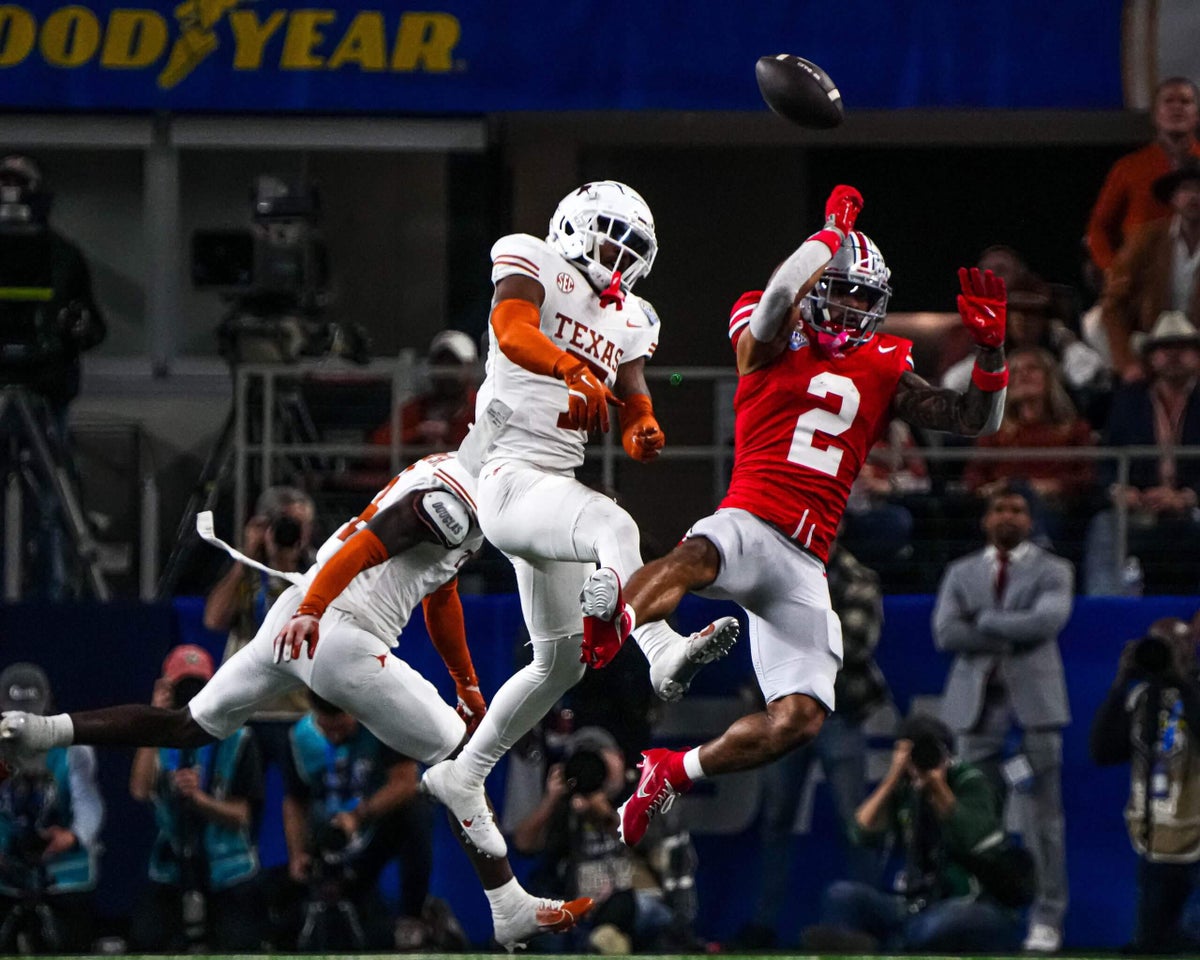
Given I’m spending part of this week at media days for the Big Ten, whose Las Vegas location makes about as much sense as its list of members, this felt like the right time to start pivoting the mailbag largely to on-field questions.
It didn’t quite work out that way, but at least it’s primarily split down the middle. Come for the discussion about possible 10th-place SEC teams, stay for a look at College Football Playoff formats and NIL.
(Note: Submitted questions have been edited for clarity and length.)
Which game in Week 1 or 2 has the most significant playoff implications? I’ll certainly be watching Texas and Ohio State, but that feels more like a game for seeding, rather than determining who is in or out. — Rob
Even as an expanded CFP proponent, I can acknowledge the stakes aren’t as high for those early-season mega-matchups. Not that I’ll enjoy them any less. However, it sounds like you’re talking about games where the two teams are both viable contenders, but without the same margin for error.
Notre Dame at Miami on Sunday night of Week 1 fits that bill.
Miami found out the hard way last year that 10-2 in the ACC is not good enough. The Canes finished No. 13 in the final CFP rankings, four spots below Mountain West champ Boise State and two spots behind 9-3 Alabama, even with the Tide’s bad losses to Vanderbilt and Oklahoma. Losing at home to start 0-1 would not help the Hurricanes’ cause.
Not to mention, Mario Cristobal’s program could use a validating non-conference win. The Canes thought they had that when they beat a ranked Texas A&M team early in the 2023 season, but those Aggies plummeted to 5-7 and got Jimbo Fisher fired. Notre Dame, coming off a trip to the national championship game, would be a whole different thing. Whereas if they lose, it’s the same old Miami.
As for the Irish, they’re always toeing a thinner line. A loss wouldn’t be fatal by any means, given they brushed off losing to NIU last year, but you never know what Notre Dame’s schedule strength will end up being. On paper, this may prove to be its toughest game. However, at least one or two teams from among Texas A&M (Week 2), at Arkansas (Week 3), Boise State (Week 4), USC (Week 5) or possibly at Pitt (Week 10) are likely to prove more challenging than expected.
The closer we get to the season, the higher I am on the Irish. Jeremiyah Love could be a superstar, and the defense is stacked at seemingly every position. However, a lot is riding on CJ Carr, whom we haven’t seen. If he’s not ready, this could easily go from a 12-0 or 11-1 team to more of a 9-3 team, and that’s not going to cut it.
Here are 10 SEC teams, listed alphabetically. By default, one of them will finish 10th or worse in the conference this year. Which team(s) do you think fall below that threshold from this group?
• Alabama
• Auburn
• Florida
• Georgia
• LSU
• Oklahoma
• Ole Miss
• Tennessee
• Texas
• Texas A&M
(Not listed: Arkansas, Kentucky, Mississippi State, Missouri, South Carolina, Vanderbilt) — Brian S.
I assume it will be more than one, given the unbalanced schedules, the hit-or-miss nature of the portal and that preseason conference polls always have at least a few whiffs.
First up would be Tennessee. It’s not just because of losing Nico Iamaleava, though that didn’t help. Appalachian State transfer Joey Agular should be decent if he picks up Josh Heupel’s offense. However, Dylan Sampson and James Pearce Jr. were so important to last year’s Vols, and their secondary suffered a lot of attrition. I could see them finishing below .500 in conference play.
Opinions seem to be all over the map on Ole Miss. You can tell Lane Kiffin is high on new QB Austin Simmons. However, Kiffin and his collective went all in on last year’s roster, particularly up front on defense, only to fall short of the CFP yet again. I see this being a rebuilding year.
And then there’s inevitably going to be one “I can’t believe I talked myself into this team.” Given how much space I’ve spent talking up Oklahoma this offseason, it could very well be the Sooners going 2-6 (again). Though not if John Mateer has anything to say about it.
What do you expect from Indiana? They have a much tougher conference schedule this season. On the other hand, they now have former Cal standout Fernando Mendoza as their quarterback (this Ducks fan wishes Oregon had given him a legit look). — Drex H.
There’s a tendency with these out-of-nowhere teams to assume they’ll come back to earth the following year, but that’s not always the case. A good example is Duke, which has gone 9-4, 8-5 and 9-4 over the past three seasons. The Blue Devils’ place in the ACC preseason poll the past three years: Last place in the former Coastal Division (RIP) in 2022, tied for sixth in 2023 and then back down to 11th in 2024 — behind Cal.
I would not discount Curt Cignetti’s second Indiana team. While it snuck up on me how highly regarded Mendoza is by NFL Draft guys, he had his moments at Cal, including a showcase night against Miami and a game-winning 98-yard drive against Stanford. And that was with an underwhelming supporting cast. IU brings back top-two receivers Elijah Sarratt and Omar Cooper Jr. and landed versatile Maryland running back Roman Hemby.
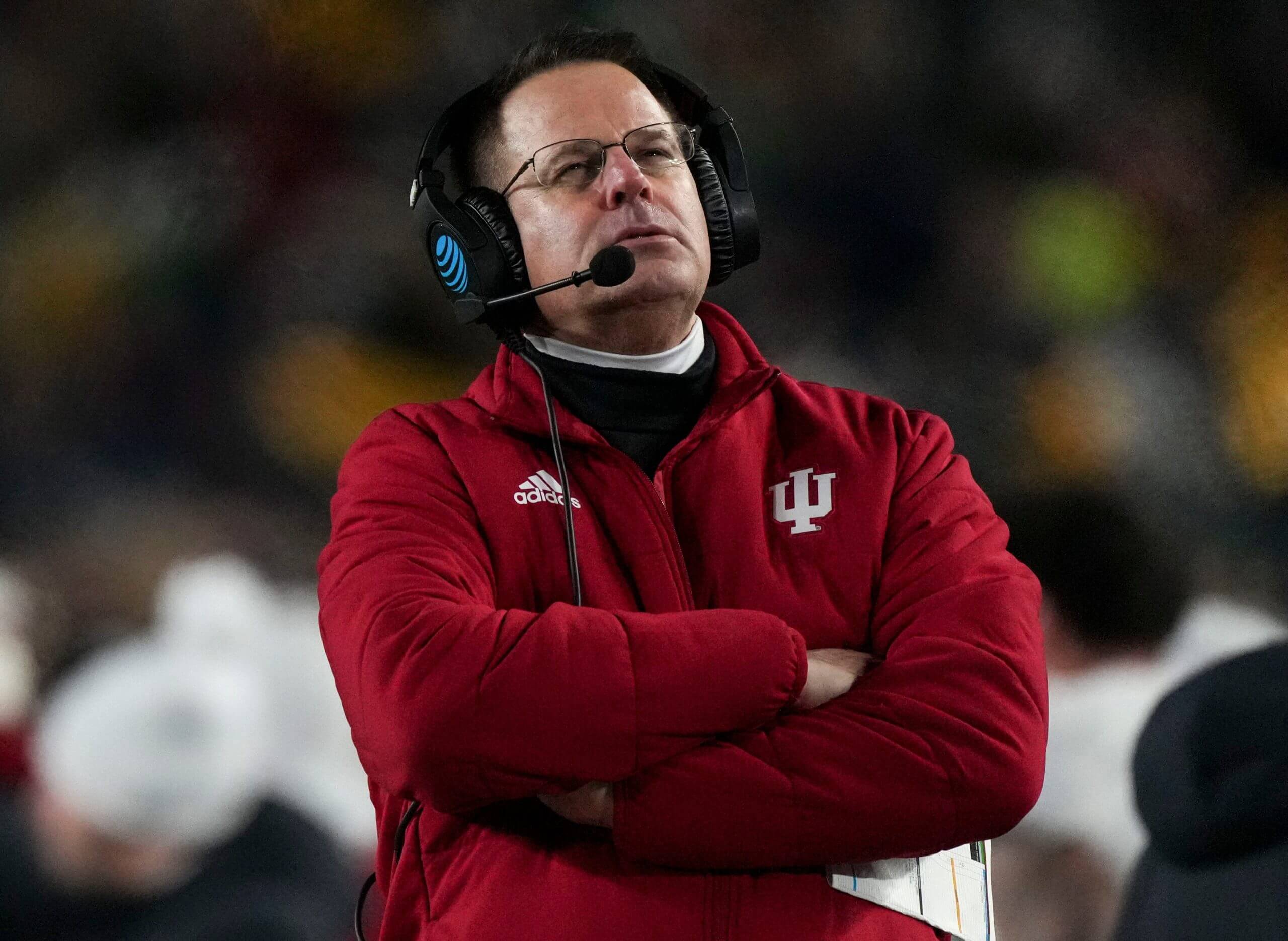
Curt Cignetti led Indiana to its best record since 1968 last season. (Christine Tannous / USA Today Network via Imagn Images)
And I’m guessing no one remembers the Hoosiers’ defense finished second nationally in yards per play per game (4.3). Three 2024 All-Americans, Mikail Kamara, linebacker Aiden Fisher and cornerback D’Angelo Ponds, are back.
However, I don’t want to minimize the schedule. Last year’s was quite possibly the weakest in Big Ten history, and while IU mostly beat up on the bottom-feeders, it lost to the three best teams it faced, Ohio State, Notre Dame and Michigan (the fact that last year’s Wolverines were the third best they faced says a lot). This year’s Hoosiers face Penn State, Oregon and Iowa on the road and a preseason top-20 Illinois team at home.
Indiana’s Vegas win total is 8.5. That’s a tough one. However, Cignetti is such a great coach that I’ll go ahead and sign on for 9-3, which, while a step down from 11-1, would still ensure the program’s second-best record since 1968.
Which Big 12 second act do you think is more likely to be a success: Scott Frost at UCF or Rich Rodriguez at West Virginia? — Kevin J.
You must have missed my coaching hire grades from this past cycle. I gave West Virginia my only “A” and UCF my only “D.” And I’m starting to wonder whether the Frost grade was too high.
If you missed Frost’s comments to Chris Vannini at Big 12 Media Days, the coach feels his 16-31 record at Nebraska was entirely the fault of Nebraska for being a “bad job” and not his for having no discernible offensive identity, inexcusable special teams play and failure to instill any confidence in his teams to win close games.
With Frost having learned nothing, I don’t know why anyone would expect his UCF sequel to be any different. This is a Big 12 job now, not an ACC – er, American – job. The week-in, week-out competition level will be closer to Nebraska’s than 2017 UCF’s.
Whereas Rodriguez has had two redemptive coaching jobs since bombing at Michigan, taking Arizona to its only Pac-12 championship game and leading Jacksonville State to a Conference USA title in just its second FBS season. West Virginia is in a much different place than it was 18 years ago.
I don’t expect a repeat of his three straight top 10 seasons from 2005-07. I also wouldn’t expect any instant returns in the first year. However, I fully expect him to have the Mountaineers in Big 12 championship contention within three years. Even if not, they will at least be far more entertaining.
Of all the active college coaches who were former players themselves, which one do you think would be the most helpful to their current team? They would be in their collegiate prime and cannot switch positions. — Daniel S.
You might assume I’d say Deion Sanders, but Colorado had the best two-way player since Deion just last year, so I don’t know whether he’d make the Buffs that much better.
The FBS answer is Bowling Green’s Eddie George. Can you imagine the 1995 Heisman winner, who ran for 1,826 yards and 23 touchdowns his senior year, going against MAC defenses? BG to the CFP!
However, the all-divisions answer is Norfolk State’s Michael Vick. Whatever the craziest stat line anyone has ever achieved for a player in NCAA Football, the 1999-2000 version of Vick would obliterate in the MEAC.
You are the commissioner of college football and your first assignment is to establish the Playoff. What would you do? A 30-team Playoff? 64? 2? Keep bowl games? Go to home games for the higher seeds? Anything goes … — Marty C.
I don’t know if it would fall under my purview, but the first thing I’d do is move up the regular season by a week so we can build a more sensible Playoff calendar. First-round games the weekend that is currently Army-Navy, quarterfinals the weekend before Christmas, semifinals on New Year’s Day and the championship a week after that, whether it falls on a Tuesday or a Saturday. No more competing with the NFL.
I’d keep the size at 12. No one who gets left out of that field has any right to complain because they don’t have much of a résumé. Plus, I like keeping first-round byes as an extra incentive on the last day of the regular season. However, they would likely go to the top-4 teams, regardless of conference, and those teams would get to host a quarterfinal game. No. 3 Texas playing its first game at the Peach Bowl last year was … something.
Which brings me to an idea I proposed a few years ago. First off, I will not apologize for giving the Rose Bowl special treatment. It will get its annual Jan. 1 date, which means it will always host a semifinal. The other five will each host one primetime semifinal and one championship game over the course of five years.
Finally, I am keeping bowls. I would love to see more bowl games, with a catch: We’re eliminating conference tie-ins. It’s going to be a circa 1979 free-market bonanza. If the Gator Bowl wants to pit 5-7 Auburn against 4-8 Florida State, knock yourself out.
I assume the Pop-Tarts Bowl will rise to the top of the non-CFP pecking order. I want to see Alabama players tearing into a giant strawberry Pop-Tart, ideally, right before SMU’s Playoff game.
Will Purdue be the first school in modern college sports history to return more starters from the men’s basketball team (four) than the football team (one) this upcoming school year? — Dan K.
There’s no way to answer this definitively, but I did do three minutes of research. I knew Jedd Fisch’s first Washington football roster had just two returning starters. It turns out that the basketball team, which had also undergone a coaching change, had one as well.
So, Purdue it is.
If you were playing Washington State’s and Oregon State’s hands from the beginning, what would you have done differently? It appears they have cemented their status as programs that will have little to no national relevance. It seems odd that they wouldn’t have done home-and-homes with as many old Pac-12 teams as possible and any brand that would bring eyes to the TV. — Themanebro
You make it seem like a school can snap its fingers and conjure up six home-and-homes on very little notice. Most schools lock in their non-conference contracts years in advance. The Pac-12 imploded in August 2023, and schools had to create schedules from scratch for 2024 and 2025. I don’t think they would have had a season in 2024 without the Mountain West’s lifeline.
As for this year, Oregon State’s 2025 schedule is frankly remarkable. It has five Power 4 games, plus the two Wazzu games. The Cal, Houston, and Wake Forest home-and-homes all came together after the Pac-12 mess. Washington State is less impressive, though it did land a one-off game at Ole Miss and has Washington coming to Pullman.
A more interesting question is this. The two schools were determined from the beginning to keep the Pac-12 alive and refused to lower themselves by joining the Mountain West. In the end, though, they formed Mountain West 2.0, with nowhere near the revenue they’d hoped to generate.
Would they have been better off just keeping football independent?
Oregon State will go from five Power 4 games this year to, at most, three next year (Houston, Texas Tech, and hopefully Oregon, though that has not yet been agreed upon). Boise State is always an attention-grabbing opponent, but at least half the schedule will consist of former MWC schools and Montana. With three years’ notice, they could have come up with a more impressive independent schedule. I’m not sure if the financials would have worked.
I’ve been busy and haven’t followed the drip, drip, drip of the offseason. Have I missed anything? — John C.
Yes, but I can give you the CliffNotes: Everybody is mad about everything.
(Top photo: Aaron E. Martinez / USA Today Network via Imagn Images)