
The Denver Broncos are a better team now than they were just a week ago before their 2025 NFL Draft endeavors.
It will be several seasons of on the field play to determine how this class stacks up compared to others around the league. In our post-draft instant reaction grade segment, I have given them a C- grade for their efforts. Though I’m certainly not a fan of draft grades, that low mark might have been a bit reactionary and too harsh.
After a week of thinking it over, I thought would be apt to give a better in-depth analysis on the Broncos’ efforts in this year’s draft.
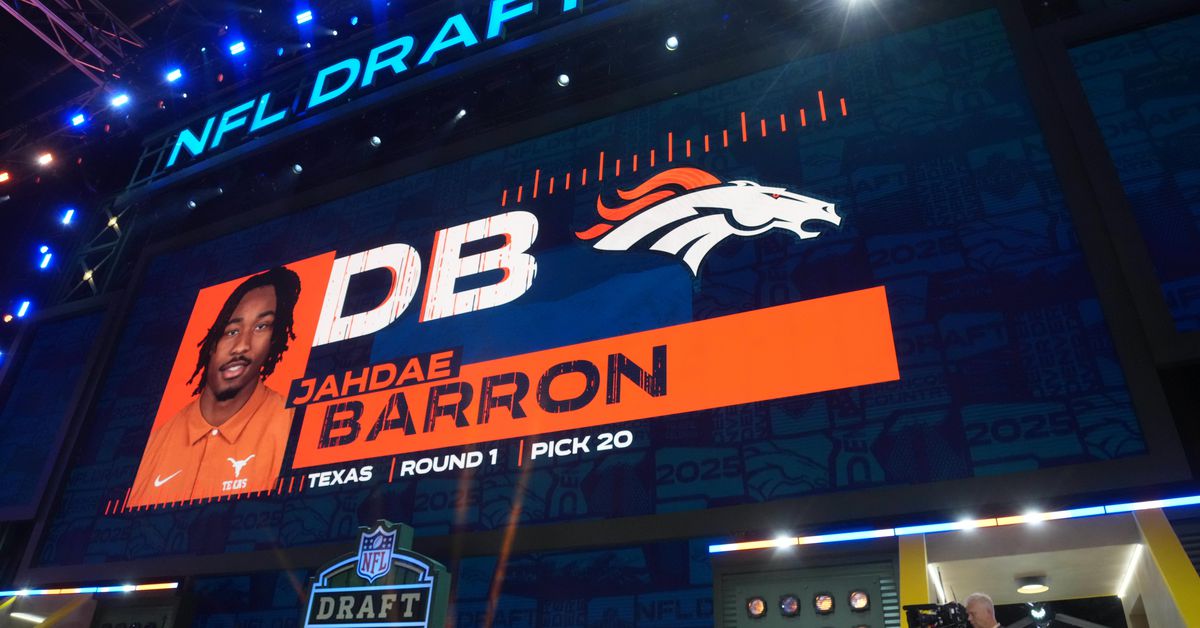
Jahdae Barron was a homerun pick in the first round
When I released by Broncos’ defensive prospect rankings, I had Texas standout Jahdae Barron as my second-ranked defensive back in this year’s class. I felt the Jim Thorpe Award winner was easily a Top 12 talent overall and was shocked that he was available when Denver was on the clock.
Addressing the secondary early wasn’t something I predicted the Broncos would do. And quite frankly, I’m not sure that would have been the case had Barron, a top 10 player on Denver’s board, been off the board. Had that been the case, the way things played out for the Broncos in the draft certainly would have been much different. Nevertheless, the Barron selection is easily my favorite by the Broncos for a few reasons.
First and foremost, it was incredible value. While I would have loved a trade down to acquire more picks—if you can get a blue-chip prospect in the latter portion of the first round—you don’t pass up that opportunity.
Jahdae Barron film breakdown.
One of my favorite players in this draft class. Ball skills, position flexibility, toughness, high motor, a willing tackler. Broncos got a complete football player in this young man. pic.twitter.com/8WTo4bjf3E
— Kevin Smith (@KTSmithFFSN) May 3, 2025
Additionally, Barron’s ability to play all over the Broncos’ secondary will give Defensive Coordinator Vance Joseph a lot of flexibility in how he calls coverages next season. While many across Broncos Country were hoping for a ‘joker’ on offense, the franchise’s first pick in this year’s draft is precisely that on defense. Whether it’s on the boundary, in the slot, or as an in-box safety, Barron’s positional versatility is a boon for the Broncos’ defense.
It’s just not a great selection in the short-term, it’s also a quality selection with long-term vision at play. The Broncos have a great core of talent on the defensive side of the ball, but they simply won’t be able to retain everyone. Prime defensive backs receive a lot of money on the open market.
If Riley Moss continues to grow and develop, a scenario exists where he could earn a lot of money in free agency after the 2026 season. With the Broncos already shelling out a top tier contract for Patrick Surtain II, having five years of cost control on a defensive back gives the franchise necessary salary cap flexibility in future seasons. That’s just another major reason why I think Barron was a fantastic pick for Denver.
Re-assessing RJ Harvey’s selection in the second round
This year’s running back class was one of the deepest in recent memory. I thought we would have seen as many as ten backs off the board by the end of Day 2. However, only six were selected. The Broncos made RJ Harvey the fifth back taken when he was their pick with the sixtieth selection.
Harvey wasn’t in my top ten running backs in this year’s class. Based on his age, prior ACL injury and fumble concerns, I had him as an early Day 3 selection with a fourth-round grade. I strongly preferred Iowa prospect Kaleb Johnson, who was my third-ranked back, but he tumbled down into the third-round and was eventually snagged by the Pittsburgh Steelers.
Head Coach Sean Payton and General George Paton obviously felt differently than I did on Harvey’s pro potential. Moreover, so did the Jacksonville Jaguars, who were poised to take him in the early third round if he was on the board. By taking him in the second round, it’s a clear vote of confidence from the Broncos’ brass that they believe he has what it takes to be an immediate contributor and focal point in the team’s offensive plans in ‘25.
As I wrote throughout the pre-draft process, finding a back who excels on zone concepts would provide a significant boost to their rushing attack. Sporting quality vision and extensive experience on zone principles, Harvey provides exactly that for the Broncos. On top of that, his contact balance and production were top-notch. Quite simply, he made a lot of plays in college and certainly will get a chance to showcase those abilities as a rookie. All things considered, he’s a great fit for what Payton and the offense are trying to accomplish and improve upon from last season.
With Javonte Williams heading to the Dallas Cowboys in free agency, the lead back position is open in the Mile High City. It’s a camp battle I think the UCF standout to win quite easily over the rest of the field. It’s too early to outline expectations for players at this juncture, but I have no doubt Harvey can come in and replace Williams’ volume from last season and be far more productive.
“If (Jeanty) is unrealistic…. where are we falling in love with somebody… I can remember the afternoon and spending two hours” watching RJ Harvey.
“And then it was like, ‘okay, be quiet'”
Sean Payton on his 2nd round RB pic.twitter.com/526OrZtzjT
— Josh Norris (@JoshNorris) April 26, 2025
Adding Sai’vion Jones and Que Robinson were sound football decisions
The Broncos certainly needed to add a developmental prospect to their defensive line. Their starting four rotation excelled in 2024, but three of those players are set to hit the market at the end of the team’s 2025 campaign. That’s why moving up to secure Sai’vion Jones at the end of the third round was my second favorite move of the draft.
Broncos’ defensive line coach Jamar Cain was with the LSU Tigers several seasons ago with Jones, so the team definitely had some inside information on him. Sporting an impressive size and the traits you can’t teach, Jones has the potential to grow into a starter as soon as the 2026 season. But for now, he certainly has the opportunity to get some decent developmental snaps (25-percent) as a rookie and help alleviate the enormous snap count Zach Allen had last year.
Where I think he can make the most difference is adding pressure from the interior. He shines in that regard going against interior offensive lineman and is a good fit for Joseph’s aggressive one-gapping scheme. I’m anxious to see how he translates in that matter from the college to pros. He had a lot of hurries the past two years of college rushing from the interior and I’m confident that trend will continue in his NFL journey.
The Broncos also have a good core four at edge with Jonathon Cooper, Nik Bonitto, and Jonah Elliss and Dondrea Tillman. But adding a fifth player into the mix with great physical traits and extensive special teams’ experience was a good move for Denver. His production numbers don’t pop off on the stat sheet, but it’s important to keep in mind he missed half of last season after an elbow injury and was playing behind several first-round EDGE rushers in his time at the University of Alabama.
His immediate impact for the Broncos won’t come in defensive snaps but on special teams. Former Crimson Tide Head Coach Nick Saban lauded Robinson’s ability in that regard. While some fans might have been hoping for a prospect with more immediate impact at a position of need, you can’t undervalue the importance of special teams. A player’s ability in that respect is one of the biggest determining factors on whether or not they are able to stick around in the National Football League for longer than the duration of their rookie contract.
Final thoughts and tidbits on the Broncos’ 2025 Draft class
Overall, I’m a bit more optimistic about the Broncos’ draft than I originally was. With their first two picks, they came away with prospects who are poised to make an immediate impact on each side of the ball. If all goes as planned, both Barron and Harvey should prove to be immediate upgrades this coming season and propel each unit to greater success.
I didn’t touch on the Pat Bryant selection in further detail, but I did have him mocked to us in the fifth-round. His fit in Payton’s offense was clear and they certainly were higher on him than the consensus. Payton has a pretty good track record when it comes to drafting wide receivers and Bryant has the mindset and traits to eventually be a quality player for the team’s aerial attack.
Their picks outside of the Top 100, the Broncos bolstered their special teams with Robinson and punter Jeremy Crashaw. Utah’s Caleb Lohner is the ultimate wild card pick. The traits are intriguing, but the experience isn’t there and he’s a longshot to make the roster. But if there is a coach in the NFL who could get the most out of him and help him develop, it’s certainly Payton. Though it’s just a pick at the end of the draft, so there’s not too much to complain about.
My major concern from this draft is the Broncos only coming away with three selections on Day 3. There were a good number of players I had ranked quite highly that were available through rounds four and seven. Each and every year, we see prospects that fall who come in and make waves as rookies.
With just a late fourth, sixth, and seventh round pick—the Broncos weren’t really in a position to do much on the draft’s final day. In prior trade backs earlier in the draft, they better positioned themselves on Day 2, though I was hoping Paton could have parlayed their higher third-round selection into more choices to help address other needs. When you gloss over some of the Day 3 hauls from other teams in the league, it does seem the Broncos did miss out on quite a bit of talent.
Only time will tell how the team’s 2025 draft class turns out. Hopefully a few years down the road we’ll get to say, “Yeah. They did better than we may have originally thought.”