
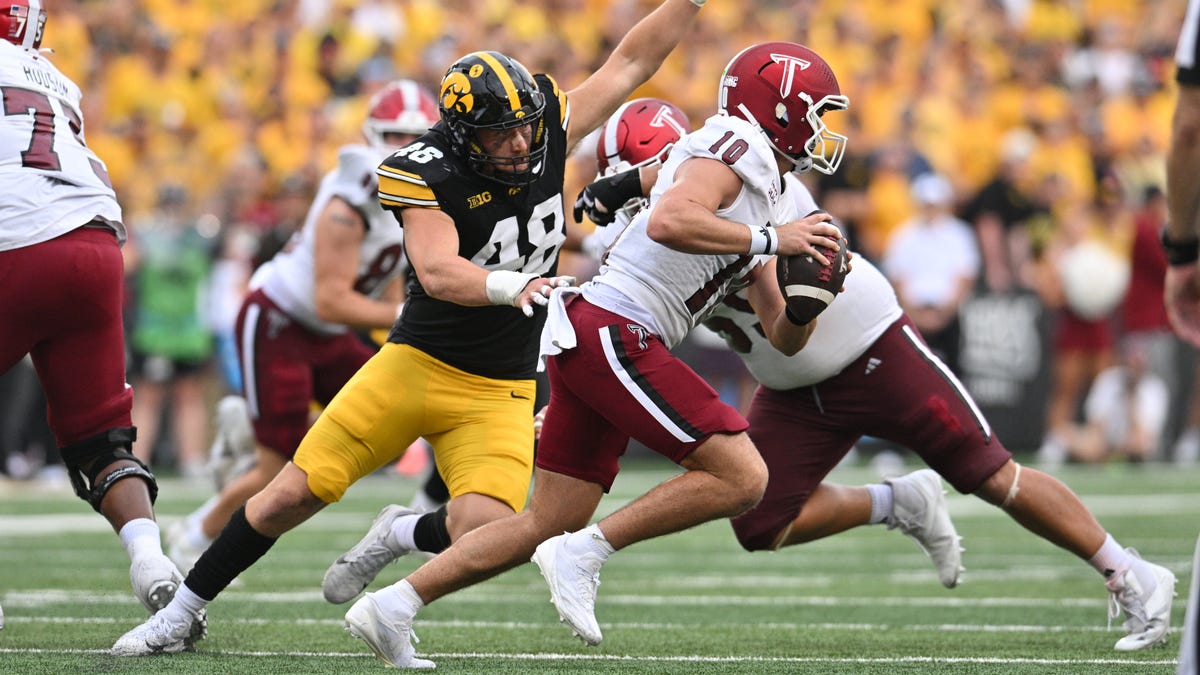
Love to see Gabe Jacas, David Bailey, LT Overton and Max Llewellyn mentioned on this pod! Llewellyn in particular kept catching my eye last season at Iowa. Has a wicked spin move, high effort/motor and had a 21% pass rush win rate per PFF. https://t.co/u8whViGQMi pic.twitter.com/zaOpdY9eTL
— Devin Jackson (@RealD_Jackson) July 4, 2025
The Kansas City Chiefs have one of the best collections of power rushers in the NFL. It’s time for the team to diversify some of the body types in its defensive end room. Several 2026 NFL draft prospects, including Texas Tech’s David Bailey, Iowa’s Max Llewellyn and Oklahoma’s R Mason Thomas, offer the explosiveness to electrify Kansas City’s pass rush.
Llewellyn is a quick pass rusher with the immediate burst to stress offensive tackles vertically. Many offensive linemen break out of their usual pass set form and chase or overextend to match Llewellyn’s speed. This leaves the linemen off balance and vulnerable to counters or line games.
Llewellyn sets offensive tackles up with his speed rush early in games before attacking the B-gap later on. He’s a fluid athlete who counters inside without sacrificing any momentum. While he sometimes attacks the B-gap with a speed rush off the line, he also works across the offensive tackle’s face mid-play when he feels his outside rush won’t get home.
Llewellyn’s pass rush plan includes chops, club-swims, long-arms, rips, swipe-rips, two-handed swipes and one of the best spin moves in the class. Llewellyn has mastered every element of the spin. He sets up offensive linemen for his best move with long strides that force them to overset, creating room in the B-gap for an inside spin. He also uses head fakes and some hip movement to manipulate the offensive tackle’s leverage.
It might sound like Llewellyn’s pass rush plan is complete, but it’s still a developmental part of his game. He relies too much on his spin move. He posts several wins per game with the spin, but offensive linemen eventually adjust and counter its effectiveness. Once this happens, Llewellyn doesn’t have other polished, NFL-caliber moves that he feels comfortable deploying.
Llewellyn currently projects as a late top 100 selection but could elevate into the second round if he refines his pass rush plan and unlocks his bend more often. He shows flashes of playing low to flatten his rush angle and beat the offensive tackle around their outside shoulder. However, his high pad level makes it difficult for him to bend around the corner consistently.
Llewellyn’s value in run defense is questionable, at best. He shows good effort but lacks the mass to anchor at the point of attack. Iowa doesn’t play him in goal line situations because he lacks the play strength to consistently stack blocks and pinch run lanes. These concerns make Llewellyn a candidate to serve as a designated pass rusher early in his career.