
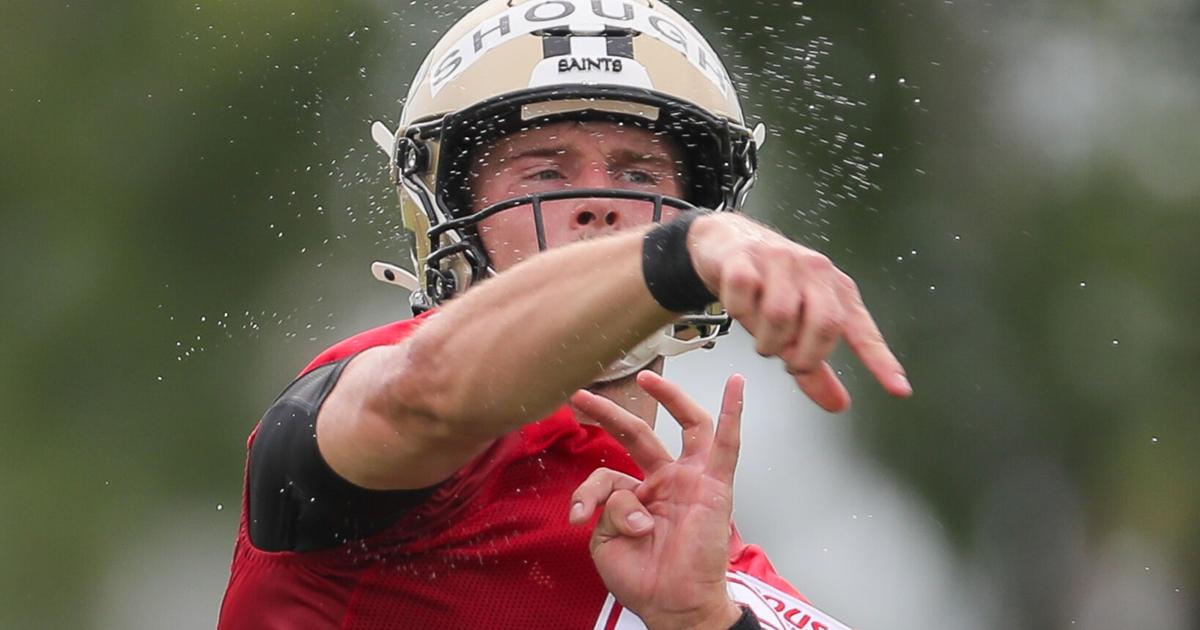
The New Orleans Saints opened training camp Wednesday in Metairie, preparing for a season that will largely transpire inside the climate-controlled Caesars Superdome. But first, they have to endure playing in a different kind of dome.
A massive heat dome — a high-pressure system that traps hot air near the ground — has settled over much of the United States, pushing temperatures into dangerous territory from Texas and the Midwest to the Northeast. In Louisiana, that dome is helping to drive heat index values as high as 114 degrees, with the National Weather Service warning that heat illness “can occur quickly” without precautions.

New Orleans Saints wide receiver Kevin Austin Jr. (81) cools off after the opening first day of training camp in Metairie, Wednesday, July 23, 2025. (Staff photo by David Grunfeld, The Times-Picayune)
STAFF PHOTO BY DAVID GRUNFELD
Louisiana recorded 51 heat-related deaths last year and 88 in 2023, according to the Louisiana Department of Health. So far this year, five people have died and nearly 1,900 have visited an emergency room for heat-related illnesses.
Keeping football players cool during the sweltering days of training camp is critical, and the strategies they use can be adapted for anyone spending time outdoors, especially those most at risk: young children, the elderly, people on certain medications or with underlying medical conditions, and those who work outside.
Saints strategies
Saints staff closely monitor the heat index (“feels like” temperature), humidity, sun angle and a measurement called “wet bulb globe temperature” to determine how long outdoor practice is safe. Sometimes, that might look like 15- or 30-minute stretches.
“We start practice inside for a walk-through or stretch, then shrink the time we’re exposed outside,” said Ted Rath, director of sports performance for the NFL team.
New Orleans Saints wide receiver Cedrick Wilson Jr. (11) and New Orleans Saints running back Alvin Kamara (41) cool off in the cooling trailer during the opening first day of training camp in Metairie, Wednesday, July 23, 2025. (Staff photo by David Grunfeld, The Times-Picayune)
STAFF PHOTO BY DAVID GRUNFELD
During practice, players rotate through two large air-conditioned tents and a “cooling box,” which Rath said can be chilled to as low as 35 degrees. Even a few minutes in these spaces can help reduce players’ core body temperature before they return to the field.
For people without personal walk-in freezers, cooling down might look like stepping inside a gas station or sitting in your air-conditioned vehicle for a few minutes, said Rath.
Beyond AC, the Saints use a variety of tools to cool the body quickly. Rath recommends a method backed by Stanford research: palm cooling. Professional football players use glove-like devices to rapidly cool the blood in their palms, which lowers core temperature.
New Orleans Saints fans are misted and shaded while watching the opening first day of training camp in Metairie, Wednesday, July 23, 2025. (Staff photo by David Grunfeld, The Times-Picayune)
STAFF PHOTO BY DAVID GRUNFELD
For those without high-tech gear, Rath suggests a low-cost version: “Throw a couple water bottles in the freezer,” he said. When you start to heat up, holding the cold bottles in your palms can offer a quick cool down.
Other simple tactics, like placing cold towels on the neck or keeping a cloth handy to wipe away sweat, help to maintain the body’s natural cooling process.
Wearing lightweight, light-colored and loose-fitting clothing also helps sweat evaporate and heat escape. Hats offer protection but can trap heat; removing them during breaks like players remove their helmets helps release body heat more quickly.
‘Cooking your internal organs’
Heat exhaustion and heat stroke can escalate quickly, especially when humidity interferes with the body’s ability to sweat and cool itself, said Dr. Gregory Stewart, team physician for Tulane Athletics.
“You’re already getting hot. Now you’re getting dehydrated on top of that,” Stewart said. The humidity in Louisiana makes it difficult for sweat to evaporate, leaving the body with fewer ways to release heat.
As dehydration progresses, Stewart explained, fluid shifts inside the body. Swelling in the hands and feet is common. So are cramps and lightheadedness, the early signs of heat exhaustion. In severe cases, when the body can no longer compensate, core temperatures can spike to dangerous levels, “essentially cooking some of your internal organs,” he said.
New Orleans Saints quarterback Jake Haener (3) takes a picture with fans during the Saints training camp in Metairie on Wednesday, July 23, 2025. (Staff photo by Brett Duke, The Times-Picayune)
STAFF PHOTO BY BRETT DUKE
Heat illness typically develops in stages. The earliest is heat cramps, which are painful muscle spasms in the legs or abdomen caused by the loss of fluids and electrolytes through sweating. That can progress to heat exhaustion, marked by fatigue, dizziness, nausea and heavy sweating. If not addressed, heat exhaustion can lead to heat stroke, a medical emergency defined by confusion, loss of consciousness and a core body temperature above 104 degrees.
Act early
At University Medical Center, emergency physician Dr. Peter DeBlieux sees the consequences of waiting too long to cool down. The escalation from heat exhaustion to heat stroke can take “nanoseconds,” he said.
DeBlieux urges immediate action by removing the person from the direct heat, getting them cool liquids and cooling them down through airflow and evaporation. The most effective approach, he said, is brushing the skin with cool towels and then fanning it, creating an artificial sweat mechanism.
Inside the hospital, doctors use cooling blankets, misting fans and specialized IVs that chill the blood directly. But outside the ER, basic steps like rest, shade, airflow and misting are what make the difference.
He also advises people to monitor hydration by watching their urine. “If you can’t force yourself to go urinate every two hours, you’re not drinking enough,” he said. “Your urine should be light yellow — like watered-down lemonade.”
Sugary, caffeinated, or alcoholic drinks can worsen dehydration because they increase urine output.
Who’s most at risk?
It’s difficult to pinpoint an exact temperature that can become dangerous, because heat affects people differently and risk depends on activity, environment and overall health.
A NFL football and sweat during the opening first day of training camp in Metairie, Wednesday, July 23, 2025. (Staff photo by David Grunfeld, The Times-Picayune)
STAFF PHOTO BY DAVID GRUNFELD
DeBlieux said those at greatest risk are the very young and the very old, those with heart conditions, people who use alcohol or drugs, and anyone taking medications that affect hydration or thermoregulation, including diuretics, beta blockers, psychiatric medications and stimulants.
Even a heat index in the 80s can be dangerous in the wrong conditions, said DeBlieux.
Acclimating to extreme heat also takes time. A player coming from a dry, high-altitude climate like Utah needs more time to adapt than someone who’s already used to Gulf Coast conditions, Stewart said. The same goes for high school band members, athletes or young children starting summer programs after months spent mostly indoors.
The first week to 10 days is the most critical. Tulane players begin with minimal gear and gradually build up to full pads as their bodies adjust.
Even pro athletes with medical teams and cooling tents can get “borderline” to overheating, Rath said. Telling a family member or friend your plans to be outdoors in hot weather can be a simple but important precaution.
“It’s a team effort,” Rath said.