
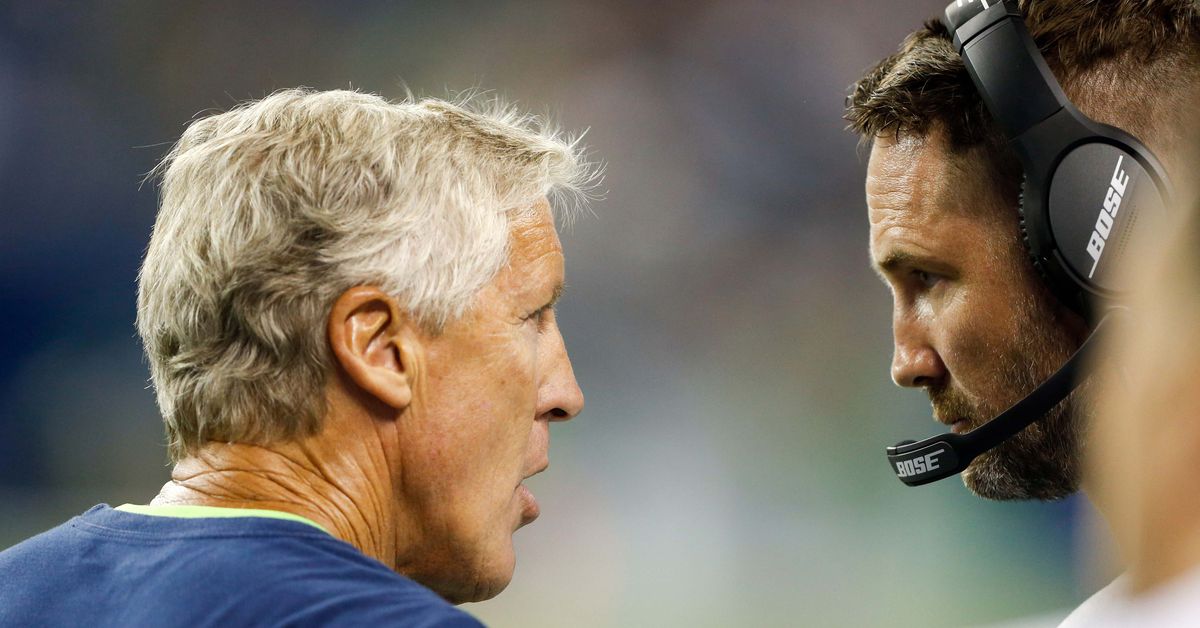
Brian Schottenheimer may not have been there for the Seahawks’ peak, but he saw what a championship culture looks like. By the time Schottenheimer arrived in Seattle following the 2017 season, the Seahawks had already won a Super Bowl after appearing in the big game two straight years. They had also just missed the playoffs for the first time in six seasons, and were looking for a bit of a reset, hence Schottenheimer’s hire.
It was a strange time in Seattle. Pete Carroll had quickly turned the organization around after posting losing records his first two years, winning it all by Year 4. He did it with a combination of fundamentally sound schemes, strong personalities with a knack for leadership, and a collective chip on the shoulder.
As hard as it is to win in the NFL, though, handling success can also be just as much of a challenge. And the Seahawks team that Schottenheimer joined was experiencing that.
Marshawn Lynch – one of the bigger personalities and leaders in that locker room – had retired two years prior. Defensive lynchpins like Kam Chancellor, Richard Sherman, and Cliff Avril had all ended 2017 on the injured reserve; Avril and Chancellor never played again, while Sherman left in free agency that offseason. And Russell Wilson was entering the final year of his contract, eyeing a significant pay raise.
So much of the Seahawks’ success had been built on their identity of being the underdog – a third-round pick at quarterback, a handful of Day 3 picks on defense, lacking any bona fide star power – that becoming a perennial Super Bowl favorite and having their best players all making top-of-market money made it harder to retain that culture.
In some ways, Schottenheimer finds himself entering a similar situation in Dallas.
Over the past decade, only seven teams have a higher win percentage than the Cowboys. They don’t win in the playoffs, but they usually make the postseason, and are frequently closer to the top than the bottom in Super Bowl odds every year. Dak Prescott is the highest paid player in the league, while CeeDee Lamb is third in annual average salary for receivers; it’s only a matter of time until Micah Parsons is the highest paid defender, if not highest paid non-quarterback.
Schottenheimer, like Carroll after the 2017 season, is trying to figure out how to field a team that plays with an edge – with something to prove – every game when their best players are already getting paid (and talked about) like they’ve already proved themselves.
Similar to the Seahawks when Schottenheimer arrived, the answer is a mix of continuity and change.
Carroll made changes after the 2017 season, firing both offensive coordinator Darrell Bevell and defensive coordinator Kris Richard. Schottenheimer came in to run the offense, and Ken Norton Jr. – who had coached Seahawks linebackers before departing to coordinate the Raiders defense – replaced Richard. Each coach brought tweaks, not massive overhauls, to the schemes while Carroll kept the same overall philosophy intact.
How did it work out? Well, Seattle went to the playoffs each of the next three years despite the Rams and 49ers both rounding into form as divisional foes during that time. Yet postseason success eluded the Seahawks each time, with Schottenheimer’s first season ending at the hands of the Cowboys.
Schottenheimer now takes over a Cowboys squad that he was part of for the past three seasons, during which he reached the postseason twice. The first time head coach has spoken about not looking to completely reset the culture, but rather build upon it with some slightly different approaches from what Mike McCarthy – a longtime friend of Schottenheimer’s – did.
So far, the Cowboys’ moves appear to be quite similar to the way Carroll – who Schottenheimer has spoken glowingly about, and who the Cowboys were once interested in interviewing – built things in Seattle. Most notably, Schottenheimer has thus far focused on the three tenets of sound schemes, strong personalities with a knack for leadership, and a collective chip on the shoulder.
Sound schemes
Schottenheimer will call plays on offense, doing so for the first time since his three-year run in Seattle, but he’s brought in Cardinals offensive line coach Klayton Adams as his coordinator. Both have talked about a commitment to the run game as a means to lighten the load on Prescott.
That’s very similar to Carroll’s approach on offense, with the newly-minted Raiders head coach often talking about his quarterback being a point guard that facilitates the offense rather than shouldering the load every game. That doesn’t always mean ground-and-pound – Seattle actually threw the ball 51.4% of the time on early downs throughout Carroll’s tenure – but it does reflect the value of a reliable run game.
Defensively, the Cowboys bring back Matt Eberflus, whose roots are in the Tampa 2 scheme. Carroll’s Legion of Boom defense was, in many ways, an extraction of that same school of thought. Those philosophical worlds collided when Eberflus became the Bears head coach and he hired Andre Curtis – who worked under Carroll for seven seasons – to coach his defensive backs; Curtis is now in Dallas as the pass game coordinator under Eberflus.
None of this is to say that the 2025 Cowboys are going to run the same exact schemes as the 2018 Seahawks – that seems unlikely – but the philosophy that forms those schemes appears to be very much in the same vein.
Leaders
Schottenheimer inherited a roster already filled with leaders. Prescott has always been praised for that aspect, and Lamb grew significantly as a leader this past season. Parsons has drawn criticism in this area in the past, but between his online retorts to the departed DeMarcus Lawrence and his decision to – for the first time – show up to voluntary OTA’s, it appears that Parsons is ready to assume his place as the leader on defense.
Then came the draft.
Time after time, the Cowboys drafted players who had been team captains on their college team. The subsequent interviews with each player backed up the presence that these newest additions bring. It’s clearly been a priority to find players with a strong leadership presence.
A chip on the shoulder
The final piece of the puzzle can’t really be proven until games start, but it’s been a stated priority by this whole staff. Schottenheimer spoke often in his introductory press conference, and several times since then, about turning the Cowboys into bullies, especially in the trenches.
It’s no coincidence that five of the team’s nine draft picks came in the trenches, either. First-round pick Tyler Booker spoke about seeing his opponents lose their love for the game when matched up against him; their final pick, Tommy Akingbesote, described his play style as “violent” and “physical at the point of attack” prior to the draft.
Both Adams and Eberflus, as well as several other coaches on Schottenheimer’s inaugural staff, have echoed similar sentiments. There is a shared goal on this team right now of playing with that collective chip on the shoulder, constantly trying to prove themselves against the opponent.
Of course, it’s one thing to talk about that and an entirely different thing to translate it to the field come Sundays. For now, though, it’s evident who Schottenheimer is looking to emulate as he tries to turn the Cowboys around.