

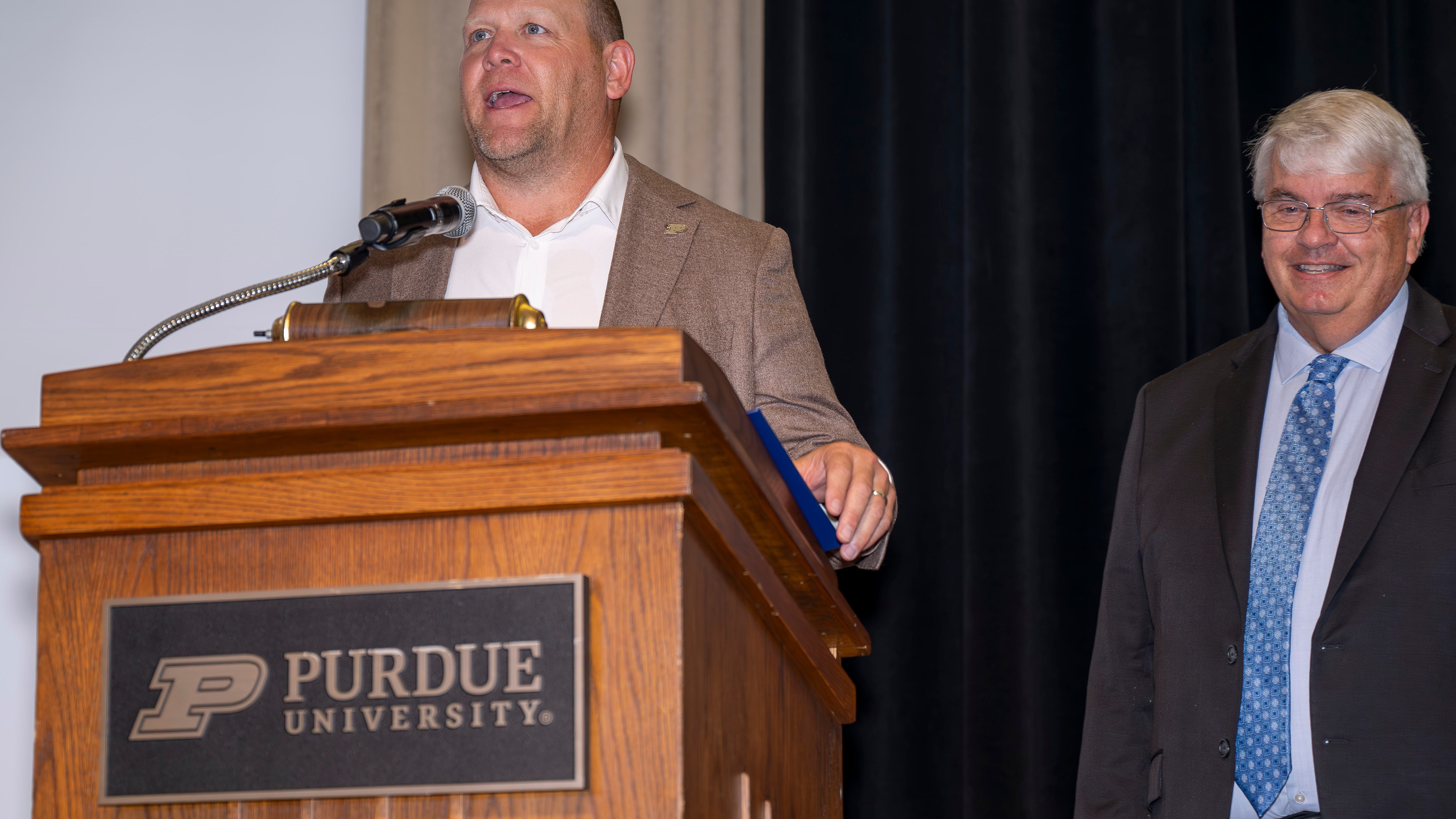

Purdue football coach Barry Odom discusses non-conference scheduling
A lot of talk at Big Ten Media Days in Las Vegas has centered around non-conference scheduling. Purdue coach Barry Odom provided his philosophy.
This week, college football’s time-honored tradition of talking season continued with the Big Ten and ACC staging their media days.
At both events, however, it was another conference that wedged its way into news conferences and media breakout sessions.
When not gushing about their own teams or touting their own conferences, several coaches turned their gaze to the SEC.
SMU’s Rhett Lashlee described the league as “top-heavy” and said it lacked depth, pointing to how only six teams have won the league since 1964 (technically, it’s seven). Hours later, when asked about his team canceling a home-and-home series with Virginia, Indiana’s Curt Cignetti took a jab at the SEC, claiming the Hoosiers were simply adopting an “SEC scheduling philosophy” by putting Group of Five and FCS opponents on their slate.
It wasn’t all quite so inflammatory.
Big Ten commissioner Tony Petitti presented a vision for College Football Playoff expansion that differed from SEC commissioner Greg Sankey’s preferred model. Penn State’s James Franklin, a former SEC head coach, critiqued the scheduling disparity between leagues like the Big Ten, with nine conference games, and the SEC, with eight, noting that “everybody should be playing the same number of conference games.” Washington’s Jedd Fisch went one step further, taking aim at much of the SEC staging late-season games against FCS foes.
“The NFL doesn’t play the CFL in the middle of the season,” he said on July 23 at Big Ten media days.
At least some of this verbal jostling can be attributed to the modern age of college football, when remade conferences fight for perceived superiority in an attempt to claim as many spots as they can in the 12-team playoff. And as long as there’s a debate over how the playoff should change, if at all, the SEC and Big Ten are going to be at the center of it.
Part of this chatter, however, is unique to the SEC.
Over the years, the conference has made itself an easy target for scorn. It dominated on the field, winning 13 of a possible 17 national championships from 2006-22. Its fans famously chanted the league’s name, igniting a noxious trend of college sports diehards pulling for their conference almost as fervently as their own team. For years, the league has rallied behind the slogan of “It just means more.” For as much as coaches and administrators from other leagues referenced the SEC at media days, it wasn’t as if Sankey didn’t puff his chest out about his league a week earlier.
While the conference was largely beyond criticism when its teams were winning title after title, that’s not the case now, making it more vulnerable to these kinds of broadsides.
For the second consecutive season, the SEC not only failed to produce the national champion, but it didn’t even have one of its teams make the title game, the first time that had occurred in nearly 20 years. It sent three teams to the inaugural 12-team College Football Playoff, one fewer than the Big Ten and only one more than the ACC. By the cartoonishly lofty standards it has created for itself for most of this century, SEC football’s in a bit of a rut.
That doesn’t mean everything lobbed in its direction was completely fair.
Lashlee’s comments were met with pushback — including from Paul Finebaum, who described them as “comical” and “embarrassing” — with some questioning why he felt the need to politic when his SMU squad earned a playoff at-large berth last year over three SEC teams, all of which had flimsier resumes than the Mustangs. Cignetti’s remarks were also picked apart, especially when Indiana’s about to go a second-consecutive season without a Power Four opponent on its non-conference schedule.
But some of these other topics can’t be so easily brushed aside.
The SEC and Big Ten share a strange, occasionally awkward relationship in which they’re both competitors and partners. Thanks to their lavish media-rights deals, the two leagues stand as the undeniable behemoths of the NCAA ecosystem, giving them significant leverage and control over what direction college athletics go during a period of remarkable tumult and uncertainty. Specifically, there are important questions about whether the playoff will follow the SEC’s preferred model — five automatic bids and 11 at-large selections for a 16-team field — or the Big Ten’s, which would have four automatic berths for itself, four for the SEC, two for the ACC, two for the Big 12, one for the non-Power Four FBS conferences and three at-large inclusions.
As long as the two have different numbers of conference games, this bickering will only continue.
Which means that this time next year, we can expect the same kind of back-and-forth. For the foreseeable future, this could simply be a fixture of media days: with conference squabbling and chest-thimping sandwiched between the usual platitudes about program culture and players being in the best shape of their lives.
And unless the college football world suddenly devolves into something truly unrecognizable, that heated conversation will always include the SEC.