
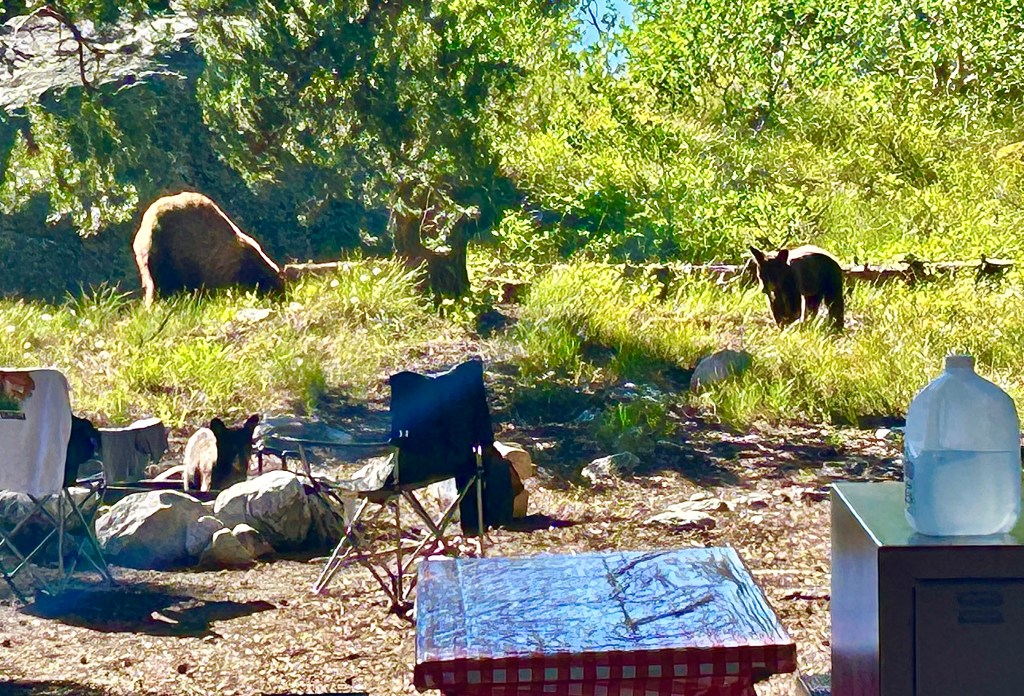
My family and I arrived at Grand Teton National Park on the Fourth of July weekend — with our tents and chuck box and backpacks — hoping to explore an iconic bit of American wilderness. And it did not disappoint. We arrived to find a mama bear and her two cubs nosing around the campsite. More bears appeared the next day. I have seen black bears before, but usually from a distance, not digging in our fire ring.
Thankfully, though, I remembered a park ranger’s bear talk from a recent trip to Rocky Mountain National Park: First, don’t get between the mama and her cubs. Second, stay calm, make noise and raise your arms to appear larger — which is what I did. I abruptly raised my arms and began to yell. “Da Bears! Da Bears! Go home, Bears!” I shouted, over and over, and kept waving, my nervous humor somehow helping to calm my fears. Finally, the massive mama bear ambled back into the woods, and her cubs eventually followed.
When my daughter and her husband originally reserved these campsites nine months prior — securing the last two spots available for the holiday weekend — I had imagined chaos. I feared the crowds: long lines for drinking water, crowded restrooms and the inevitable bottleneck at the park’s most popular scenic overlooks. I pictured throngs of families jostling for space, moms and dads snapping selfies while trying to wrangle kids in front of tumbling waterfalls.
And, my fears were realized — the park was crowded. Dozens of sweaty kids and their parents trudged up and down the trails. I chatted with many along the way. But I was pleasantly surprised by how attentive and thoughtful and even thankful people seemed. “Mom, this is so amazing,” one teen boy said as they approached the rocky, roaring marvel of Hidden Falls. I just didn’t expect the overt expressions of awe and wonder.
So what was going on? It was vacation, so people were more relaxed. But maybe, I finally decided, it was also because for a few days we were not focused on ourselves but on other animals, the ones who lived there — the bears, moose, elk, wolves and bison. And perhaps we were again remembering our own sense of belonging to the natural world?
Our time at Grand Teton was part of a two-week road trip that included visits to three other national parks: The Badlands and Wind Cave in South Dakota and Yellowstone. Each park offered something unique, but the thread that wove them all together was the same: a public space in which you would encounter the wild beauty in the ever-changing flora and fauna and landscape.
In an August 1934 live radio address to the nation from Glacier National Park in Montana, President Franklin D. Roosevelt reiterated this commitment to the parks as a public space.
“There is nothing so American as our national parks,” Roosevelt said. “They are not for the rich alone. Camping is free, the sanitation is excellent. You will find them in every part of the Union. You will find glorious scenery of every character; you will find every climate; you will perform the double function of enjoying much and learning much.”
“The fundamental idea behind the parks is native. It is, in brief, that the country belongs to the people, that it is in the process of making for the enrichment of the lives of all of us. The parks stand as the outward symbol of this great human principle,” he continued.
The accessibility and public aspect of the national parks has been protected since their inception in the mid-19th century — the parks as a natural treasure, open to all. And that “treasure” is not just a metaphor. Last year, a record 331 million people visited our 63 national parks. That’s more than twice as many people who voted in the 2024 presidential election. The national parks are loved by Democrats and Republicans alike. And all that popularity resulted in a $55.6 billion benefit to the nation’s economy last year, supporting over 400,000 jobs.
To put it simply, the national parks are hugely successful, and supporting them may be one small way to help bring our deeply divided country together.
Researchers: How do we help America’s national parks? Make global visitors pay more.
So, it comes as no surprise that the rangers and visitors I talked with during our trip were baffled by the recent budget cuts to the national park system and the talk of privatizing them. These changes were proposed by President Donald Trump, Elon Musk and Interior Secretary Doug Burgum, a former real estate developer. This trio of billionaires does not seem to recognize the value of public lands –– or of public housing, or public education, or public broadcasting, or public transportation. Or that that word — “public” — is synonymous with our nation’s core democratic ideals.
Since the Trump administration took office, the National Park Service has lost 24% of its permanent staff, a crippling reduction that has left many parks scrambling to operate with stripped-down crews. Those who remain must do more with less, and it’s not sustainable. What the politicians don’t realize is that the national parks already operated on a tight budget and rely heavily on unpaid volunteers. There is no waste to cut. Nevertheless, the president’s new budget proposal would claw back $267 million already committed to the national parks for 2026.
This could perhaps all be resolved if we would only elect a few black bears to serve in Congress, or appoint an elk or moose to head the Department of the Interior. And perhaps an owl as head of Housing and Urban Development — given their skills at restoring abandoned housing? A gray wolf or grizzly for the Department of Defense? And why not a red fox as secretary of commerce?
But I don’t think that’s going to happen anytime soon. In the meantime, all the other animals have to rely on is us — the supposedly “smartest” animal — the one whose choices can and should be guided by conscience.
Tom Montgomery Fate, a retired English professor, is the author of six nonfiction books, including “Cabin Fever” and “The Long Way Home.”
Submit a letter, of no more than 400 words, to the editor here or email letters@chicagotribune.com.