
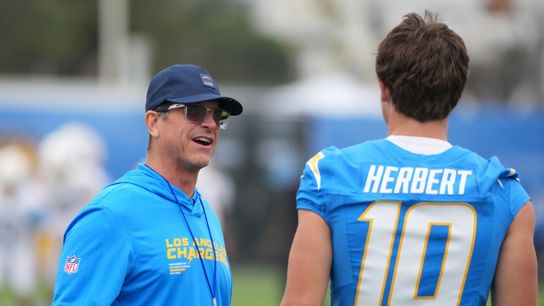
EL SEGUNDO — Justin Herbert is entering his sixth NFL season, and the conversation around him is starting to shift. What began as starry-eyed praise for the rocket arm and video game stats has given way to more challenging questions about wins, leadership, and legacy. This season, Herbert’s challenge is no longer proving he can be great—it’s proving he can lead the Chargers to something meaningful. And with Jim Harbaugh in charge, there’s no more room for excuses.
Herbert, 27, burst onto the scene in 2020, and it looked like the Chargers had found the next superstar. The physical tools were obvious: elite arm strength, pinpoint accuracy, poise under pressure. He set rookie records and made throwing 40-yard lasers look routine. But five seasons later, the Chargers have two playoff appearance—and zero playoff wins—to show for all that talent. The clock is ticking.
And the playoff failures have been particularly bitter.
-544x306.jpg "Los Angeles Chargers quarterback Justin Herbert (10) throws the ball during training camp at The Bolt.")
Kirby Lee-Imagn Images
Los Angeles Chargers quarterback Justin Herbert (10) throws the ball during training camp at The Bolt.
In 2022, Herbert and the Chargers jumped out to a 27-0 lead on the road in Jacksonville, only to collapse in one of the most stunning postseason losses in NFL history. That 31-30 defeat to the Jaguars put a harsh spotlight on game management, coaching, and Herbert’s inability to close. Then last season, with their backs against the wall in the Wild Card round again, the Chargers were thoroughly outplayed and outcoached in a 27-10 loss to the Houston Texans. Two games, two losses, two different kinds of disappointment—but the same result.
The supporting cast around Herbert also appears different. Gone are the aging stars and high-priced veterans. Harbaugh and GM Joe Hortiz are rebuilding this roster with a run-heavy mindset, a focus on the offensive line.
Fair or not, quarterbacks are judged by wins. Herbert knows it. Harbaugh definitely knows it. And after five seasons of promise but little payoff, fans are starting to wonder: Can Herbert be more than just a highlight reel?
And in Los Angeles, the pressure is different.
This isn’t Green Bay or Buffalo or Cleveland, where football is life 12 months a year and quarterbacks are treated like local legends regardless of playoff records. In L.A., the Chargers don’t just compete against NFL teams—they compete against attention. They fight for headlines with the Lakers, Dodgers, USC football, even the Rams across town. It’s a market driven by star power and winning, not patience or process. If you’re not delivering in the postseason, you’re fading into the background.
For Herbert, that means being great isn’t enough. He has to be relevant. He has to win in January to earn space in a crowded city with no shortage of options for fans and media. And fair or not, another year of 4,500 passing yards without a playoff run won’t move the needle in L.A.—not when the standard is championships, and not when you’re the face of a team that still feels like the second tenant in its own stadium.
One of the first places Jim Harbaugh turned his attention to upon arriving in Los Angeles was the offensive line — the foundation for everything he wants to build. For Harbaugh, it starts up front: physicality, discipline, and the ability to run the ball when everyone in the stadium knows it’s coming.
Bradley Bozeman signed an extension during the offseason, bringing size, leadership, and toughness to the middle of the line. A former Alabama standout and Ravens starter, Bozeman knows what Harbaugh demands from the trenches — his older brother, John Harbaugh, coached him in Baltimore. He’s not just a technician; he’s a tone-setter, and his experience will be crucial for a line learning to finish plays and dominate the line of scrimmage.
Bozeman will be playing most of the reps at left tackle while swapping back and forth, depending on what the coaching staff asks of him. When Bozeman resigned this offseason, the front office was upfront with him about not being named a starter and informed him that he would need to come in and compete.
“I’ve always been a competitor, never backed down from a challenge,” Bozeman said. “I love the honesty and the front office being up front.”
Entering Year four, Zion Johnson is expected to take another step forward under offensive line coach Mike Devlin. Johnson, a first-round pick in 2022, has flashed Pro Bowl potential but has also been inconsistent in pass protection. With a simplified, power-based scheme under Harbaugh, Johnson could thrive in a system that plays to his strength: drive-blocking and mauling defenders downhill.
With Johnson being shifted around the offensive line, sometimes playing center and other times playing guard, he indicated that it’s a significant step to take on the responsibility of observing the play develop from two different positions.
“It helps you paint a picture of where you need to be and where everyone around you needs to be,” Johnson said. “It gives you better communication, even as a guard. If I know where my tackle is going to be on every single play and I know where the center is going to be at every single play, that really shrinks my role of what I need to do.”
The Chargers declined Johnson’s fifth-year option this offseason, but it’s not affecting him; instead, it’s a motivator. Johnson understands the priorities and the bigger picture, which are the team and winning.
“For me, my main priority is helping the team win in any way I can,” Johnson said. “I think all of those things will play themselves out. I’m for the team, I’m for my teammates and everyone else around me.”
Heading into 2025, the Chargers’ O-line is undergoing a cultural and personnel shift to match that identity. A major improvement for the offensive line was the addition of Mekhi Becton, who won a championship with the Philadelphia Eagles last season.
Johnson discussed Becton and his contributions to the offensive line. He will be playing alongside Joe Alt, and together they add significant size to the unit. Johnson emphasized Becton’s physicality and the skills he brings, which could raise major concerns for the defenses they will face every Sunday.
“Mekhi is a large human,” Johnson said. “He plays with aggression, he’s a great guy in the room, and a great human being.”

Kirby Lee-Imagn Images
Los Angeles Chargers quarterback Justin Herbert (10) talks with guard Mekhi Becton (73) and center Bradley Bozeman (75) during training camp at The Bolt.
Bozeman expressed enthusiasm about Becton joining this unit this season, noting how much easier everyone’s job will be due to his size and mobility.
“Massive human being,” Bozeman said. “He understands the concept, the movement aspect of the game, and to be able to move guys off the ball.”
The Harbaugh system demands offensive linemen who aren’t just skilled, but relentless. This isn’t a finesse offense. It’s power runs, gap schemes, pulling guards, and clock-chewing drives that wear down defenses over four quarters. For years, Herbert has had to carry the team through shootouts with little help in protection or the ground game.
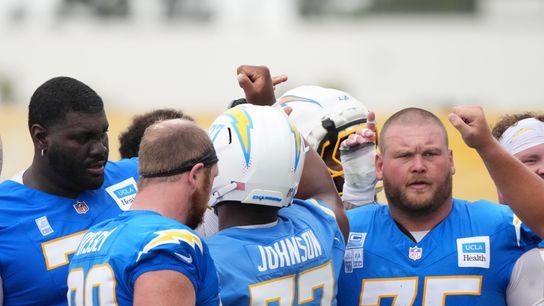
Kirby Lee-Imagn Images
Los Angeles Chargers offensive linemen huddle at training camp at The Bolt.
If this offensive line stays healthy and gels, it gives the Chargers something they haven’t had in Herbert’s career: a chance to win at the line of scrimmage — and play on their terms.