
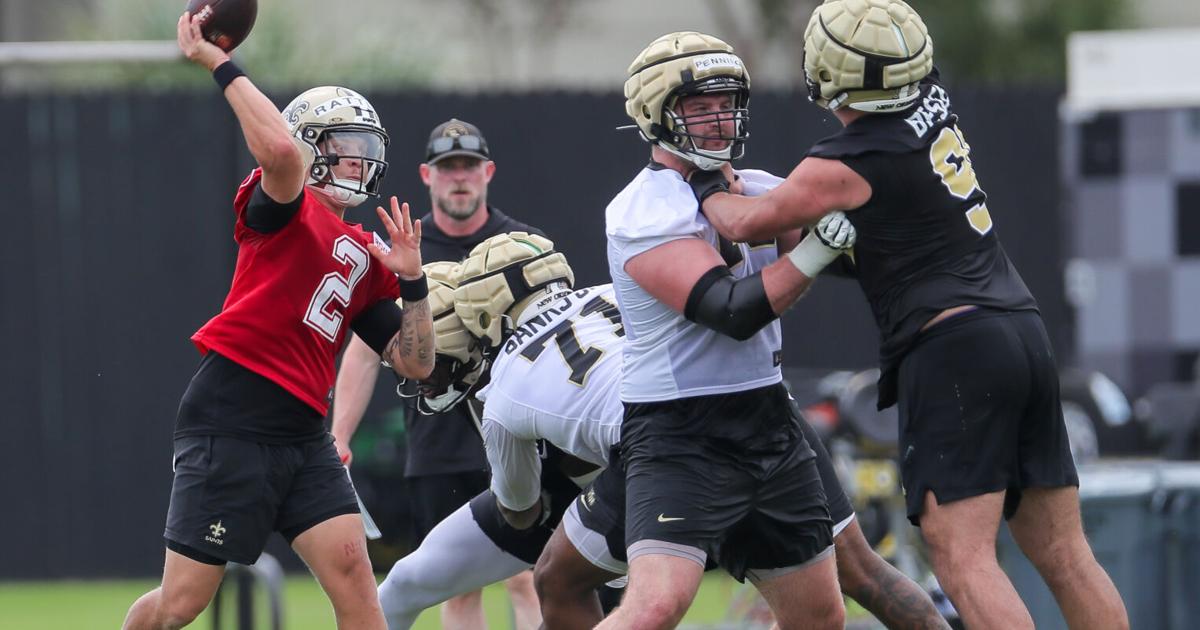
Late in Thursday’s practice during a red zone period, Spencer Rattler rolled to his right, saw nothing there and decided to heave the ball out of the back of the end zone.
The problem is the ball didn’t get there.
“Gotta put more on it,” Rattler said. “Just missed it. Bad decision.”
The ball hung up and stayed inbounds, allowing New Orleans Saints rookie corner Quincy Riley to pluck it out of the air for an interception. It was a notable lowlight that landed in reporters’ notebooks and made the rounds on social media.
And then, on the very next snap, Rattler saw the defense parting in front of him and scrambled through the gap for a touchdown.
As the Saints let a three-man race play out for the starting quarterback job, the players competing for the spot are focusing on doing exactly what Rattler did in that moment: Not letting one bad snap turn into several bad snaps.
They’re playing a high-stakes game where mistakes can feel magnified. That requires mental focus and the ability to not only flush a poor moment, but correct it in the aftermath.
“It’s always about how you respond to adversity,” said coach Kellen Moore. “Guys are going to make mistakes, Spencer threw an interception today in a red zone period, which he’d done so many good things down there. Those moments change games, so he gets to evaluate it and learn from it, and I thought he responded really well.”
Rattler, Tyler Shough and Jake Haener have all been in these spots plenty of times before. All of them were involved in competitions while in college, and Rattler and Haener spent all of last training camp duking it out to be Derek Carr’s primary backup on game day.
Those experiences have helped form their mental approach as they go into this training camp vying for QB1 status.
“The biggest thing you can tell yourself is these competitions aren’t won with one rep,” Haener said. “… Number 1, it’s a long camp, and number 2, I’ve just got to do everything I can to focus on what I can control.”
In the past, Haener has worked with mental coach Brett Sandwick, whose clients also include U.S. military special forces. And for Haener, that means dialing in his mindset — how will he respond when things don’t go his way? And how will he respond when things are going well?
At least from the outside looking in, Haener appears to have the longest odds of winning the battle. After struggling in his lone starting opportunity last season, he then missed almost all of the summer program because of an oblique injury. He will also be the last of the three to get a crack at operating the first-team offense.
But Haener uses all of that to fuel the mental side of his approach. He said he’s always considered himself an underdog, and while he doesn’t necessarily seek out evidence of people doubting him, he will add it to the fire when he sees it.
“I’ve always got a chip on my shoulder,” Haener said. “I want my teammates to feel my energy and my passion in my command of the huddle, because when those things happen we tend to be more crisp, more upbeat, and when those things happen we execute.”
Like Haener, Shough is doing his best to remind himself not to place any added significance on one play — good or bad, by either himself or someone he’s competing against.
Practices, he said, are scripted by scenario. It’s not quite like the regular flow of a game.
“So a lot of times, a throwaway or not taking a sack … are sometimes good plays,” Shough said. “They may not look good in comparison to if I have a good throw or if Spencer has a good throw or if Jake has a good throw. I just try to go out and win that rep; that’s the whole goal.
“I’ve been in a bunch of different competitions, so human nature is, ‘Oh this guy threw it deep, I want to throw it deep.’ But the biggest thing that Coach is looking for and what I want to do is execute it to the best of my ability, and then the good things will happen.”