
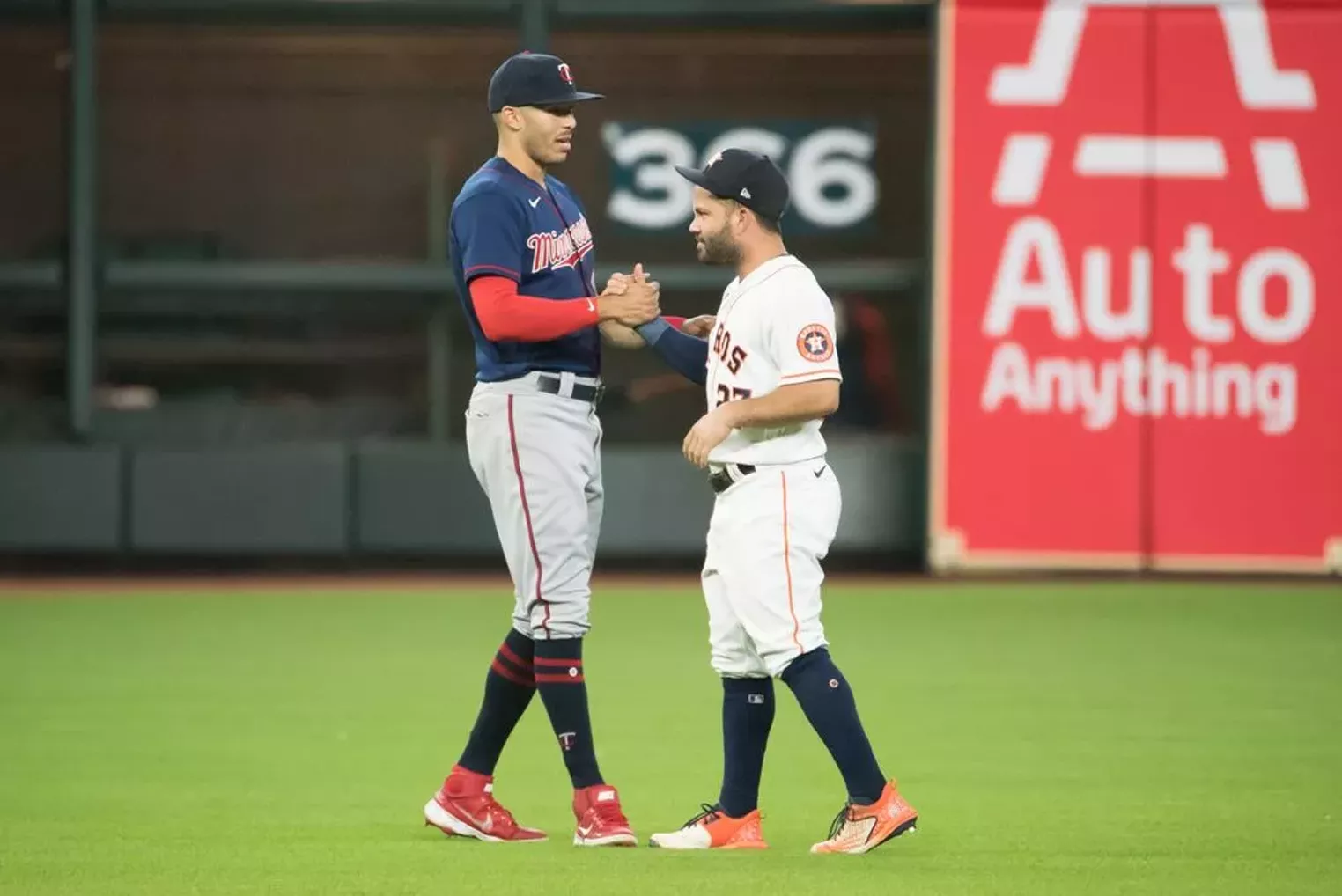
“Deadline” Dana Brown was back at it on Thursday managing to pull off a pair of deals to shore up spots on his Astros roster that has been decimated by injuries. Chief among those moves was the return of former Astros shortstop Carlos Correa in a deal with the Minnesota Twins. Correa, who left the Astros in 2022 to sign with the Twins, will return as a third baseman to the team that reared him.
In addition, the Astros acquired lefty outfield hitter Jesus Sanchez from Miami to go with Ramón Urías, a defensive ace utility infielder from Baltimore they dealt for on Wednesday night.
It was a particularly wild trade deadline in baseball with dozens of deals happening throughout the week, most of them leading up to the 6 p.m. eastern deadline Thursday. And while it looked for a moment the Astros might even acquire starting pitcher Dylan Cease from the Padres, when they didn’t fans weren’t left wanting considering the quality players Brown acquired and the little they had to give up for them.
Let’s discuss.
Correa makes a return and the Astros need him.
The emotional component of Correa’s return cannot be overstated. He was the vocal leader of this team before he left in free agency and there is no reason to think he won’t be again. And defensively, he remains one of the best infielders in the game, now getting a chance to ply his wares at third base, a position that seems naturally suited to his size and arm strength. He’s been up and down offensively this season, but was still one of the better offensive shortstops in baseball as recently as last year. With reports saying Isaac Paredes will miss the entire season with his hamstring injury, this move comes at a very opportune time for the Astros and probably Correa as well, who would only waive his no-trade clause for his home team.
The Twins will pay for $33 million of the remaining $100 million (and change) on Correa’s deal (and only High A pitcher Matt Mikulski went back to Minnesota in the deal), which runs through 2028. After that, there are several years of team options. When Paredes returns in the spring, the team will have to sort out the infield, particularly after youngster Brice Matthews showed while he might not be ready this year, he probably will be next year. But, for now, this was a move that both looks good on paper and feels good if you’re an Astros fan.
Sanchez gives them another left handed bat the team has lacked.
The numbers for the Marlins outfielder aren’t going to pop off the page at anyone, but he has been outstanding against right handers this season with nine of his 10 homers against them. He is a solid athlete with above average defensive skills who can play all three outfield spots providing the kind of versatility the team loves. Sanchez is also just 27 and still under team control until 2028. He’s a platoon outfielder, but it makes for a good fit with the mix of players they have there while Yordan Alvarez and Jake Meyers continue to recover from injuries.
Because Sanchez is under team control, the Astros had to part with a few decent pieces to get him. Ryan Gusto, though not someone that was ever going to figure into the Astros top of the rotation, was an innings eater and helped the team through a spate of injuries this season. Meanwhile, infielder Chase Jaworsky (21) and outfielder Esmil Valencia (19) both project as average MLB players.
Infield depth is no longer an issue with Urías.
People may sleep on the Astros Wednesday acquisition of Urías for minor league pitcher and winner of weirdest and yet most apt name in baseball, Twine Palmer. But, what Urías brings is a stellar defensive resume for a team that has struggled to keep guys healthy on the infield. By all accounts, he can play pretty much every spot across the infield (except catcher) and even won a Gold Glove in 2022. With Jose Altuve’s permanent move to the outfield, seeing Urías and Maruicio Dubon share time at second isn’t a stretch. It also allows the team to give days off where needed.
Urías isn’t going to blow anyone away at the plate, but he has shown good consistency in recent years, particularly against left-handed pitchers. He will add to the team’s depth, particularly on defense where he has excelled this year.
Kudos to Brown for giving up very little in return.
While we all want to spend time talking about the gifts we get to unwrap, we shouldn’t ignore the fact that the Astros gave up one middling starting pitcher and a handful of prospects, none among the team’s top 10, to get legitimate players that will immediately improve their 26-man roster. The Correa deal in particular seems like a fleecing of a team that put everyone on the market this summer.
There are still holes to be filled, but some of that will happen via players who are currently rehabbing (more on that in a moment) and the young players who got time in the bigs the first half of the season will undoubtedly benefit from those mound and plate appearances.
The cliche about getting injured players back equaling trades may actually be true for the Astros.
It’s a ridiculous thing that GMs and coaches say every year around this time. “We feel like getting X back is like trading for a starter.” Of course you do. But, in the case of the Astros, who recently had as many as 18 players on the IL, it may not be that big of a stretch. Jeremy Peña is expected to return Friday in Boston. Starting pitcher Spencer Arrighetti should be back next week. From there, it won’t be long before Cristian Javier is back at the major league level followed by Luis Garcia and J.P. France.
Then there is Yordan Alvarez, who Brown recently said is progressing well and could be back by middle of August. Jake Meyers and Zach Dezenzo probably won’t be far behind Alvarez, closer to the end of the month. To say the team has the chance to be stacked by the first of September is really not an understatement. That all depends on good recoveries, naturally, but this may be a rare instance when a illy cliche might actually be true.