
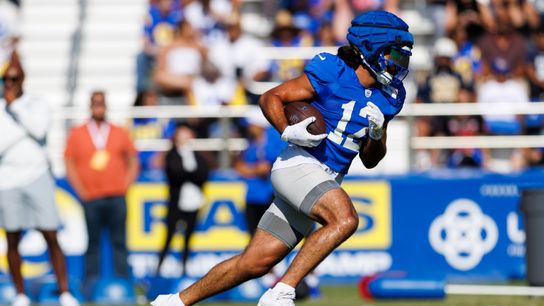
LOS ANGELES –– The early afternoon sun shines gold across the practice field, baking the grass turf. Five yards out, Southern endzone. Jimmy G barks signals, his eyes scanning the middle.
Across the line, Ahkello Witherspoon – veteran, wily, worn leather against youthful oak. And there, wide, Puka Nacua. Year Three. Not the wide-eyed revelation anymore, but something… denser. More layered.
The snap cracks the arid air. Nacua drives. Not pushes up the field, measured, deliberate and carving. A sharp cut towards the far pylon.
Witherspoon, a sound technician in his own right, shadow-steps, mirrors, blankets Nacua’s every move. Jimmy’s head snaps right; the spiral waltzes on a straight line, beautifully, towards Nacua’s outside shoulder.
Witherspoon’s hand flashes, a bat, a denial. Both men tumble, a tangle of limbs and intent. The ball, seemingly lost, floated in the air, then fell like a missile towards the ground, then…impossibly, secured. On his back, staring at the vast California sky, against Witherspoon’s desperate coverage, Nacua plucks it. Pure, practiced, preposterous possession. The dude is ridiculous. Even here in practice. Especially here.
Nacua attacks the ball like a child does pizza. He consumes it. With a ferocity and fearless physicality that would garner Anquan Boldin’s nod in approval.
Remember Year One? The eruption? 105 catches. 1,486 yards. Records shattered. Fifth-round pick? Ha! A seismic shockwave rippling through the league. He wasn’t just productive; he was vital. The angles, the leverage, the late separation forged by relentless hand-fighting made him stand out as a rookie. He morphed between receiver to running back on jet sweeps, tough, slippery, leaving defenders grasping air.
His mitts? Magnetized. Contested catches? A basketball rebounder battling in the paint. Nacua plays with the joyful exuberance and slightly terrifying abandon of a man whom the world doubted. Scouts saw the 4.57 forty, the unimpressive vertical, and the middling college stats at Washington and BYU – injuries, COVID, and circumstances dimming the output, hiding the potential. They overlooked the gauntlet drill speed, the actual game pace and the sheer competitor burning beneath the underwhelming metrics. The Rams saw it at 177th overall. We saw it. The league felt it.
Then, Year Two. The numbers: 92 catches, 1,255 yards. Still stellar, objectively. Top-tier. Yet… a slump? Nuance whispers the truth.
A nagging knee, a constant companion, a dull ache, stole his explosive burst early in the season. His body, a relentless engine, betrayed him. Not catastrophically, but insidiously. A step was lost here. A fraction of separation was fought there with more intricacy. The crisp angles softened just a degree. The late catch space became a battleground, not a birthright. He was still Puka – the impossible catches like the one against Witherspoon still happened – but they cost more. They demanded more. The effortless flow of his All-Pro rookie year became a grind. He played despite being hurt and managed to produce despite the pain. But the sheer, terrifying ease was momentarily muted.
Listen to Sean McVay, though. Listen closely. “Curiosity,” McVay says. That’s the bedrock for Nacua’s success. “Humility,” McVay insists. That’s his wideouts’ fuel. “Continuous learner… student of the game… enjoyment for the mastery.”
While the stats dipped slightly in his second year, the craft deepened. Watch Nacua now. You’ll see Cooper Kupp’s fingerprints on how he attacks his routes. You can see how he absorbed the master’s nuances. Watch him refine his releases with Davante Adams. He painstakingly mimics every detail until he feels confident and comfortable applying it in practice. See him huddle with Eric Yarber, Les Snead and Matt LaFleur – a sponge for feedback, refining routes, honing releases, studying leverage points with an architect’s precision.
The physical gifts – the strong hands, the body control, the deceptive power after the catch – remain. But layered atop them now is practiced precision, veteran savvy. He’s now orchestrating routes; he no longer runs them. Last year’s slump wasn’t a decline; it was a detour. A necessary friction tempering the steel. He learned to produce differently. To win smarter. To leverage his intelligence, his feel, his sheer, stubborn will when his body protested.
That catch against Witherspoon? Perfect coverage. Perfect throw. Perfect defensive play. Perfect Puka response. He didn’t need the separation he might have had in Year One. He found the ball anyway. On his back. Against logic. That’s the promise. That’s the hope.
Year one was the explosion, the revelation. Year two was the lesson, the refinement forged in the fire of adversity. Year three? It is prepped to be his synthesis. The physical gifts, tempered by experience, guided by relentless curiosity and honed technique. The hands haven’t softened. The fierceness hasn’t faded. It’s simply been focused, channeled and made more efficient. The angles are sharper again, the late separation more sudden, the YAC more punishing.
He’s not just the fifth-round steal anymore. He’s Puka Nacua: the technician, the warrior, the continuous learner. The man who makes the impossible look routine, even when covered, even when hurt, even when falling. The best, McVay might muse, is not behind him. It’s being built, snap by impossible snap, right before our eyes. His future is meticulously crafted, fiercely caught and utterly relentless.