
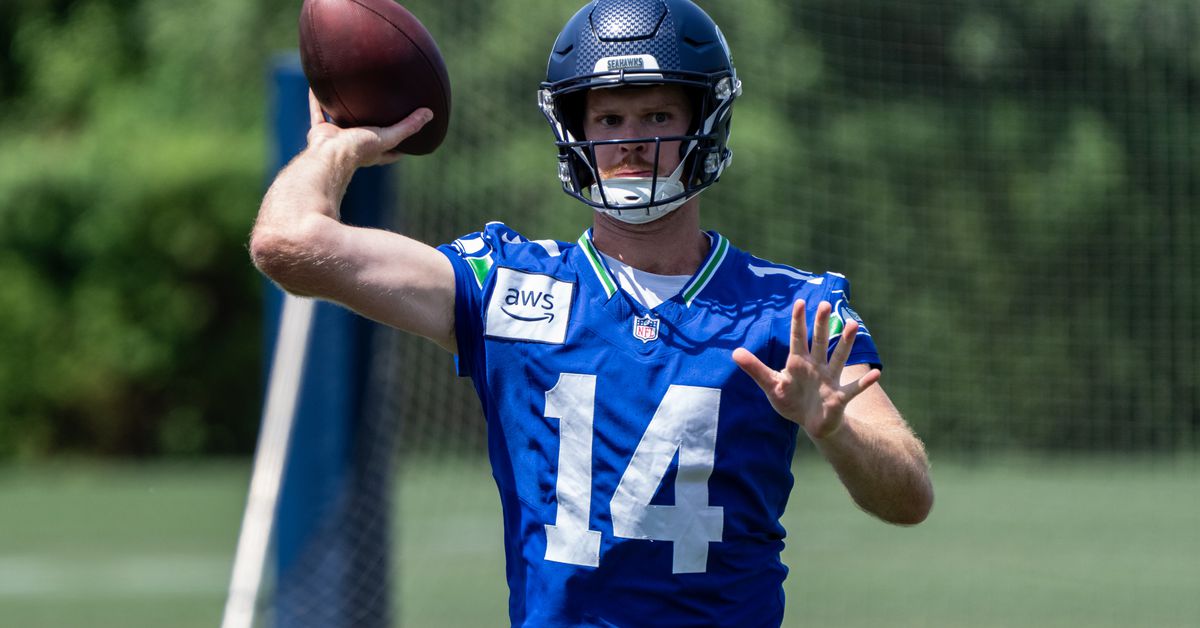
New Seattle Seahawks quarterback Sam Darnold threw 4,319 passes for 35 TDs and 12 interceptions in his one season with the Minnesota Vikings. His completion percentage was 66.2%. Interceptions aren’t always the quarterback’s fault alone. Let’s analyze Darnold’s picks and understand the real reasons.
Stats
Despite an excellent overall rating (100.8), interceptions had an impact—which caused fluctuations in his QBR.
The pattern shows that Darnold was most susceptible on medium-depth passes. A third of his INTs were concentrated between 11 and 30 yards, indicating difficulty reading defenses on the move and in zone reading.
In 2024, Darnold had 12 interceptions in 17 games—which ranks him 6th along with CJ Stroud and Patrick Mahomes and behind only Jordan Love, Jared Goff, Geno Smith, Baker Mayfield, and Kirk Cousins.
Not Guilty
Darnold’s read was correct. The center is unable to contain Dexter Lawrence, who hits the QB’s arm and the pass falls short, being intercepted. Could Darnold have felt the pressure better? Yes. But the offensive line should have done its job.
The pressure came very quickly. It was fourth down, so a sack or an interception wouldn’t have made much of a difference here. Darnold takes a chance and is intercepted.
Fixation on Primary Targets
The clearest trend in Darnold’s interceptions was his insistence on consistently targeting his primary target—Justin Jefferson. On at least half of his interceptions, Darnold forced passes to Jefferson even when double or triple coverage was involved. This fixation limited his read progression, which made life easier for defenders.
A striking example of this is that in the game against the Jacksonville Jaguars, Darnold threw three interceptions—all targeting Jefferson, all in a zone with multiple defenders nearby.
This also happened to Jordan Addison. A serious mistake by Sam Darnold here. This could even have been a touchdown if he had thrown the ball to Aaron Jones in the flat. Darnold even looks at Jones but for some reason rejects the idea and goes to work on the other side of the field. Brian Branch runs the route for an interception.
Nick Cross and Jaylon Jones had Justin Jefferson double-teamed, but Sam Darnold locked onto JJ and forced the pass right into Cross’s hands. He threw the attempted forced pass right into Cross’s hands, and Cross intercepted the ball. The fixation on Jefferson caused Darnold to miss Jordan Addison open on another route.
Justin Jefferson simply misses this route, and the ball is deflected. It’s reasonable for Darnold to believe that Jefferson could have made the play here, but again, he fell into the same trap of fixating on just one target.
Problems Against Zone
Another pattern that repeated itself throughout the season was Darnold’s ineffectiveness against zone schemes, especially those with two safeties deep (Cover 2, Cover 4, and Cover 6). Defenses that hid their intentions well pre-snap led Darnold to throw where there appeared to be a window—but it quickly closed after the snap.
A total of 9 of the 12 interceptions occurred against zone defenses, with many of the passes being delivered into congested areas or directly into the hands of linebackers or safeties. With the movement and the defender following the play, he thinks the receiver will have a free release, thus becoming his first read. Darnold doesn’t notice Fred Warner’s drop, who makes an easy interception.
The Packers start with two safeties deep and rotate to just one. The TE’s out route would have leverage against the safety, but Darnold didn’t see the cornerback. Carrington Valentine made a spectacular play and came away with the interception.
❌Execution Errors
He made an aggressive but correct read and missed the throw. The pass was too strong and went wide.
A basic error: he throws against the movement of his body. He relies too much on his arm and probably thought Zaire Franklin would continue running laterally, which would open a window for the pass. Big mistake.
He sees Justin Jefferson on the sail route and has him open, but this is poor ball placement. The pass should have come much closer to the pylon for this play to work. Darnold’s execution error.
Patience in the pocket, and he makes the right read and decision. The problem is that he throws the ball low and behind JJ, when he should have been right in front. Good process, poor execution.
✅ Conclusion
The 2024 season marked a partial rebirth in Sam Darnold’s career, but it also exposed recurring patterns that have followed him since his early years in the NFL. With 12 interceptions thrown throughout the year, some questions have emerged regarding the causes of these turnovers. Below are the main factors explaining this number and the contexts in which the errors occurred.
The interceptions in 2024 represent a combination of:
Excessive aggression and focus on a target;
Lack of effective zone reading;
Handoff and ball placement errors—especially on tight routes;
Improving coverage reading, route progression, and accuracy under pressure will be essential for Darnold to reduce these errors and maximize his strong aggressive arm in 2025.
Sam Darnold was efficient in many games and had a good season statistically—but the interceptions reveal clear areas of need: reading the defense, patience in the pocket. Reducing this number will be crucial for further improvement, especially if he wants to maintain a high level in critical games.
If he wants to evolve from a functional QB to a truly reliable one in a competitive system, Darnold will need to refine his field vision, modulate his aggression, and increase his effectiveness against defenses that prioritize confusing QBs mentally—a common occurrence in today’s NFL.
Darnold could make a leap in 2025, provided he corrects these tendencies and continues to gain playing time in a more controlled and vertically balanced system.