
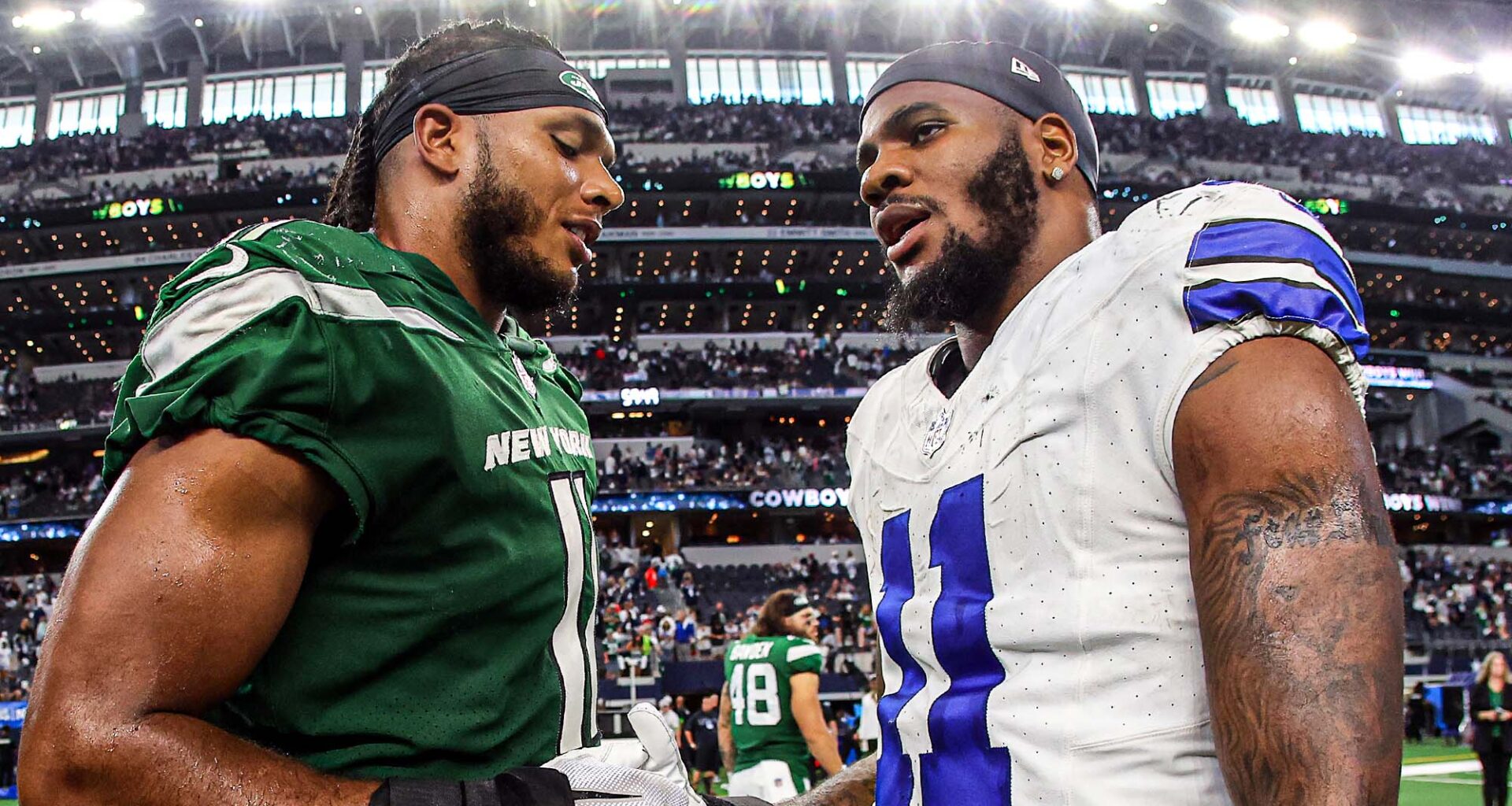
Micah Parsons has set the NFL ablaze by demanding a trade from the Dallas Cowboys.
Team owner Jerry Jones has insisted that Cowboys fans should not “lose sleep” over Parsons’ trade request, but Parsons appears determined to force his way out. On Friday, he released a lengthy statement that referred to his time with the Cowboys in the past tense. Most notably, Parsons wrote, “Unfortunately, I no longer want to be here.”
If Parsons gets his way, oddsmakers in Las Vegas believe the New York Jets are one of the top contenders to land his services.
New York Jets’ Top-10 Odds to Land Micah Parsons
According to DraftKings Sportsbook, the Jets have +2500 odds to be the next team Parsons takes a snap for, tying them for ninth-highest.
Dallas Cowboys: -300
Philadelphia Eagles: +1000
New England Patriots: +1000
Los Angeles Chargers: +1500
Arizona Cardinals: +1600
San Francisco 49ers: +1600
Los Angeles Rams: +1800
Carolina Panthers: +2200
New York Jets: +2500
Las Vegas Raiders: +2500
Chicago Bears: +2500
Should the Jets consider inquiring about Parsons?
Let’s go over the pros and cons.
Why the Jets should consider pursuing Parsons
At first glance, it is easy to dismiss a potential Parsons trade as a reckless headline-chasing move that would be made by Jets regimes of the past, not the more level-headed one that took control in January.
The Jets are a retooling team. They do not intend to compete for a Super Bowl in 2025. Thus, it seems logical to suggest that New York should focus on maintaining its draft picks and long-term cap flexibility.
But Parsons is a completely different beast than the “win-now” moves that have sunk this organization in the past.
We are not talking about short-term rentals for 40-year-old Aaron Rodgers or 30-year-old Haason Reddick. This is a 26-year-old megastar. Parsons is on a trajectory to continue providing Hall-of-Fame-level impact for at least the next five seasons.
That’s not a “win-now” player. Parsons is someone who would fit the timeline of any NFL team.
In that case, it stands to reason that giving up a massive haul of draft picks would be worthwhile to acquire a player of Parsons’ caliber, even for a team in the Jets’ position.
The Chicago Bears’ September 2018 trade for Khalil Mack is a reasonable model for a Parsons trade. In exchange for the then-27-year-old Mack, the Oakland Raiders received two first-round picks (2019 and 2020), a third-round pick, and a sixth-round pick. Chicago also received a second-round pick and a conditional fifth-round pick with Mack.
For all intents and purposes, the price boiled down to two first-round picks.
So, look at it this way: Do we really think the players selected with New York’s next two first-round picks will combine to match the impact of one Micah Parsons?
That’s extremely unlikely.
Just ask the Raiders. The two first-rounders netted by Mack yielded cornerback Damon Arnette (who played 13 NFL games) and running back Josh Jacobs (who had one All-Pro season). Mack proceeded to play four seasons in Chicago, collecting 36 sacks and two more All-Pro appearances. The Bears flipped him for a second-round pick at the tail end of his tenure, which turned into Jaquan Brisker, a solid starting safety.
Parsons has recorded four straight seasons of 12+ sacks since he entered the NFL in 2021. His 52.5 career sacks are the sixth-most in NFL history through a player’s first four seasons. He is also tied with Maxx Crosby for the league lead in pressures since 2021, racking up 330 of them, per Pro Football Focus.
Not to mention, the Jets have a murky future at Parsons’ position, which happens to be a premium role on the field.
While the Jets are poised to start two talented first-rounders on the edge this year (Will McDonald and Jermaine Johnson), they have long-term concerns at the position.
Johnson is coming off a torn Achilles. It is anybody’s guess as to how he will look after the injury.
McDonald has an immense pass-rush ceiling, but his struggles in the run game could limit his overall ceiling. Parsons, who ranks fifth in the league with 53 tackles for loss since 2021, is an all-around edge defender.
Behind Johnson and McDonald, the Jets do not have much to write home about on the edge. Their 2022 fourth-round pick, Micheal Clemons, has been disappointing and will already be 28 years old in a few weeks. Past Clemons, they do not have an edge rusher who recorded a sack last season or was drafted earlier than the fifth round in this year’s draft.
Parsons would solve a short- and long-term hole for the Jets. Along with Sauce Gardner, Quinnen Williams, Jamien Sherwood, Michael Carter II, McDonald, and Johnson, the Jets would be set up with one of the best defensive cores in the NFL for multiple seasons into the future
At his age, Parsons could be worth the trade package and the likely record-breaking contract for New York. As much as it would seem like a hasty move for a team that has played it safe this offseason, we shouldn’t automatically label aggressive moves as a bad allocation of resources. There are times where it makes sense – such as investing in a known commodity who is young enough to maintain his world-class impact for the duration of the contract that he signs.
Why the Jets shouldn’t pursue Parsons
The Jets are in the first year of a new regime that is trying to clean up the messes of multiple coaches and general managers before them.
The franchise’s many years of poor drafts, going past Joe Douglas and back to Mike Maccagnan, have decimated the roster depth. Sure, Douglas nailed a few first-rounders with the many high picks his team lost its way into, but the back ends of his classes were routinely poor, which is why the Jets’ roster looks so top-heavy today when you stack it up from top to bottom.
Prior to Douglas, the roster started at ground zero following Maccagnan’s eradication of the roster. Douglas’ woes only exacerbated the issues he inherited.
From the head coaching spot, the Jets deteriorated into a laughingstock of a culture due to the mismanagement of Robert Saleh and Adam Gase. By January 2025, the franchise that was already viewed as a joke for multiple decades had become less respected than ever before in its history.
Aaron Glenn and Darren Mougey are tasked with patching the holes of the porous ship they’ve been entrusted to guide. But they aren’t interested in merely staying afloat – they want to completely rebuild the foundation, constructing a sturdy vessel that can carry the franchise to sustained relevance for many years to come.
Building through the draft is a critical part of that journey.
Yes, Parsons is probably more valuable than whoever the Jets might draft with the picks they would hypothetically give up for him. But he won’t win them a championship on his own. The Jets will still need many more pieces to reach contention – along with a complete reinvention of their culture and philosophies.
Trading for Parsons would stomp all over the work that Glenn and Mougey have put toward establishing a foundation New York can build upon.
The loss of multiple premium draft picks – likely at least two first-rounders and one more Day 2 pick – would set the Jets back as they try to fill out the rest of their depth chart with long-term solutions. Looking past 2025, they have vacant long-term starting spots at wide receiver (two), safety (two), defensive tackle, running back, and linebacker. They also have both starting guards slated for free agency.
Not to mention, the Jets don’t have their eventual Super Bowl-winning quarterback on the roster yet (sorry, Justin Fields). The Parsons trade package would take away the Jets’ ability to either draft a potential franchise quarterback or cobble together a haul of picks to trade for one.
We must also weigh the ramifications that Parsons’ pending contract will have on New York’s ability to establish a sustainable foundation.
Parsons is likely seeking to eclipse the record-setting four-year, $160 million deal signed by Cleveland Browns defensive end Myles Garrett. After already extending Sauce Gardner and Garrett Wilson for over $120 million apiece, that would give the Jets a third nine-figure extension to carry into the future, combining for over $400 million in maximum value.
It’s not as if Parsons is not worth the contract he will eventually receive, but for a Jets team that still has the skeleton of a roster that went 19-32 over the last three seasons, it might not be worthwhile to invest such a large chunk of future cap space in one player. Giving Parsons a gargantuan contract would likely cost the Jets multiple starters who will soon be looking for new deals.
Their two high-quality starting guards, Alijah Vera-Tucker and John Simpson, are on expiring contracts. The same goes for Quincy Williams and Breece Hall. Will McDonald, Jermaine Johnson, and Joe Tippmann will seek extensions after this year if they perform well enough. Olu Fashanu’s talks are only two years down the line.
At some point, the Jets will start losing good players because of Parsons’ contract. Again, it could be argued that it’s worthwhile – Parsons is much better than any of these other players – but the Jets’ roster is too thin at the moment to start compromising a quantity of good players for one elite player. They will be more equipped to trade for someone like Parsons in a year or two, when Glenn and Mougey have had more time to deepen the roster.
Last but not least, Parsons is a risk to compromise the work that Glenn has done with New York’s culture. Parsons is an extremely outspoken player who is active on social media. Is he the type of player Glenn wants in his locker room as he strives to create a football-focused environment in Florham Park?
Not ludicrous, but likely smart to avoid
The Jets should not rule out a trade for Micah Parsons. Due diligence is necessary when a player of this caliber becomes available. It does not happen often.
For many reasons, going all-out for Parsons could be considered a logical pursuit despite appearing garish on the surface. This is a 26-year-old edge rusher with three top-three Defensive Player of the Year finishes in four NFL seasons. It could prove worthwhile to sell the farm for that type of player, even if you are not an immediate contender. He can still be the best player on your team in four years.
However, the cons arguably outweigh the pros for New York.
This franchise’s main goals boil down to one word: sustainability. It’s not about opening a window in 2025, 2026, or 2027. It’s about setting a foundation that can allow the Jets to play meaningful football every year for the foreseeable future, the same way that franchises like Baltimore, Buffalo, Kansas City, Philadelphia, and Pittsburgh have accomplished.
Adding a player like Parsons would obviously help the Jets pull that off – but only to a certain extent. It might be wiser to save the assets it would cost to acquire him and spread them out in a more economical fashion, allowing the Jets to build a deeper roster, stay younger, maximize their chances of landing a franchise quarterback, and continue building upon the culture that Glenn and Mougey have established.
Should the Parsons saga progress to legitimate trade conversations, do not be surprised if the Jets come up as a rumored suitor. After all, as you narrow down the contenders, the Jets emerge as one of the most reasonable options for the Cowboys, who ultimately hold the cards here.
Dallas would prioritize trading Parsons to the AFC, narrowing New York down to one of 16 contenders. Jerry Jones would probably prefer to trade him to a perceived weaker team; it helps him avoid strengthening a potential Super Bowl contender while improving the outlook of the picks he’d acquire. That pushes the Jets further to the top of Jones’ list. With the Jets also having full control of their future draft picks, they could certainly be targeted by Jones.
Despite it all, Glenn and Mougey seem too focused on their mission to sidetrack it with a blockbuster trade. A brief conversation may take place, but unless Dallas becomes desperate, Mougey is unlikely to stay on the phone for very long.
The Jets should not be expected to trade for Parsons. Still, it is not completely outside the realm of possibility.