
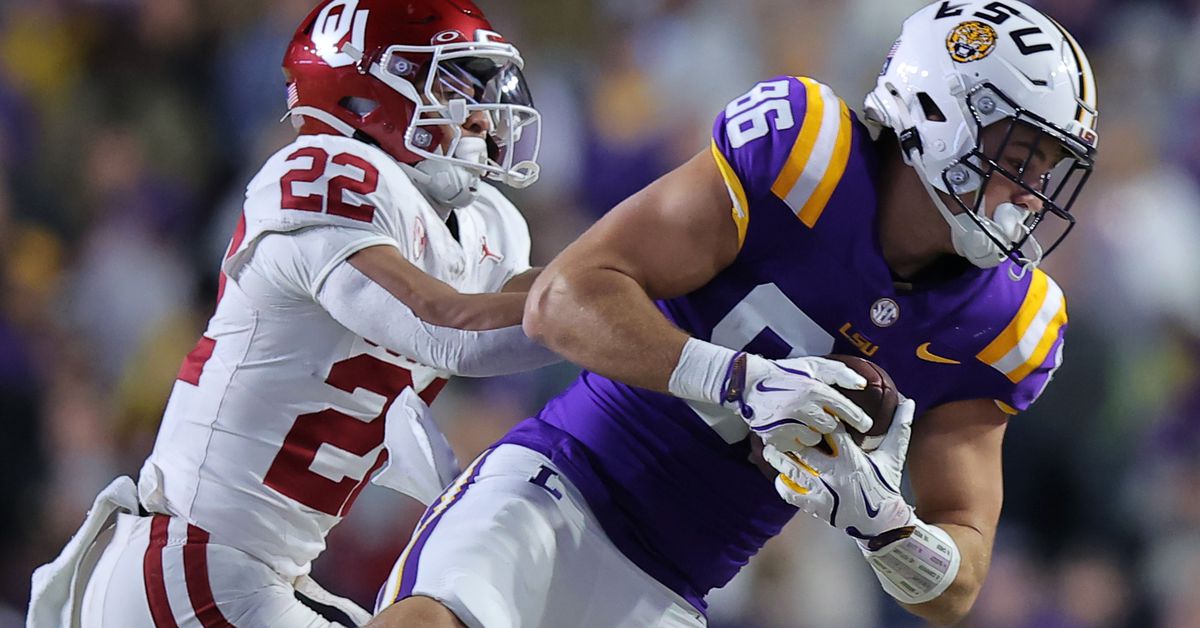
The New York Jets drafted former LSU Tigers tight end Mason Taylor in the second round of the 2025 NFL draft. Today we break Taylor down in detail.
The 20-year old Taylor is listed at 6’5” and 251 pounds. He was a third team all-SEC selection in 2024. He caught 129 passes for 1,308 yards and six touchdowns in three seasons at LSU.
Background
Taylor is the son of Hall of Fame defensive end Jason Taylor, who spent most of his career with the Dolphins but was with the Jets in 2010. He headed to LSU as a four-star high school recruit and started the last 12 games of his freshman season in 2022.
Taylor ended that season with 38 catches for 414 yards and three touchdowns and looked set to take his game to another level in his sophomore season, but he suffered an injury in the second game of the year which caused him to miss one game and limited him for several weeks. As a result, his production was down slightly, and he ended up with 36 receptions for 348 yards and just one touchdown.
His junior year saw his role expand and he caught 55 passes for 546 yards and two scores before sitting out the team’s bowl game to prepare for an early entry into the draft.
Taylor opted not to work out at the NFL scouting combine, but he had a strong performance at his pro day and was regarded as a likely day two pick. The Jets selected Taylor in the second round with the 42nd overall pick.
Let’s move on to some more in-depth analysis of what Taylor brings to the table as a player, based on extensive research and film study.
Measurables/Athleticism
Taylor has decent size, although his length and catch radius are slightly below average for the position.
At his pro day workout, he impressed by running a 4.65 in the 40-yard dash and posting 28 bench press reps and a 7.06 three-cone drill. All three marks would have placed him in the top five at the scouting combine.
He didn’t participate in the broad jump or vertical jump and his short shuttle was below average for the position.
Usage
Taylor is a modern-style tight end who has lined up outside or in the slot more than half of the time. He lined up as a conventional tight end about 45 percent of the time, with a marginal decrease over the course of his career.
Even when he did line up as a conventional tight end, he typically was off the line of scrimmage and he regularly went in motion.
Downfield threat
Taylor was mostly used as a safety valve during his first two seasons and didn’t catch any downfield passes until his third year. He only averaged 10.1 yards per catch for his career and did not record a 40-yard play.
He’s not the kind of player you can expect to get behind the defense on a deep route, but he did get down the seam to stretch the field for a few downfield passes last season.

Routes
Taylor moves around naturally and smoothly, and looks the part when running routes, although he doesn’t necessarily use deception or sharp changes of speed and direction to get separation.
A lot of his production comes underneath or leaking out to the flats but when he has ventured further downfield, he looks comfortable.
Hands
Taylor looks natural catching the ball as well. He tracks and adjusts to the ball well, can extend to make catches beyond his frame and is able to hang onto the ball in traffic.
While he doesn’t necessarily have a lot of highlight reel catches in his film, he has shown good body control in making some nice catches keeping his feet inbounds near the sideline and has made some impressive snags at full extension.
He had seven drops in three seasons at the college level, but he showed dramatic improvement in this area with just one in his last 88 targets.
Red zone
Taylor only had six touchdowns in his college career, with five of these coming from inside the red zone. He had 14 receptions for 100 yards and five scores overall in the red zone.
These scores mostly came about from Taylor leaking into an open area rather than beating tight coverage. The Tigers showed good faith in him on this game-deciding two-point conversion during his freshman year as he showed a good nose for the goal line.
After the catch
Taylor generates plenty of yardage after the catch because he will often be targeted on short passes that enable him to turn upfield. However, while he might on occasion be able to slip the first tackle, he’s yet to show he can be dynamic enough to break multiple tackles in space and create big plays from nothing.
He’s generated consistent yardage in the screen game, averaging just under eight yards per catch. He will finish his runs strong and is tough to bring down as he tries to fall forwards for a few extra yards.
One nitpick is that Taylor will often go to ground as he secures a catch in space, seemingly in situations where he might have been able to stay upright and pick up some extra yardage.
He had one fumble during his college career.
Run blocking
Taylor isn’t the finished article as a blocker, but he has shown some promise in that area. He is effective on the move and in space, but he also held his own when required to block on the edge.
He battles to maintain leverage in the trenches but can often fail to sustain it through the play. Technically, he needs to be better with his hand placement. Opposing players are able to get up into his chest when he doesn’t keep his hands inside.
Pass blocking
Significantly, Taylor stayed in to pass protect 93 times last season. That’s more than all but three tight ends from Power Five conferences. This is always a strong sign that the player is close to being able to handle the same duties at the NFL level, especially when paired with good numbers for pressure rates. Taylor only gave up a few pressures all year, so his pressure percentage was also in the top five.
Earlier on in his career, Taylor’s pass protection numbers were still good but he did give up a couple of sacks.
This one came about because of a similar loss of leverage as that which we mentioned will occasionally be seen from him when run blocking.
Physicality
Taylor has decent strength and battles in the trenches and for every yard when he has the ball in his hands as noted. He only had one contested catch in his first two seasons, but he had several last year.
The main thing it would be nice to see him add to his game is more route physicality. He is big enough to lean on or box out defensive players to generate separation but doesn’t seem to do much of this.
Special teams
Taylor doesn’t have a very good record on special teams. In his first ever game, he lined up on the edge on the placekicking unit for five snaps but the last of those saw a last second game-tying extra point blocked as FSU overloaded his side and a blocker came free.
After that, he never saw action on special teams again, although that was probably because he became a starter rather than some kind of punishment or benching.
Instincts
Taylor doesn’t seem to blow any obvious blocking assignments or run the wrong route and has a knack for coming back to the football when plays are extended or sitting down in open areas in the defense.
He had three false starts last season, including two on back-to-back plays, albeit that these were in the closing moments of a comfortable win.
Taylor was a two-time member of the SEC academic honor roll.
Attitude
Taylor grew up with a father and uncle who were both recently enshrined into the Pro Football Hall of Fame. While his father is Jason Taylor, his uncle is Zach Thomas. With this pedigree, and these people in his life to mentor him, it’s not surprising that Taylor has reached a high standard.
He’s very passionate about football, to the point where he doesn’t have many interests outside the game, and he is known as a hard-worker and a good locker room leader.
His on-field discipline has been good with just nine penalties in his career. Three of his four penalties in 2024 were false starts.
Injuries
Taylor hasn’t been too badly affected by injuries in his career so far, but he was slowed in 2023 by an ankle sprain. He missed the next game but then returned to the line-up, showing toughness, although it seemed to limit him for most of the rest of the year.
Scheme fit
Taylor fits into the projected tight end rotation with Jeremy Ruckert and Stone Smartt, neither of whom have been able to establish themselves as being worthy of a full-time role. Taylor will therefore have his eye on this, although to be successful, he will need to prove he can line up on the line of scrimmage and hold his own.
At LSU, they used zone blocking schemes on approximately 60 percent of their carries, which is consistent with other players the Jets have added on offense.
He was a teammate of current Jets defensive back Jarrick Bernard-Converse during his freshman year with the Tigers.
Conclusions
Taylor seems like a safe pick with a high floor and excellent upside. None of his weaknesses seem unfixable, with many of them likely to naturally improve as he continues to mature and gets used to NFL lifting and conditioning programs.
The tight end rotation was one of the weakest spots for the Jets following the departure of Tyler Conklin and the team will be happy to have been able to add Taylor to help fill that out. Some rumors suggested they had interest in Tyler Warren in the first round, but the assumption is that they felt the drop-off at tight end was less than at right tackle, so they could afford to wait.
It seems likely that Taylor will get a lot of opportunities for playing time and, if he’s on the field with Justin Fields, then that should mean he is involved in the passing game based on Fields’ recent history.
In the longer term, the Jets will be hopeful that Taylor can develop into one of the better tight ends the team has had in recent memory. The strides he made in several key areas last season are hopefully a positive sign that this is feasible.