
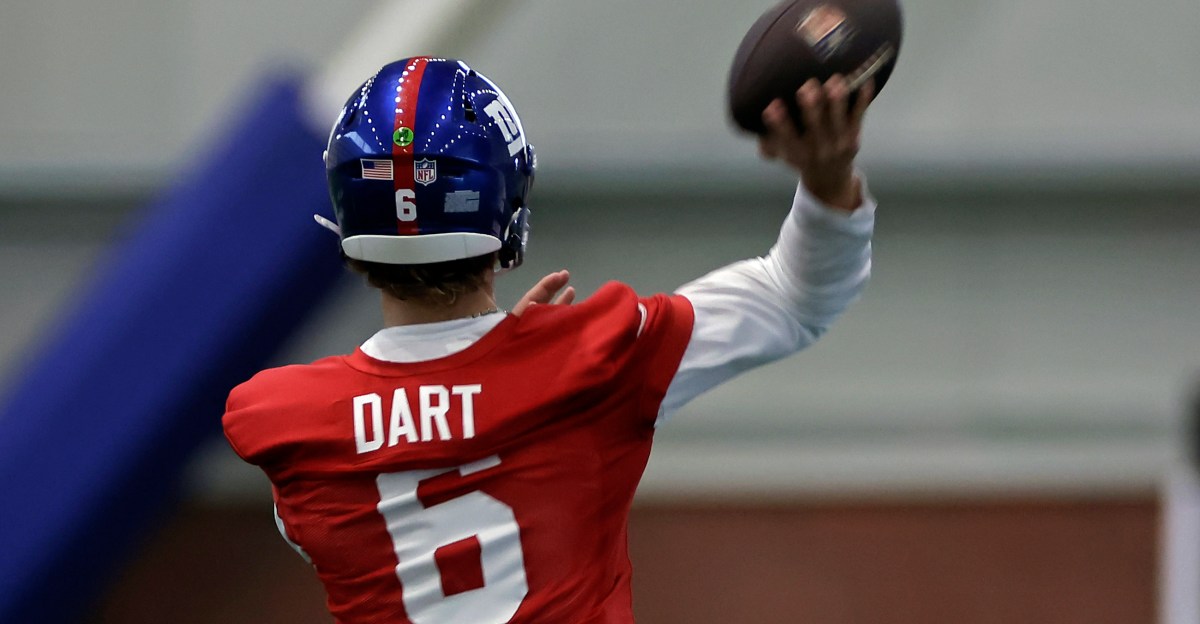
A persistent question dogged Jaxson Dart throughout the draft process, from the Senior Bowl to when the New York Giants traded up to select him at 25th overall in the 2025 NFL Draft.
Nobody disputes that Dart has the raw tools to be a starting quarterback at the NFL level. He has good size at roughly 6-foot-2, 225 pounds, with a strong enough arm to drive the ball. Likewise, he might not be a true “dual threat”, but he can extend plays or hurt the defense with his legs.
He also put up gaudy numbers his final year at Ole Miss, throwing for 4,276 yards and 29 touchdowns to just 6 interceptions. Dart led the FBS in yards off of deep passes, was sixth in average depth of target (11.9 yards), and was fifth in Big Time Throw rate (7.1 percent).
And yet there were persistent questions as to whether that would translate to the NFL.
Draft history is littered with failed quarterback prospects who pass the eye test with flying colors, but couldn’t make the mental leap. The worry was that Dart would fall in that category.
After all, Dart put up his numbers in Lane Kiffin’s offense. It’s an undeniably effective scheme at the collegiate level, but it also exploits the wider hashmarks to use extreme spacing to stress the defense. It’s also a relatively simple scheme that doesn’t put much of a mental load on the players and uses a wide variety of wrinkles with a relatively limited number of distinct concepts.
The questions weren’t whether Dart could physically execute at the NFL level – there was never really any doubt of that. The question was whether he could process at the NFL level.
That was the same question Sean Payton had when scouting a young quarterback at Texas Tech by the name of Patrick Mahomes. Mahomes was capable of truly impressive feats of creativity, but also did so in Kliff Kingsbury’s take on the Air Raid offense. While Kingsbury’s scheme had some concepts in common with the NFL, it was much more wide open and simple than what he’d see in the pro’s.
So, Payton set out to see if he could find some way to quantify a quarterback’s processing speed.
So he looked at quarterback stats and tried to see artifacts of processing speed. Rather than look at the positive stats – raw yardage, yards per attempt, or touchdowns, all of which could be impacted by scheme or surrounding talent – he looked at the bad plays. He settled on the rate at which a quarterback was sacked, fumbled, and threw interceptions.
He added those rates together, and decided that a lower sum generally signaled a faster processor.
The formula is, P = (S+F+I)
P = Processing score
S = Sack rate
F = Fumble rate
I = Interception rate
The rates all being over total dropbacks.
To bring this back to the New York Giants and Jaxson Dart, I decided to see how the Giants’ rookie quarterback – and hopefully QB Of The Future – fared.
Dart had 398 total dropbacks in 2024, with 28 sacks, two fumbles, and six interceptions. Therefore, he had a 6.6% sack rate, 0.5% fumble rate, and a 1.5 % interception rate. Plugging those into the formula, we get P = (6.6 + 0.5 + 1.5), for a P of 8.6, while completing 69.3% of his passes.
And as noted up above, they weren’t short, easy passes either.
For some context, Cam Ward’s “P-Score” (that’s the term I’ve been using) worked out to be an impressive 6.7 (67% completion), while Shedeur Sanders’ was 11 (74% completion).
Dart’s 8.6 lands squarely in the middle of those two numbers, and it also compares well to that of the top quarterbacks in the 2024 class. Caleb Williams had a P-Score of 17.5, Drake Maye had a P-Score of 10.5, and J.J. McCarthy had a P-Score of 7.8. Bo Nix, who Payton ultimately selected, had a P-Score of 2.3.
Mahomes, who first inspired Payton to try and quantify processing, scored an 8.1.
That isn’t to say that Nix is the next Peyton Manning-esque football savant. Nor is this to say that Jaxson Dart is going to be anything like Mahomes.
Payton’s formula is really more of a rough guide than anything else, but it does do a few pretty insightful things.
The first is that it uses rate and not just raw stats. That can give us a better idea of just how well, or poorly, a player is performing. After all, if two quarterbacks were each sacked 20 times, the raw numbers don’t tell us much. But if one dropped back 250 times while the other dropped back 500 times, that would give us a much better idea of which responded better to pressure.
The second is that it only uses negative outcomes. There’s a tendency to concentrate on highlight reel plays when evaluating players, but those can lead to a distorted perception of a player. The “gold standard” is raw game tape that shows highlights, lowlights, and everything in between. But mistake reels are also useful to study as well, because figuring out why a play had a negative outcome is often instructive. Were they over-aggressive or just unlucky? Or did they fail to read a concept or defense correctly? Or did they just freeze – or worse, panic?
The rate of negative plays can throw up a red flag that those negative outcomes need to be studied more closely.
And finally, those stats are all pretty sticky. In other words, they all have a reasonably strong correlation coefficient and a tendency to remain stable from college to the NFL, and from team to team. In general, a quarterback who is sacked a lot in college, will be sacked a lot in the NFL and it doesn’t much matter which team they go to either.
In fact, I myself use sack rate and interception rate in the “predictive stats” sections of my quarterback deep dives.
The fact that Dart’s rate of negative plays is pretty darn low lends credence to the positive reports from people like Louis Riddick, Jon Gruden, and the Giants’ own praise of how he can absorb information. There were also reports that Dart’s intelligence and processing allowed Lane Kiffin to expand the playbook over time to incorporate more West Coast concepts.
There’s a difference between traits and skills, and in many ways Dart is in a similar place as a hyper-athletic skill position player. He has the tools to succeed, but still needs to master them.
The hope is that the relatively low rate at which he had negative plays suggests that he’ll adapt well as he takes on a much more sophisticated offense. The ability to take in a high volume of information, process it quickly, and make good decisions is absolutely crucial to success in the NFL at any position and at quarterback in particular.
Dart (probably) won’t come out of the gate at a Pro Bowl level, and we should probably expect him to make mistakes out of the gate. After all, his first throw of training camp was an interception and his early practices were littered with them. Then he seemed to settle in, process the defense more efficiently and made far more good (or great) throws than poor. Former NFL quarterback Chase Daniel recently broke down Dart’s play in camp and complimented how Dart is reading the defense and working through his progressions.
He improved every year at Ole Miss, which hopefully predicts regular improvement as a pro. Right now, however, we’ll want to see the baseline he establishes this week against the Bills, then how he builds upon it as the preseason progresses. And how he processes unfamiliar defenses will be a big part of that baseline and progress.
Let’s see if he proves that Payton’s formula is accurate.