
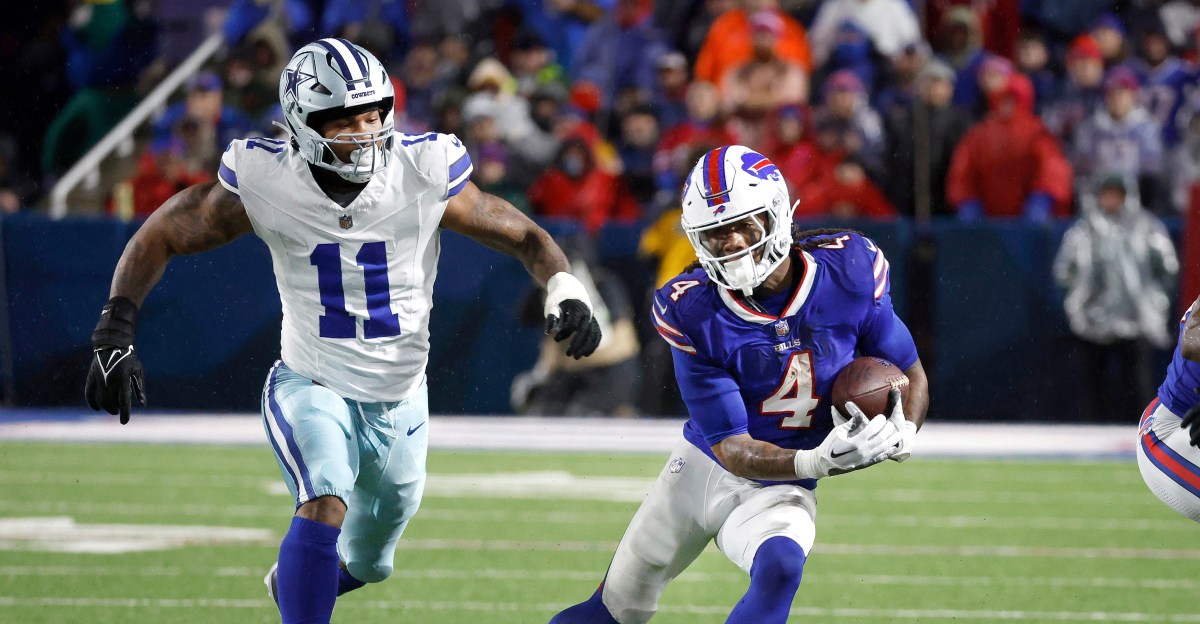
Dallas Cowboys star pass rusher Micah Parsons formally requested a trade a few days ago, announcing on social media that he “no longer wants to be” in Dallas. He has not partaken in the Cowboys’ practices during this summer’s training camp.
Not long after, Buffalo Bills running back James Cook decided to stand on “business” (a word he repeatedly used to describe his lack of involvement in practice) by literally standing on the sideline while the remainder of his healthy teammates prepared for the team’s first preseason game against the New York Giants.
At first glance, the hold-ins of Parsons and Cook may not appear to be connected in any way apart from the fact that they both exist. The players don’t share a position, a side of the ball, or even an agent. But as the natural questions that arise from the Parsons hold out come up, we find that the two players’ situations may have more in common than originally thought.
There are three major questions that originate from any conversation around a potentially high-priced trade acquisition:
Would I do it?How much would it cost?Can my team do it?
Everyone who wants to opine on the situation opines on these three items, often in concert.
Immediately after Parsons’ trade request was posted on social media, the question for almost every NFL fan base was “would you trade for Parsons?” The answer for essentially anyone who roots for their team playing good football was a resounding “yes,” followed by a conversation on what it would hypothetically cost. For a team that has consistently been let down by its defensive performance in the playoffs, most of Bills Mafia was aligned in saying they would love to have a player like Parsons on their team, even if the cost was very high.
The next logical question that pops up is “what would it cost.” Here’s where the Cook and Parsons situations start to connect. The Bills need a pass rusher. Many were shocked that the Cowboys waited until the fifth round to get a running back in the draft given their perceived need at the position.
It doesn’t take much connecting of the dots to begin seeing any hypothetical Bills offer to the Cowboys potentially including Cook. If the Cowboys aren’t willing to pay Parsons $40 million-plus per season, maybe they’d be more willing to meet James Cook’s $15 milion-plus average annual value demand.
The last question is one of feasibility. If a team has the desire to make the move and a desire to pay the necessary price, all of that is moot if they cannot feasibly make the finances work. The NFL salary cap is a highly flexible item, but it has its limits.
The truth is that neither Cook nor Parsons are likely to get moved. Players of Parson’s caliber rarely ever get moved even if their relationship with the team is seemingly strained. Cleveland Browns future Hall of Famer Myles Garrett changed his tune quickly when the Browns came to the table with the largest non-QB contract in NFL history for him.
But for the sake of this conversation, I’ll state the following:
Yes, I would make the trade for Micah Parsons;Yes, I would give up multiple firsts, plus A.J. Epenesa, Curtis Samuel, and James Cook to do so;Yes, the Bills can make it work.
The Bills would likely need (not even necessarily want) to move Epenesa and Samuel in any deal because they would need to move salary off their books. They don’t need to generate a surplus of $40 million cap space; they only need to fit Parsons’ current $24.7 million cap number into their books and can then sign him to a massive extension that actually lowers that 2025 cap number, with the larger numbers occurring in 2026 and beyond in his new contract.
So Cook and Parsons are loosely connected by the hypothetical trade that could make sense in a world of bubble gum, fairies, and rainbows that happens sometimes in a fantasy football league or in a Madden NFL video game. But the two of them are also connected by the diametrically opposed methodologies and strategies set forth by the player and the player’s representation around acquiring their desired outcomes.
Parsons went public and he went long form with his dissatisfaction. He spoke directly to the fans and explained why he arrived at the conclusion that he didn’t want to be in Dallas anymore. He told an unflattering story about Cowboys owner Jerry Jones attempting to circumvent Parsons’ agent and negotiate directly with the player in a conversation Parsons thought was going to be about leadership. The entire situation put Parsons in a very sympathetic light.
There are three sub sections of fandom from a public relations standpoint:
Fans who are almost always inclined to side with the organization in a disagreement;Fans who are almost always inclined to side with the player in a disagreement;Fans who situationally side with either the player or the team in a disagreement.
Much like in American right/left politics, the goal of the public relation war between a player (and their representation) and the team is to successfully gain the support of the fans in category three without losing your base (categories one or two). Winning the PR battle is not often a significant boon in leagues where the team has the amount of leverage that NFL organizations do, but it’s better to win than lose.
The Cowboys, and specifically Jerry Jones, won’t likely change their behavior. But if they were, it would be in response to public embarrassment — which only occurs when the player can tell their side of the story and have their side of the story be more than just “I wanted $45 million and they only offered $40 million.” Fans in category three don’t generally have sympathy for that unless the team’s offer is laughably below market.
Parsons’ approach sparked a national conversation about the tactics of Jerry Jones, with numerous other corroborating accounts coming to light of Jones attempting the same agent circumvention with other players that he was trying with Parsons. It was an understandable frustration the way Parsons put it, and given the Cowboys’ recent track record of dragging their feet when it comes time to pay their star players, Jones didn’t exactly have the benefit of the doubt in the mind of the public.
Let’s compare that approach to the one taken by James Cook. When given the opportunity (and the mic) to elaborate on his absence from practice over the last few days, Cook repeatedly used only one word to answer any question: “business.” He neither told a story nor gave any of the fans who could be swayed towards team or player based on a specific situation any reason to come to his side.
We know he wants money that the Bills aren’t currently offering. National insiders (being leaked info from either the team or Cook’s agent Matt Leist of LAA) have said that they don’t believe the team and Leist are that far off from a deal. Whether this is pacification from the Bills or Leist isn’t immediately clear, but the fact is that the fans don’t have a sympathetic story to rally behind Cook.
From a team perspective, this is a great thing in the any perceived PR battle. Cook and his agent can’t tell a story about the team that is demonstratively false; they can’t risk lying and having a general manager like Brandon Beane (prone to demonstrative media appearances) come out and call them out on their fiction. So if Beane and any Bills front office negotiator don’t pull a Jerry Jones and give Cook someone else to say, all he can say is “business.”
And “business” doesn’t get anyone on your side.
So while the easier connection between the Parsons and Cook situations is a hypothetical (and so unlikely it’s almost purely fictional) trade discussion, the potentially more interesting connection is the difference in which they’ve each handled their respective contract dissatisfaction, which then connects to the differing strategies employed by the Bills and the Cowboys.
And so while we wait on the inevitable anti-climactic resolution to the Cook and Parsons sagas, we can use our current situations to highlight the different organization philosophies at play.