
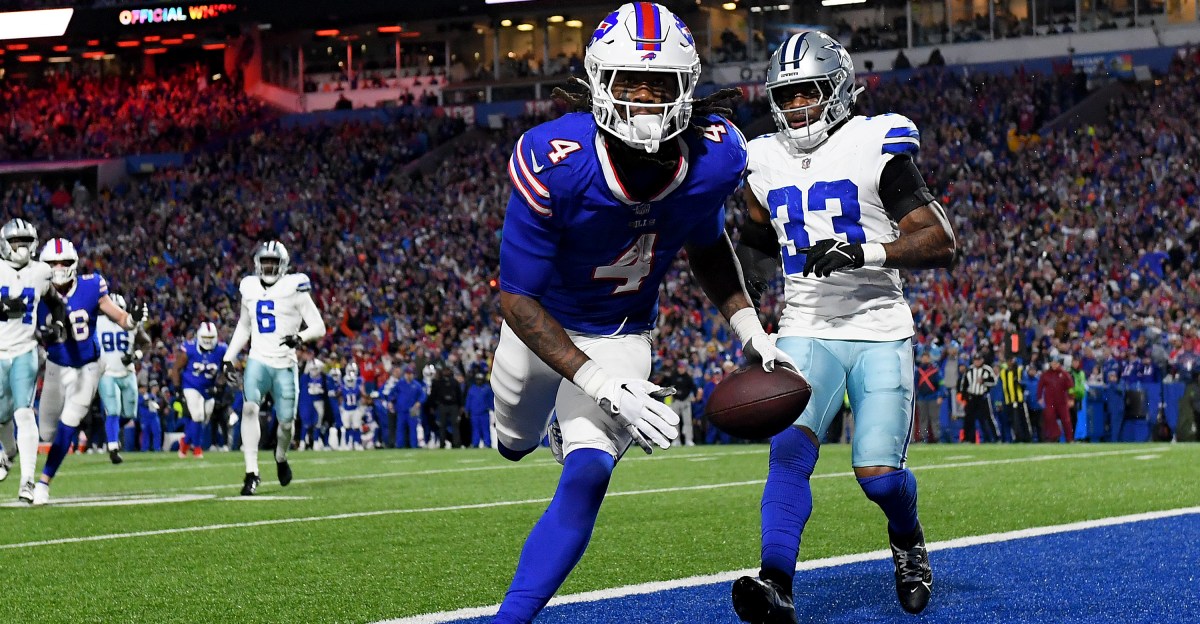
An oft-repeated phrase in plenty of Bills Mafia circles, the saying goes that, essentially, Buffalo Bills running back James Cook is an unreliable receiver. In the lead up to the 2022 NFL Draft, many analysts were quick to praise Cook for his dual-threat ability. With the Georgia Bulldogs, Cook proved capable lined up anywhere as a skill player.
Plenty of analysts saw him as a perfect complementary, change-of-pace back; perhaps someone ill-suited to featured work due to size and strength concerns, yet a potential matchup nightmare in passing situations thanks to his speed and hands. Respected draft analyst Lance Zierlein’s NFL comparison for Cook was none other than fellow Bills running back Darrynton Evans.
Bills fans were excited about Cook’s prospects in Orchard Park, NY — a more nuanced version of Alvin Kamara, if you will. Yet, no one quite knew what to expect from Cook. Was he the heir-apparent to C.J. Spiller, or someone destined to play a more thorough role given time in the system?
At Georgia Cook was part of a timeshare and employed as a true X-factor, his best season coming as a senior where he had 113 rushes for 728 yards and seven touchdowns; adding 27 receptions for 284 yards and four more scores. In four seasons with the Bulldogs, Cook carried the ball 230 times for 1,503 yards and 14 touchdowns; with 67 receptions for 730 yards and six touchdowns.
At first blush, those numbers are good (heavily lifted by his senior season), but not representative of a featured back. Hence the analysis trends being what they were about Cook. Yet consider that the Bulldogs had an enviable roster of running backs, with D’Andre Swift and Zamir White leading the way during much of Cook’s time at Georgia. But Cook was too good to keep off the field, and he made teams pay almost every time he touched the ball.
His reputation as a versatile receiver caught everyone’s attention, and it became near-routine to see him take outlet passes far beyond expectations or haul in downfield grabs for huge gains. James Cook was the perfect X-factor the likes of which general manager Brandon Beane had sought out since day one.
Yet Cook’s rookie season didn’t have the most promising beginning; that fumble on his first carry set him in head coach Sean McDermott’s doghouse. It was a place that Cook found himself in a few times over the course of his first two NFL campaigns. Though he wasn’t the only player who didn’t perform up to his coach’s expectations, it was often only Cook who wasn’t on the field with the offense in situations that demanded his ability.
Though just speculation here, what many saw as “tough love” being doled out by McDermott may have been rooted in deeper on-field concerns about Cook. After all, no team has ever lost a game on a fumble in the first quarter, the first play of a game. Right?
Suddenly, people began to focus in on Cook’s role as a receiver, noting how often he appeared incapable of corralling passes from quarterback Josh Allen. However, that criticism of Cook seems misguided to me. In looking at Cook’s NFL stats with Pro Football Reference, one thing stands out: his efficiency, both as a runner and receiver.
We well-understand Cook’s ability as a runner, where he’s proven doubters wrong about his toughness between the tackles as a down-hill runner, and ability to break would-be tackles on swings outside the hashes. It’s Cook’s role as a receiver where I believe people misunderstand him.
During Buffalo’s 2024 season, Cook caught 32 of 38 passes thrown his way for 258 yards in 16 games. His 2023 season represents a high point to this point in his career, hauling in 44 receptions on 54 targets for 445 yards and four touchdowns. Overall, he’s made 97 receptions on 124 targets for 883 yards through three professional seasons.
The idea that Cook drops too many passes is false. What has plagued Cook is dropping passes in big moments, namely certain scoring opportunities. What people really mean is that Cook seems to drop all the important passes — that he can’t be trusted down to down. Again, that’s false.
For the role that Cook has carved out for himself (and which continues being defined by offensive coordinator Joe Brady), it feels to me like the team could find more creative ways to use him in the passing game. Split out wide, in the slot, as part of two-back look; all of it may benefit Cook if he were to see more of those opportunities.
If the Bills don’t trust Cook as a pass blocker, they should find more ways to get him on the field as a receiver in those moments. That would give defensive coordinators more to worry about in, say, win-or-go-home situations. For all the great things that both Ray Davis and Ty Johnson bring as rushers and receivers, neither plays as explosively as regularly as does Cook. Adherence to 12 personnel (two tight ends) or using one running back in third-down passing situations only serves to limit Buffalo’s potential.
Cook is one of but a few players capable of taking it to the house from anywhere on the field. Well, at least when he’s not on the sideline. He has the potential to influence a game the way New Orleans Saints running back Alvin Kamara did in his best seasons.
The offense is different now that Stefon Diggs isn’t a Bill, and that should open the door for Cook to take a bit of Diggs’ downfield reigns, similar in scope to Kamara. Cook has come a long way since being drafted, essentially developing counter to what he was expected to become in the NFL. He’s a more complete, classic dual-threat running back — but one who has shown too many struggles trying to block pass rushers.
I’m not here to debate Cook’s efficacy as a pass blocker. That, alone, has proven detrimental to his status as a three-down back, and may very well cost him some significant money when he signs his next contract. Buffalo’s brass likely doesn’t endeavor to pay any running back top-five money for part-time work, no matter how much they produce in that limited role. Yet, there’s room to question if only Cook is to blame for his timeshare situation.
It’s worth wondering at this point whether or not Cook’s pass-blocking deficiencies should be enough to sideline him when the team could most-use a play maker. Plenty of people focus on how much Cook should be paid, whether it should come from One Bills Drive, and if the team needs him at all.
To me, it’s how Cook has been and will be utilized within the Bills’ offense that’s a vitally important facet to these discussions. That is, if Buffalo’s decision makers have limited Cook’s potential thanks to a playbook’s stogy paradigms.