
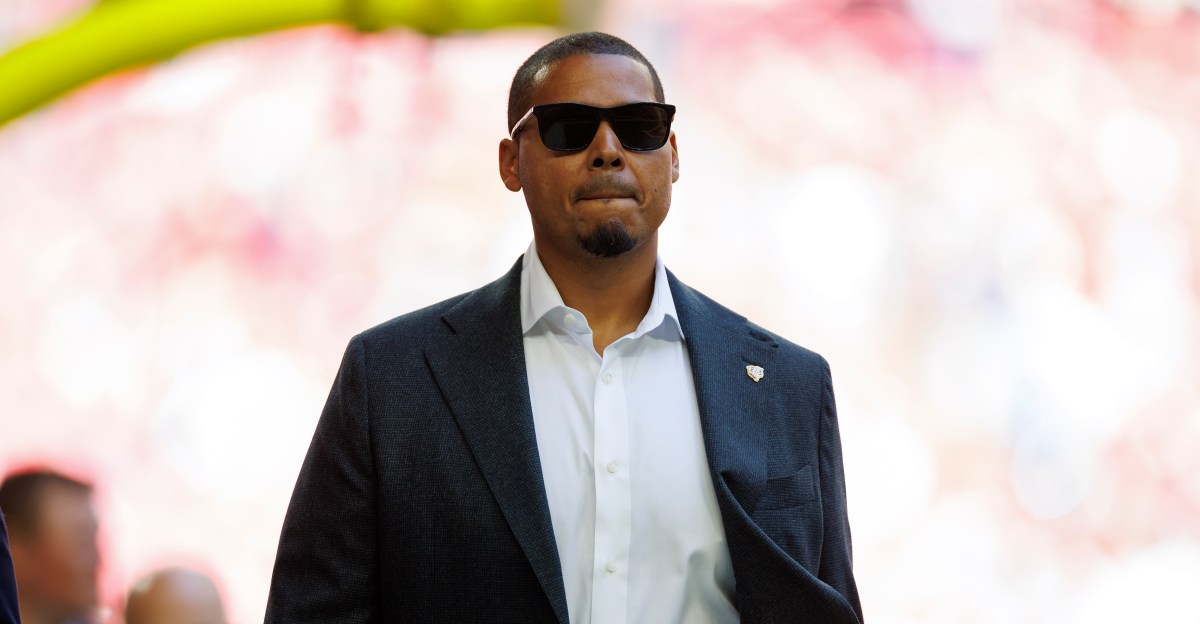
The 2025 NFL draft saw the conclusion of the Carolina-Bears trade that offered Ryan Poles a wealth of draft capital. Notable, as well, is that if Ben Johnson proves to be the answer at head coach, then Chicago cannot expect another Top 10 draft pick (unlike the last three years). This means that the front office might need to build its draft capital in other ways—ways that frankly are more traditional for competitive teams.
Poles is familiar with the process in both directions. He certainly isn’t afraid to trade for players ahead of free agency, with Joe Thuney and Jonah Jackson being the most recent examples. To be fair, Ryan Poles is also not afraid to trade players away (e.g. Robert Quinn, Khalil Mack, Roquan Smith). He understands how this game is played. With that in mind, here are three places Ryan Poles might want to consider leveraging assets to add to his pool of draft picks.
The Left Tackle Situation
Starting-level offensive linemen don’t tend to be traded, and the ones who are typically are seeking large contracts because they already have considerable accolades behind them. The highest-value trade packages all had multiple Pro Bowl honors at the time of these transactions. Braxton Jones likely does not fit into this category.
The three recent trades who are closest to Braxton Jones are arguably Marcus Cannon (RT, age 33), Kevin Dotson (OG, age 27), and Cam Robinson (LT, age 29). Of these, Cannon had two years left on his contract but was coming off of a season where he did not compete due to COVID. Dotson had one year left on his contract and had been playing at what was probably at least a slightly above-average level before his trade. Robinson was also in his final year and had been performing as a competent starter.
In each of these cases, no new picks were acquired. Cannon was traded with a 5th-round pick for a 4th-round pick while the teams also swapped 6th-round picks. When Dotson was traded along with a 5th-round and 6th-round pick, he earned the Steelers a 4th-round pick and a future 5th-round pick. Finally, before the 2024 trade deadline, Cam Robinson was sent with a 2026 7th-rounder for a 2026 5th-rounder that could theoretically become a 2026 4th-rounder.
In each of these cases, the value gained was that of 5th- or 6th-round selection. Almost all of the other offensive line trades in the last five years have been for players, picks of lesser value than this, or lesser pick swaps. If this is the most interest available for Jones, this is an easy decision. Chicago needs a backup plan on the offensive line more than it needs an earlier Day 3 selection, but if some team is desperate enough to offer a Day 2 pick before the deadline, that’s another matter.
Best Case Scenario: A team like the Chargers suffers a setback and offers a Day 2 pick for Jones, leaving Chicago with Trapilo at starter and Amegadjie as backup.
Alternate Scenario: Jones leaves in free agency and signs a large enough deal to qualify for a 4th-round compensatory pick (which means he would probably need to be paid like a top-20 starting left tackle, but not like a top-10 one).
Cole Kmet is probably in regular contact with his agent, and should have been since the first day of the 2025 draft, if not longer. It seems unlikely that for the long haul Kmet and Loveland with get enough reps to justify their respective salaries and draft positions. The obvious point of comparison for trading Kmet would be when Detroit traded T.J. Hockenson and 4th-round picks (in consecutive years) for a 2nd-round pick and a future 3rd-round pick. Hockenson was 25 (Kmet is 26) and had a Pro Bowl season but production comparable to Kmet’s. However, Hockenson had over a year left on a cheap rookie contract while Kmet has already been signed to one of the ten most-expensive tight end contracts in the league.
Hayden Hurst is another possible comparison point, because he was traded to Atlanta and despite being a far lesser contributor than Hockenson or Kmet, he was bundled with a 4th-round pick in order to earn the Ravens a 2nd-round pick and a 5th-round pick. However, he once more was under a rookie deal for at least two more years.
Darren Waller was 30 and in the middle of a high-value contract when he was traded for a 3rd-round pick; Waller had once been a Pro Bowler and had two different thousand-yard seasons, but he had also seen waning production. Zach Ertz was 31 and in the final year of an extension on his rookie deal with three Pro Bowl seasons under his belt; he was traded for Tay Gowan and a 5th-round pick.
This suggests that while his youth and his production are on his side, his contract status might impact his value.
Best Case Scenario: Kmet is reunited with Justin Fields in New York. Because New York’s Day 2 picks are tangled up with the Reddick trade, Poles might delay gratification a little and take a 2026 4th-round pick and a conditional pick in 2027 that could be worth as much as a 2nd-round selection or as little as another 4th-round selection.
Alternate Scenario: The Titans’ desire to set Ward up for success draws an unencumbered Day 2 selection from them for 2026.
When Ryan Poles drafted both Colston Loveland and Luther Burden in the Top 50 of the 2025 draft, he created a logjam at pass-catcher. With DJ Moore, Rome Odunze, Olamide Zacchaeus, and Cole Kmet already on the roster and expected to see action, that made six quality pass targets in addition to a pass-catching running back in D’Andre Swift. This is after also signing Durham Smythe in free agency. What does that mean for the back end of the roster?
One idea that will earn considerable attention is the prospect of trading DJ Moore, but such a move would deprive the pairing of Caleb Williams and Ben Johnson of the most reliable receiver on the team–which would be unexpected given how much the team has worked at flexing Moore into various additional roles this summer. Moore is essentially the proven and experienced threat on the team.
It’s worth considering the value of Tyler Scott, and the 23-year-old still has the speed that made him a fan favorite draft pick in 2023, even if he has limited production to date. However, on the last five years pretty much the only team to trade for a wide receiver with such limited production has been Chicago (N’Keal Harry and Jakeem Grant were both picked up by Chicago for very low trade value–a 7th-round pick and a future 6th-round pick–and even they had proven more than Scott has to date).
Best Case Scenario: The receiver room is crowded but productive in 2025, with too many quality targets being on the list of ridiculous things to complain about. Heading into 2026, Poles can assess the merits of trading the final four years of Moore’s contract (he would be only 29) after gaining more confidence in Odunze and Burden.
Alternate Scenario: A team decides to risk a future pick from the end of the draft (a 2027 7th-rounder for example) for Scott.
Good teams end up developing more talent than they can keep, and they find ways to recoup value from those players. On the simplest level, teams do not extend free agents who then walk away and feed the comp pick formula. However, teams can also get younger and add to the talent pool by trading away players before they decline or in order to replace them with cost-controlled alteratives. If Poles successfully moves the Bears into the playoff contention, he will need to be willing and able to lose pieces at crowded positions in order to keep his own options open in the future.