
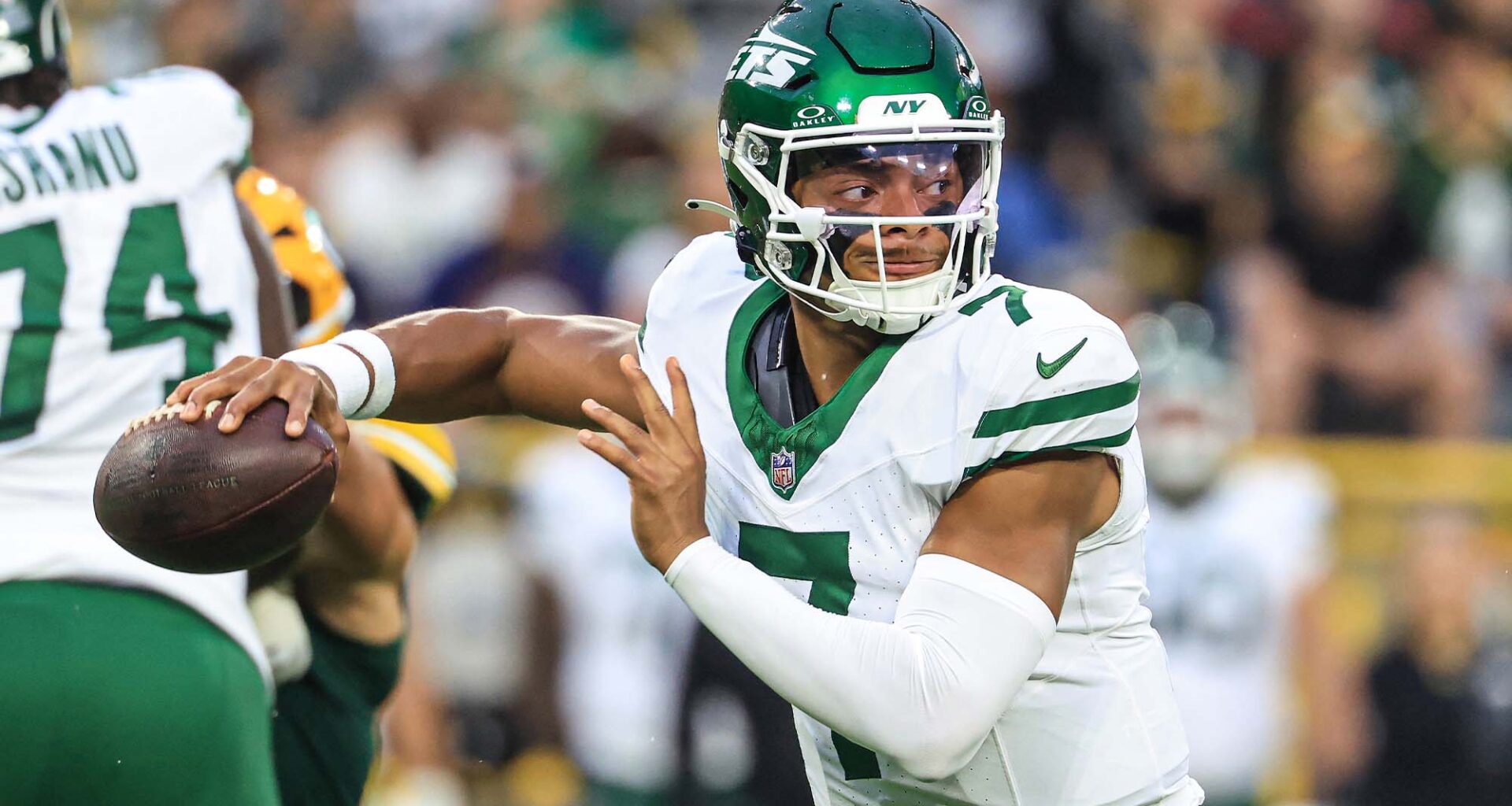
Justin Fields has made his first live-game appearance as the New York Jets’ starting quarterback.
How did he do?
Prior to Saturday’s preseason opener, I broke down the proper way to evaluate Fields’ performance in Green Bay. I implored fans to ignore Fields’ box score stats and evaluate his process instead.
These were the three aspects of Fields’ game where I wanted to see him excel:
Release speed/Decisiveness
Contextualized accuracy
Decision-making consistency
Focusing on Fields’ performance in these areas can help us gauge the status of his development as he seeks a breakout season in Year 5.
Let’s analyze each of Fields’ six dropbacks in Green Bay.
Play 1: 3rd & 5 at NYJ 26
The Jets began the drive with two handoffs to Breece Hall. While they only yielded a combined five yards, it put Fields in a manageable third down situation.
Expect the Jets to frequently use this run-run-pass strategy to take pressure off Fields’ shoulders on third down. If they can consistently churn out chunks of positive yards on first and second down, it could work pretty well.
Now, let’s talk about the play itself. Fields checks all three boxes on this play: he’s quick and decisive, accurate, and makes the right decision.
Post-snap, Fields sees the Packers’ middle linebacker turn his back and retreat into a zone well beyond the first down marker, which tells him that Tyler Johnson will be wide-open in the shallow middle. Knowing he only needs five yards here – and that the coverage call is designed to stop the deeper routes, anyway – Fields bypasses his downfield options and quickly progresses to Johnson.
If we want to nitpick, Fields could have possibly gotten this out a split-second faster – there is definitely a tiny hitch/hesitation at the top of his drop – but he gets the ball to Johnson with plenty of time for him to put his head down and get the first.
Take note of the pass protection, too, which was excellent for the Jets throughout this game. Olu Fashanu and Joe Tippmann lock down the left side, with help from Isaiah Davis, while Armand Membou and Alijah Vera-Tucker handle a stunt on the right side.
Play 2: 1st & 10 at NYJ 32
After moving the chains, Tanner Engstrand comes back with a quick-passing concept on first down. All of these routes are shallow; the play is designed for Fields to make a pre-snap decision and release the ball immediately to his favorite option.
This is a good rep for Fields in terms of decision-making. After sending Garrett Wilson into pre-snap motion, Fields can tell based on the defense’s reaction that it’s probably Cover 3, which means Wilson’s man will likely bail into deep zone coverage and leave Wilson uncontested on the speed out. Based on this, Fields already knows he is going to Wilson before the ball is snapped.
Post-snap, Fields confirms this information by reading the safety, and then makes the quick and proper decision to target his best receiver against soft coverage. There is still a slight hesitation in his throwing process that you would like to see him eliminate – his mechanics feel clunky – but he gets this out with plenty of time to hit Wilson before the coverage closes in.
However, Fields puts the ball too far outside, forcing Wilson to make a diving attempt. It’s a catch that Wilson can make, but Fields shouldn’t make it this difficult to catch a 5-yard out route to the boundary side (with no pressure in the pocket). Fields would definitely like this one back.
Play 3: 2nd & 10 at NYJ 32
Give Engstrand credit for putting the ball right back into his quarterback’s hands on second-and-10 after a first down whiff. Fields rewards his OC’s confidence.
Nothing too crazy here: Just Fields playing the quarterback position efficiently, which is precisely what the Jets want to see from him.
Fields takes a seven-step drop off play action. We can’t see exactly what they ran without the All-22, but the Jets have their outside receivers, Wilson and Arian Smith, running vertical routes to clear out the defense. Seeing the linebackers gain depth and widen, Fields quickly recognizes that Andrew Beck is coming open in the middle of the field, and Fields doesn’t hesitate to let it rip as soon as he sets his feet.
Fields looks smoother and more decisive on this rep than the previous one. There’s less clunk to his throwing motion; he looks confident and assured in his decision, which allows him to rip the ball smoothly. Fields has excellent velocity, so if he is throwing confidently with no hitches, he can get the ball to his man in a hurry.
With a quick/decisive release, proper decision-making, and good accuracy (although this is one of the easiest passes you could attempt, so I sure hope he can hit it), it’s another plus rep for Fields.
Give credit to the pass protection once again. Fashanu and Membou keep the edges clean, but the key block belongs to Vera-Tucker. Left in a one-on-one situation, Vera-Tucker influences his man to the outside, keeping the throwing lane clean for Fields.
Play 4: 1st & 10 at GB 42
After a 14-yard run by Braelon Allen, Engstrand goes back to Fields for his fourth dropback in five plays. It shows that, while the Jets will be a run-first team, Engstrand will not hesitate to let Fields control a drive if the situation calls for it.
The Jets run play action to Isaiah Davis, and despite Allen gaining 14 yards on the previous play, the linebackers don’t buy it. Once again, the linebackers gain plenty of depth, and Fields makes the boring-yet-correct decision: just check it down and keep it moving.
There is a little more havoc in the pocket this time, but Fields stays calm and stands tall in the pocket instead of scrambling. He steps up into the open space and delivers the throw. As fun as it is to watch Fields run around, it’s plays like this that he must make more often to reach his ceiling. If there’s an open man, hang in there and hit him.
Based on his usage with the starters on Saturday, it sure seems like Beck is going to play a key role in the Jets’ offense. Not only can he be used as a fullback, but the Jets also used him as an H-back and a traditional Y tight end. He is arguably the Jets’ best skill-position blocker, and, as he showed last night, a competent pass catcher.
Mason Taylor’s absence paved the way for Beck to get more reps, and he took full advantage of them.
Play 5: 2nd & 6 at GB 14
The 24-yard pass to Beck was followed by a four-yard Breece Hall run (despite the broadcast saying 2nd & 7). On second down, Engstrand went back to Fields with a play action bootleg to the field side.
Fields’ first read is Josh Reynolds (bottom-most WR). While we can’t see for sure without the All-22, it seems obvious that Reynolds is covered on his deep corner route, as he’s bracketed by the safety and cornerback. Fields’ second option is Wilson on the shallow crosser, and he’s double-covered as well.
Fields’ third option is Johnson, who sits near the line of scrimmage and is open. There’s only one defender in his area, and it’s a defensive tackle, so Johnson could have made a big YAC play if Fields hit him.
However, I commend Fields for bypassing Johnson. To hit Johnson, Fields would have had to throw across his body toward the middle of the field – with a defender pressuring him, to boot. That is the most dangerous throw a quarterback could make. In fact, Fields threw an interception in a recent camp practice on a play just like this, per Jets X-Factor’s Robby Sabo.
We want to see Fields eliminate dangerous throws from his game, so it’s a positive for the long term that he decided against this pass, even if it may have yielded a good result in this specific situation.
Fields goes to his fourth option, tucking it and taking a one-yard gain to put himself in third-and-manageable. It’s the safe decision, which is a good sign for the development of this particular quarterback.
Play 6: 3rd & 5 at GB 13
Now this is the stuff that shows why New York still believes that Fields can be a star. There is probably only one other quarterback in the league who could step up at the 20-yard line while being grabbed and still be a threat to score the ball.
But there is still a lesson to be learned.
Fields starts his read to the boundary side. He wants Wilson on the out route past the sticks. Based on the coverage (the DB playing over the top, anticipating a vertical route), Fields can see that Wilson will likely be open. However, just at the moment when Fields is about to wind up, he sees pressure bearing down in the throwing lane, so he tucks the ball and steps up.
One could argue that Fields had time to stand in there and anticipate this throw to Wilson. As Wilson comes out of his break, Fields is still standing in a clean pocket with no defender within three yards of him. A quarterback with elite anticipation probably would have made this throw.
Even if Fields weren’t deterred by the pressure, he may have been late on his throw to Wilson anyway, based on how late into Wilson’s route that Fields still had not begun winding up. With top-tier anticipation, this ball would have already been in the air when Wilson turns his head around.
Fields must improve his anticipation so he can hit throws like this one more consistently. However, what allows Fields to survive as an NFL starter is that he is talented enough to miss an opportunity like this and still make magic happen.
Fields’ process after bypassing Wilson is good. He doesn’t panic or look frazzled by his surroundings. The fifth-year vet shows excellent pocket awareness; he knows where his safe space is, and he takes advantage of it.
You also love to see Fields stepping up instead of running backwards. This does two things for him: It keeps all of his passing options available (as opposed to cutting the field in half), and it requires him to cover significantly less distance if he wants to scramble and make a play himself.
Outside of the designed bootleg, Fields never bailed the pocket on his other five dropbacks in this game. He always stepped up and through the pocket. That is a positive sign for his development. The more he does that, the more effective he will be. He must trust that the outside-the-pocket scrambling will come up instinctively when the situation demands it. Otherwise, though, his go-to process should be to climb the pocket.
Back to the play. Once Fields steps up, he immediately decides that he is taking this thing himself. He doesn’t scan his passing options at all. That’s the wise decision in this situation, because Fields sees the green grass in front of him and knows that he has the speed to outrun the lone linebacker who stands in his way.
Fields’ burst is a sight to behold. He sticks his foot in the ground and reaches his top speed in a flash (the toe clearly isn’t bothering him). Then, once he gets going, it is eye-popping to watch how much faster he is than the front-seven defenders who try to catch him.
Give a ton of credit to Isaiah Davis on this play.
Davis improvises into a vertical route once he sees Fields stepping up, which causes the linebacker to start trailing him toward the back of the end zone. But once Davis sees that Fields is running in his direction, he makes an incredibly savvy heads-up play.
Instead of trying to block his man, Davis extends his hands as if the ball is in the air, which dupes the linebacker into chasing him toward the back pylon. Davis tricks the linebacker into being completely unaware of Fields’ scramble, which is what opens up the space for Fields to reach the goal line.
Great pass protection by the Jets’ tackles, too.
Takeaways
Fields only ran six plays of a vanilla offense, so it would be silly to put too many words in this section.
Still, this was a positive outing for Fields overall. He was quick and decisive for the most part, he usually chose the best option available, and he was willing to take the “boring” or “safe” options to keep the offense moving forward.
We saw one accuracy whiff from Fields, and a few instances of the trademark clunkiness in his mechanics. His processing still seems a tad slow at times. These things could be ironed out with more experience in a brand-new scheme and organization, but they are also things he has struggled with for his entire career, so we will have to wait and see whether they are fixable or not.
Do we give letter grades for six-play appearances in the preseason? Is that legal? I’m not sure if it is, so if I never write another article after this, you’ll know why.
But here it goes: I’ll give Fields an A- for this one. After a shaky start to training camp, you wanted to see Fields come out in a live-game environment and show some signs of hope that can be built upon, and I think you got them.