
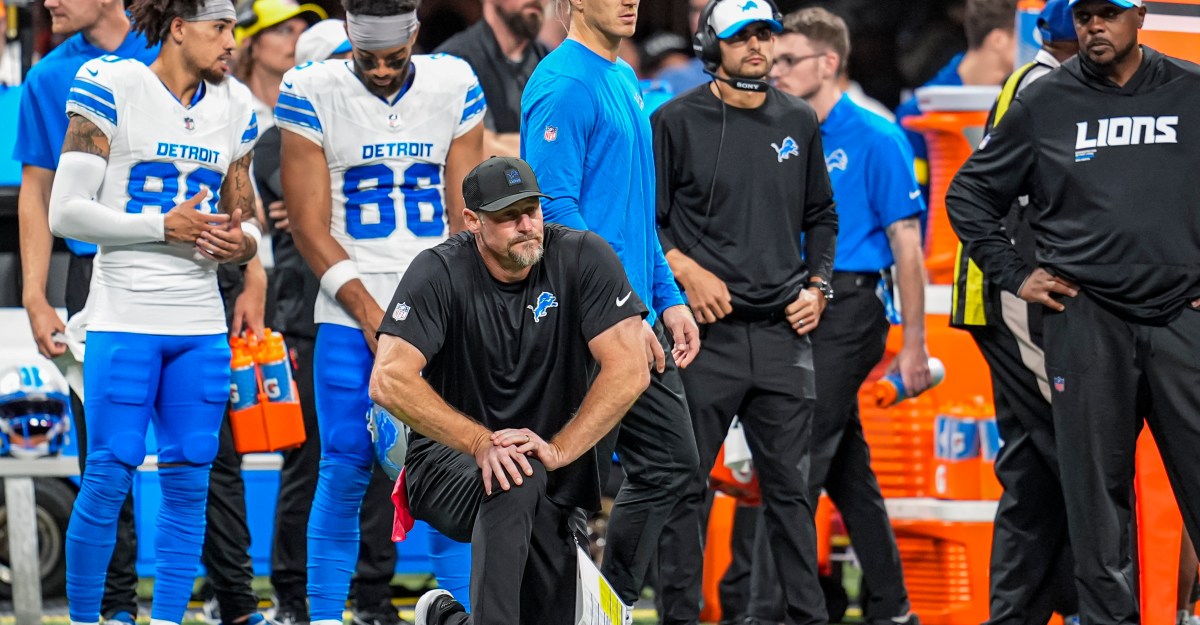
The injury bug is a terrible thing, and the Detroit Lions are seemingly suffering an outbreak.
After a 2024 campaign marred by injuries up and down the roster, 2025 is not off to a better start. Defensive lineman Levi Onwuzurike underwent season-ending shoulder surgery before the start of training camp. The Lions will be without young defensive backs Ennis Rakestraw Jr. and Dan Jackson for the 2025 campaign due to shoulder and leg injuries, respectively. Just days after the Lions’ second preseason game, a trio of players landed on the injured reserve: offensive linemen Colby Sorsdal and Justin Herron, as well as tight end Kenny Yeboah.
Not even two weeks into August, the Lions are already looking at a depleted roster. Six players are out for the season, while players like Alim McNeill and Malcolm Rodriguez are likely to miss the start of the regular season. Sprinkle in question marks like Josh Paschal, Mekhi Wingo, and Miles Frazier, and the injury questions are stacking up.
Given how 2024 played out and how this season has started, is there an issue with how the Lions conduct themselves with regards to player health? How can a football team be so marred by injuries? Is there rhyme or reason to it, or are the fates simply not cooperating?
Today’s Question of the Day is:
Do the Detroit Lions have an injury problem?
My answer: Yes and no. The Lions are losing valuable contributors at a seemingly above-average rate, so I would agree that the Lions have an injury problem. However, I do not believe that this wave of injuries in recent seasons is an internal issue with the organization.
When Sorsdal, Yeboah, and Herron were added to the injured reserve on Sunday, there were many immediate responses blaming aspects of the team in some way. Are the Lions playing too physically, especially in the preseason? Is the Lions’ strength and conditioning team subpar for allowing all of these ailments to occur? Is general manager Brad Holmes to blame for acquiring injury-prone talent? Each of these points are worth discussing, sure, but blaming one as the cause of the Lions’ injury woes is simply not fair nor realistic.
Look at the devastating incident involving Morice Norris. The outcome of the tackle was horrific for fans and players alike, but it was a tackle attempt that is normally benign. Football is a dangerous sport, and moments like that are dark reminders that the difference between a serious injury and a normal down is often just chance. If that tackle is safe 99 percent of the time, then that was the rare instance that it was not. The coaches and coordinators are not at fault for encouraging physicality in their game. If anything, adapting to physical play early on can better prepare someone for reps during more meaningful games. Learning how to hit and how to take hits is a crucial part of the ramp up portion of the training camp. Adopting a passive training camp environment would only result in ill-prepared players come the regular season. You have to accept that injuries will forever be part of playing football.
The blame towards the Lions’ medical staff is perplexing to me. Hiring new trainers is not a cure-all solution to this string of injuries. A proper training and recovery program can help mitigate the risk of injury, but not eliminate the risk of injury. This is not a case of negligence or malpractice. Sometimes a player’s body fails them. Other times, an unpredictable freak injury occurs—football is a chaotic sport. There is nothing that the training staff could do to prevent Aidan Hutchinson from breaking his fibula and tibia last season. Players are human beings, injuries can and will happen despite everyone’s best efforts. Instead of faulting the training staff for injuries, they should receive praise for the unsung work they do behind the scenes. For example, Hutchinson doesn’t return to form without them.
The notion that a player is “injury prone” is a valid one, but one thrown around too often—if a player gets hurt too many times, you just slap the label on them, end of discussion. Holmes has bet on some players with extensive injury histories, without question. Emmanuel Moseley joined Detroit after suffering an ACL injury the season prior, but he spent a majority of his Lions tenure on the injured reserve list. The Lions signed an oft-injured Marcus Davenport, and he only managed two games with Detroit before getting hurt. Levi Onwuzuruike has battled injuries since being drafted, and will now miss all of 2025. Cornerback Ennis Rakestraw had a checkered injury history in college, and he too is out for the upcoming season.
However, it is worth remembering how they got injured. Moseley had torn his left ACL with the San Francisco 49ers in 2022. Though he suffered a torn ACL with the Lions, it was instead his right ACL. He tore his pectoral muscle the following year, making three straight injuries in three different locations. Davenport, meanwhile, had suffered through ankle and shoulder injuries during his prior NFL tenures, but it was a torn triceps that ended his first season in Detroit—again, on a freak play. Onwuzurike overcame his early-career back injury and thrived in 2024, but it was an ACL injury that wound up putting him on the reserve list this year. Rakestraw suffered a torn ACL in college and was bothered by a hamstring injury throughout 2024, but it was a shoulder injury that will force him to miss 2025.
All of these players had injury histories, but you also have to acknowledge that very few of these injuries were repeats. Is this a sign that these players are fragile, or is it a sign that the Lions are just unlucky? That’s for you to decide. On the other end of the spectrum, a formerly injury-prone Alex Anzalone has seen a renaissance with the Lions, while Tim Patrick had a fantastic turnaround season in 2024. If we are to criticize Holmes for his injury-prone signings, we should also commend him when it pays off.
The Lions have made steps towards building a safer environment for their players. In 2023, the turf at Ford Field was completely overhauled, ushering in a top-of-the-line field to protect every player on the field. Given the logistics of playing indoors in downtown Detroit, this was the best possible solution given the current turf technology. More recently, the Lions invested heavily into new and expanded locker rooms and weight rooms. The Lions organization is not being neglectful towards the health of their players.
All of this boils down to one question: why are the Lions getting hurt so much? The truth is not satisfying, nor is it comforting. It is just bad luck. A player, a coaching staff, and a training staff can do everything right, yet injuries will still happen. Football is a game of inches in more ways than one. Inches can be the difference between a win or a loss, but they can also be the difference between a career-derailing injury or a regular play. Bad injury luck is obvious—it means a lengthy injured reserve list, as we saw last year. Yet good injury luck? That often goes underappreciated. Going back to Norris’ injury, a tackle like that happens multiple times a game, yet we rarely acknowledge that the players involved were fortunate to escape injury.
Unfortunately, there is no easy way for the Lions to stay healthy. The Lions can be protective of their starters in preseason, but otherwise, it is simply a case of rotten luck.