
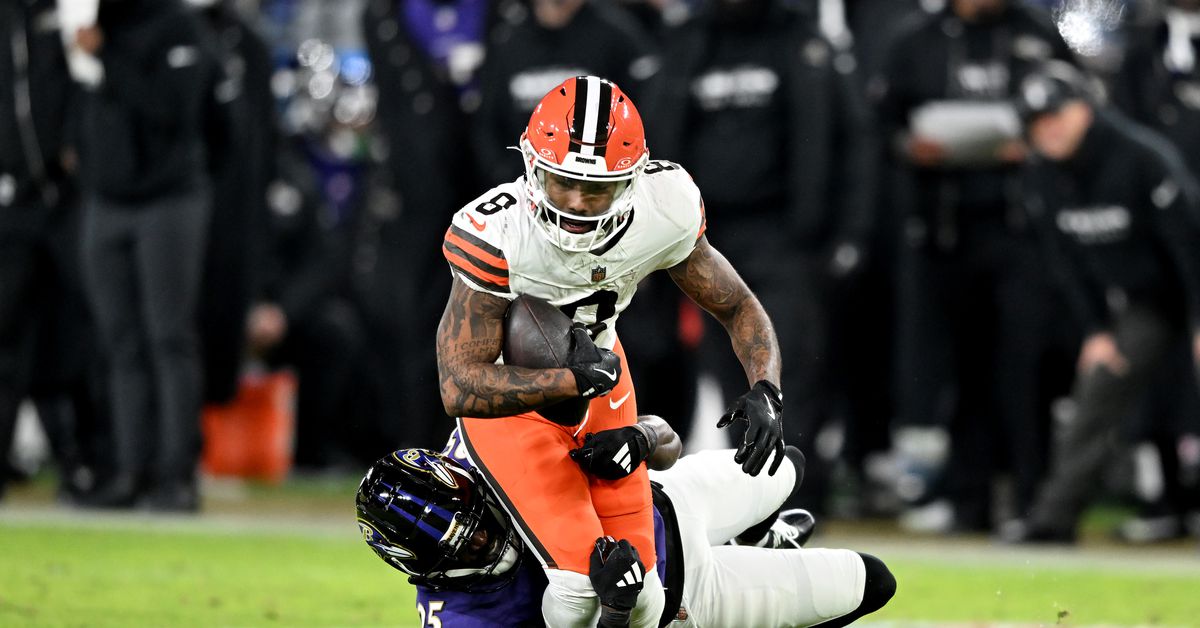
Buffalo Bills general manager Brandon Beane recently had a bit of a tirade regarding the team’s inability to draft a wide receiver with a premium pick in the 2025 NFL Draft. We may never know what precisely led to his uncharacteristic response but perhaps it was because he knew all along he’d be exploring other avenues to add firepower to the skill positions.
Shortly after Beane’s on-air radio appearance with WGR550, the Bills were in the news again, this time hosting free-agent wide receiver Elijah Moore at team facilities. Then on Wednesday, April 30, we found out that Moore was, in fact, signing with Buffalo for the 2025 NFL season.
So what does the former New York Jets and Cleveland Browns receiver Elijah Moore bring to the field? Let’s do some analysis.
On Elijah Moore’s potential
When Elijah Moore was drafted with the 34th pick in the 2021 NFL Draft, the Jets were likely focused on the information contained in this handy chart from mockdraftable.com.
Approaching the diminutive stature of Cole Beasley, Moore shouldn’t be expected to win jump balls as a 5’10, 180-pound wide receiver. But look at that speed! The shuttle times and three-cone drill results are also tantalizing aren’t they?
Want more charts? Who doesn’t want more charts?
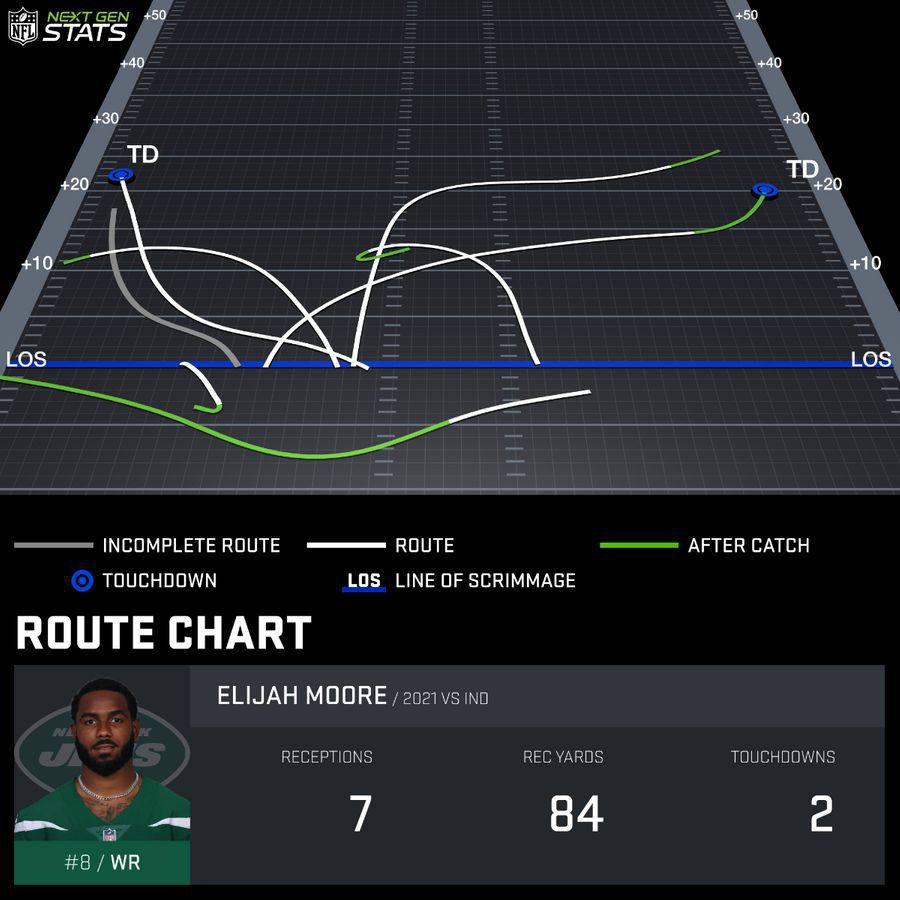
Moore doesn’t have a plethora of charts from Next Gen Stats, but the ones he does have paint a picture of what the Browns and Jets felt he could do. The one I embedded is in my opinion his most complete (charted) game. Honestly, this would be a very complete game for any player.
This chart wasn’t selected to suggest that Moore should be expected to produce these types of numbers or results all the time. I wanted this to serve as the illustration, one that shows a relatively diverse route tree with successful results. The game this represents had him primarily as a slot player, but looking through all his charts there’s a good amount of boundary use with the anticipated speed-dependent routes.
On-field analysis of Elijah Moore
The spider chart is of course Moore’s college performance/athleticism, and a lot can happen in a few years. In the spirit of “what have you done for me lately” let’s take a peek at Moore’s most productive game from 2024 — a loss against the Denver Broncos in which Moore caught eight passes (14 targets) for 111 yards.
Play 1 — A willing blocker

Did I mention that Elijah Moore is pretty small for an NFL wide receiver? I’m pretty sure I mentioned that. I don’t consider myself a very large person, I mean my nickname is “Skarekrow” after all. I’m significantly larger than Moore. Patrick Surtain II, who Moore was matched up with here is larger than me. Here, Elijah Moore effectively blocked the much larger Surtain.
Play 2 — Is this even allowed?
This was against Levi Wallace, a name I know we’re all familiar with. Wallace is not an All-Pro but he is a solid NFL starter. This was what, a triple move by Elijah Moore? If it weren’t for the fact that Moore has to flatten his route to the sideline to catch the ball this was a touchdown. He got preposterously open. I genuinely like Levi Wallace, which makes this a play where the potential of Moore jumps off the screen. This play right here is the gamble. This is who you hope you’re getting.
Play 3 — Snap back
I’m sure you’ve all figured out at this point that I’m a science nerd. But did you also know I used to be an anime nerd? One of my favorites is Rurouni Kenshin. In one of my favorite scenes, the titular character Kenshin is trying to defeat a much larger opponent without giving up any of his secret techniques. The much smaller Kenshin darts back and forth with extreme changes in direction until ultimately his much larger opponent’s body can’t cope with the change in momentum and his leg gives out.
While that’s just a cartoon, there is a reason that smaller receivers often thrive in the slot and Kenshin illustrates this expertly. Weight directly impacts change of direction capability thanks to the principle known as “momentum.” This isn’t the last time you’ll see this today, but Moore’s ability to turn back to the ball isn’t just a “turn.” I classify what he did here as “snapping” back to the ball. I don’t believe I need to discuss the result, which the GIF makes obvious.
Play 4 — Staying alive
Life in the slot requires a bit of bravery to be sure, as the job usually winds up in traffic in the middle of the field. I give Moore kudos for something I often praised in Stefon Diggs’ play. Namely, knowing how to live to fight another day. Moore made the catch but did so without giving up a big hit.
Play 5 — So close
I’m gonna level with y’all. I pride myself on trying to show a balanced perspective of things, but with Elijah Moore it was difficult to avoid giddiness. Play after play there was something to delight in. That said, let’s not measure his gold jacket just yet.
This wasn’t the best throw by any means, but the lack of height and reach looms large here. Smaller players = smaller windows. There’s no getting around that. I would also add that I chose one of Moore’s best games of the season and even then there’s a play or two I bet he’d want back. Let’s move on to the conclusion…
The Final Straw
I do generally try to see the good in new acquisitions for the Buffalo Bills, but I have to say Elijah Moore feels different. Moore has the capability to open up possibilities for the offense much like Cole Beasley did. That “easy button” when you need it. That guy who can be open almost anywhere on the field when you need it.
I’m going to do two atypical things. First, I’m going to end with a GIF in the summary section and GIFs are usually reserved for up above. Second, I’m going to trash talk.
I’m as big a fan as Joe Flacco as anyone but 2021 – current Joe Flacco can’t hold a candle to Josh Allen. Joe Flacco has to be hands down the best quarterback Moore has played with. Take a look at the GIF I’m ending with and let’s pretend that Josh Allen is the quarterback.