
The key to a successful draft is figuring out where the market is irrationally low on players and irrationally high. You target the former at ADP because the prices are so low that they give you such upside if you’re right about the market being wrong, without much downside. I recently wrote about the best examples of those players. Now, let’s look at the pitfalls to avoid by ignoring the inflated prices of the following players in fantasy drafts.
I’m basing prices on current Fantasy Pros positional ADP (half-PPR) and noting where the players land in my positional rankings. I don’t focus on overall ADP. Formats are too varied. Again, the more WRs you play, the more you need to prioritize WRs. If you start just two and a flex, you have to prioritize RBs. QBs in 1-QB leagues go off the board in very league-specific ways, and I also want you to stack with your top WRs. Plus, there are SuperFlex/2QB leagues, which completely alter the overall landscape.
Quarterback
Kyler Murray, ARI (FantasyPros consensus QB9 — my QB13): For his career, Murray is below average relative to the league in every key stat except completion percentage. His designed run rate in 2024 was barely above the NFL average of 4.0%, at 4.6%. His TD% hasn’t reached 4% since 2021 — less than 20 TDs per 500 passes. He’s too short to see over the middle of the field — 27th in EPA/dropback between the hashes, 26th in passer rating and 29th in YPA on these passes. You do get the rushing yards via scrambles, but he wears down. In 2024, he averaged 43 rushing yards per game in September and October, and 25.3 the rest of the year. That’s a 41% decline.
Running back
Christian McCaffrey, SF (RB5 — my RB12): Max NGS/NFL radar speed: 20.27 mph in 2022; 20.93 in 2023; 17.41 in 2024. How many second acts are there for running backs? He’s 29 and has missed 33 games the past five seasons. Remember, it wasn’t just an injury last year. McCaffrey did nothing in his four games (4.0 yards per carry, no rushing or receiving touchdowns in 65 touches). He was 28. He’s in his ninth season. If we look at Hall of Fame RBs who played less than half the season at age 28 with 4.0 yards or less per carry to see if there were any bounce backs, we only have three players: John Riggins, Terrell Davis and Gale Sayers. Riggins was a fullback then, had subsequent big years, and basically secured his Hall of Fame status after this setback (knee) — an incredibly unique career. Davis played one more year and did not score a TD in eight games (179 touches). Sayers retired after his age 28 season. McCaffrey is “in the best shape of his life, ” reportedly running like the Six Million Dollar Man in camp. I’m fading the hype.
Alvin Kamara, NO (RB15 — RB24): Kamara is playing his age-30 season. I need to be persuaded to draft a 30-year-old RB. I want no part of the New Orleans offense after Derek Carr’s retirement. Kamara was fine last year in the advanced stats, but not great in any of them. He’s just average now as a receiver at 6.1 yards per target, and we have no way of projecting him as a receiver with a new QB. He’s never had a 1,000-yard season and should not be projected for more than 850, given he is about a 200-carry rusher even if healthy (career 17-game average is 228). Even without Taysom Hill (ACL), Kamara may not be the goal-line back — essential when playing for a team that could be league-low in scoring.
Wide receiver
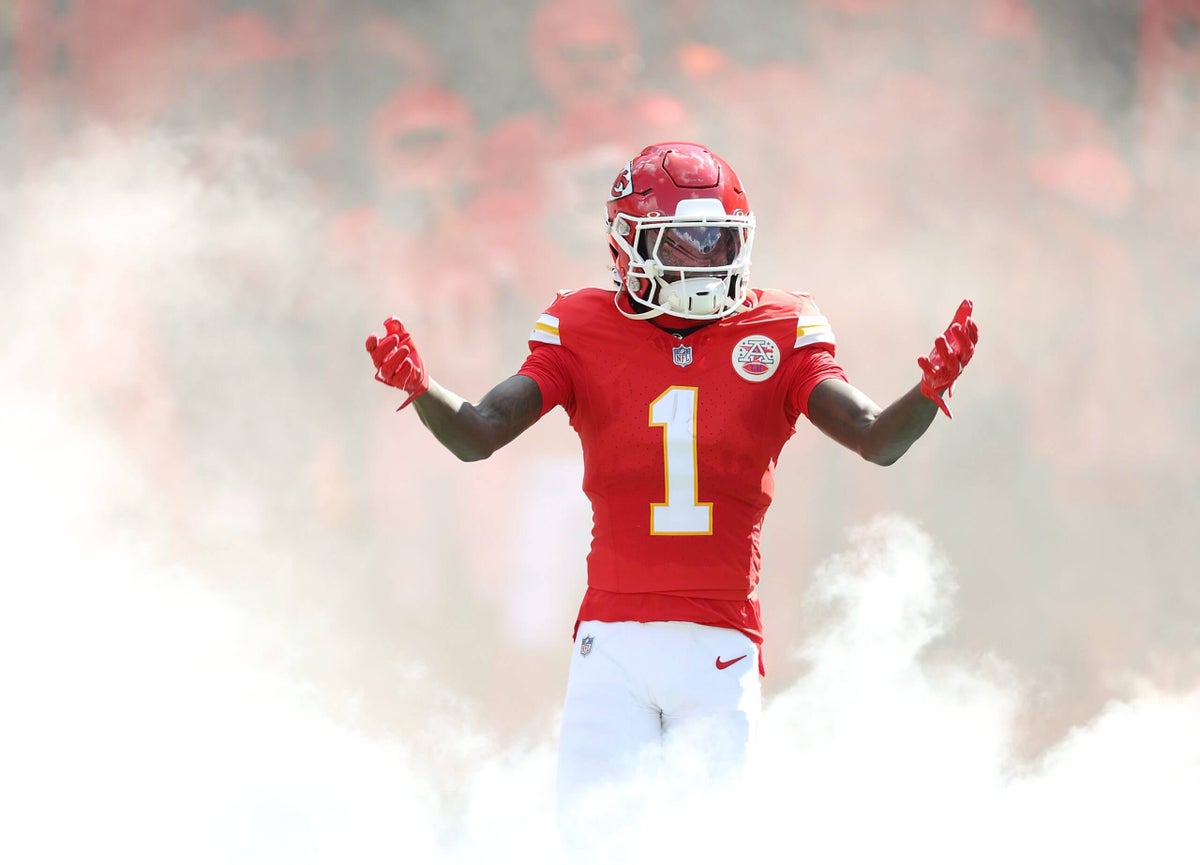
Xavier Worthy, KC (WR23 — WR35): Patrick Mahomes was next to last in air yards per attempt last season. Worthy was all screens and go routes. Just 11% of his targets were in the money zone of 10-to-19 air yards downfield. The average is 27%. His very real speed is wasted since he’s a deep-ball decoy and then just runs screens and hitches. Until I see him have some usage diversity and that intermediate target rate climb to average, I just can’t take Worthy seriously. Worthy didn’t have 80 yards in any game before coming on in the postseason. But Gabe Davis came on in the postseason once, too. I think that was more likely a fluke than a fact, but that’s the calculus for drafting him at his ADP — do you believe those last two games of a combined 56 PPR points, even remotely? I do not.
Jake Ciely’s take on Rashee Rice and Xavier Worthy
Matthew Golden, GB (WR42 — WR63): So there have been 38 rookie receivers drafted between picks No. 15-25 overall this century (Golden was picked 23rd). Eight (21%) had over 200 PPR points, which is sort of the WR25-30 bucket, definitely a starter in Flex 10. A dozen (32%) had over 150 PPR points as rookies. And the rest were basically fringe as rookies at best. But 13 (34%) were total busts (under 100 PPR points). So, the most likely outcome of the three is that he busts, with a bust being about 1.6 times more likely than boom. The alpha WR slot on Green Bay is indeed wide open. The issue is Golden wasn’t an alpha even in college — 16% market share in catches last year at Texas. In yards, it was a little better — 22%. I think 15% market share for Golden this year in Green Bay is a little bullish, and that’s not worth much of anything. So he’s a hard pass for me.
Tight end
Evan Engram, DEN (TE8/TE18): “The Joker!!!” People love saying that. “He’s the Joker, Mike. Come on!” Isn’t being the “Joker” bad, unless you’re a master criminal? Whatever, nerds. He was just released, and Cooper Kupp’s value declined a lot after being let go by the Rams, but we somehow ignore it with Engram, who has never been prolific. Famously once faster than peak Odell Beckham, he’s now 17th percentile in speed at the position, according to 2024 radar times. Engram scores a TD about once every 30 targets for his career. Gross. He’s 31. He had 5.7 yards per target last year and 6.7 for his career. Let’s give him 6.5, which is very bullish. And let’s give him 110 targets, which is borderline unbelievable. So that’s 715 yards and four TDs — and that’s the 60th-percentile projection, maybe 70th. For the love of god, please draft Tucker Kraft (i.e., George Kittle Jr.), TE12, instead.
(Photo of Xavier Worthy: Jamie Squire / Getty Images)