
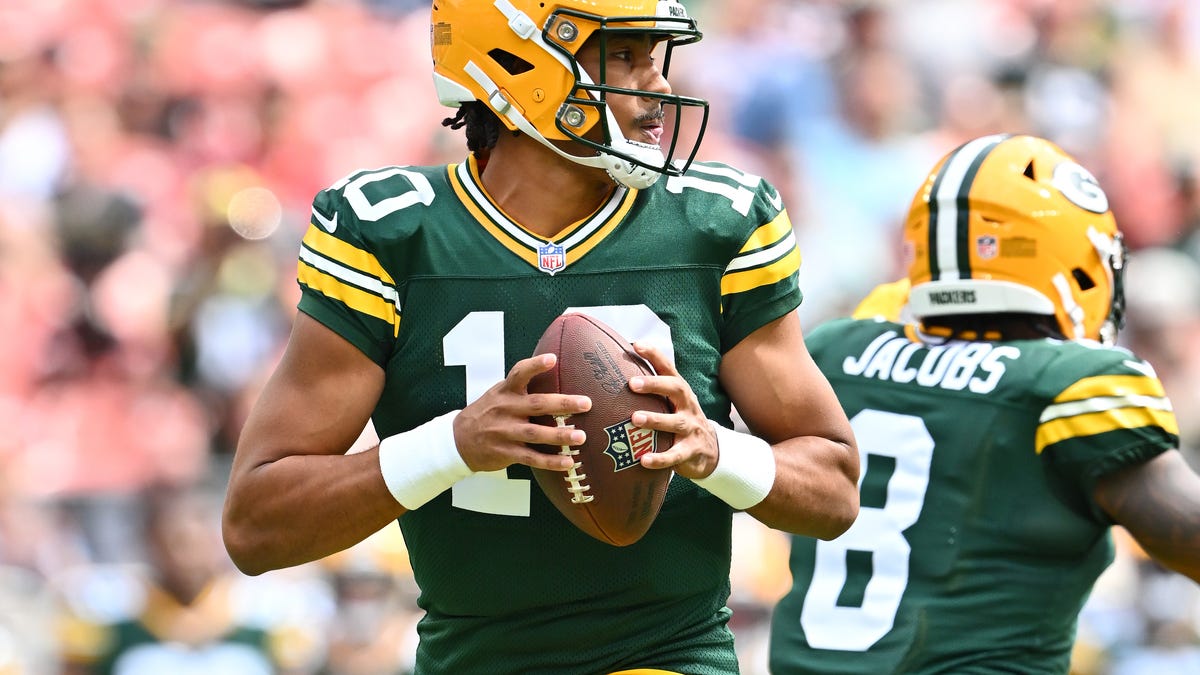
The Green Bay Packers enjoyed a successful regular season in 2024, but struggled in their division, going 1-5 against the Detroit Lions, Minnesota Vikings and Chicago Bears.
The NFC North projects to be a competitive division once again this year, so how does Green Bay stack up on paper from a roster standpoint? Let’s compare the Packers offense with their competitors in the North.
Quarterback
Green Bay and Detroit are clearly the teams feeling the most comfortable with their quarterback situation, with Minnesota (J.J. McCarthy) and Chicago (Caleb Williams) both fielding young, unproven starters.
Jared Goff probably has the higher floor than Jordan Love and has operated one of the league’s best passing attacks in recent seasons, but with Ben Johnson gone, will he be able to maintain the same level of play? Love boasts the higher ceiling, and if he can stay healthy in 2025, could well take another step and establish himself as the top quarterback in the division.
Running back
The Packers and Lions also have the top two groups at running back, with the Vikings’ backfield, consisting of Aaron Jones and Jordan Mason likely in third, and the Bears, led by D’Andre Swift, in fourth.
To date, only Josh Jacobs has established himself as a true bellcow back, but the Lions’ one-two punch of Jahmyr Gibbs and David Montgomery is more accomplished than whichever runner Green Bay can pair with Jacobs. Former third-round pick MarShawn Lloyd has generated plenty of buzz at training camp now he is healthy though, and could add a change of pace to the Packers rushing attack which could help them rival Gibbs and Montgomery in 2025.
Wide receiver
In terms of depth, it is hard to argue with the Packers winning out, but the Vikings and Lions both have the luxury of a true game changer in Justin Jefferson and Amon-Ra St. Brown, respectively.
Between Jayden Reed, Romeo Doubs and Dontayvion Wicks, Green Bay may have at least three receivers as good or better than either of Minnesota or Detroit’s second receiver though, and that is before factoring in Christian Watson who could return to the lineup as early as week five.
The Bears have the least proven group, with DJ Moore taking a step back in 2024 and Rome Odunze enduring a tough rookie year.
All four teams have X-factors at the position after taking at least one wide receiver in the first three rounds of this year’s draft. The Packers spent the most capital at the position, selecting Matthew Golden in the first round, who already looks the part, and Savion Williams in the third.
Depending on whether you value a wealth of options or having one all-world receiver, an argument for the best room can be made for any of Green Bay, Minnesota or Detroit, but due to their youth and investments made this spring, the Packers look to have the best avenue for improvement.
Tight end
Minnesota’s duo of TJ Hockenson and Josh Oliver has to be considered the best tight end duo in the North given the pelts they have on the wall, but Green Bay is probably in second place with their combination of Tucker Kraft and Luke Musgrave.
Detroit has Sam LaPorta, who enjoyed a tremendous rookie season before taking a step back in year two, but very little behind him.
In terms of the established top tight end on each team, Cole Kmet for the Bears is the least impressive of the four teams, although he has still had a solid career.
However, Chicago’s first-round pick Colston Loveland, now coached by Ben Johnson, the same play caller who got the most out of LaPorta in Detroit, could change the pecking order significantly if he hits as a rookie.
Offensive line
The constructions of the NFC North’s offensive lines are interesting to examine and could lead to any of the four teams having the best overall unit in 2025 if everything breaks the right way.
Chicago has a case for the best top five on paper after spending the offseason acquiring veterans in Joe Thuney, Drew Dalman and Jonah Jackson to improve the interior, while also having young, solid to strong options at both tackle spots in Darnell Wright and Braxton Jones.
They also have Ozzy Trapilo and Kiran Amegadgie as depth, both of whom were day two picks in the last two drafts.
There is some risk to their strategy however, with Thuney turning 33 during the season and Jackson, who will turn 29, only played four games last year.
The Lions have one of the very best tackles in the league in Penei Sewell, and have been an extremely strong unit in the past, but suffered some losses during the offseason, with Kevin Zeitler leaving in free agency and excellent center Frank Ragnow retiring.
They are set to start two unproven players in rookie Tate Ratledge and second-year player Christian Mahogany, who was a sixth-round pick and has only 75 NFL snaps under his belt. They will need both to hit the ground running.
Two of their other projected starters, Taylor Decker and Graham Glasgow, will be in their age 31 and 33 seasons, respectively. Detroit is trying to thread the needle with their offensive line this year.
Minnesota’s situation has shades of both Chicago and Detroit. The Vikings were probably the worst offensive line in the division last year, and sought to fix it this offseason both in free agency and the draft.
They signed veteran center Ryan Kelly, who has had plenty of success in the league but is now 32 and played only 10 games last year. They also added guard Will Fries, who had an unremarkable career before 2024 when he took his game to a new level… but only played five games.
Their first-round pick was a guard in Donovan Jackson, but he was not ranked in the first round on the consensus big board, sitting at 39th. He essentially has to start and sink or swim. A caveat: they will have the benefit of their best lineman, Christian Darrisaw returning from injury.
There is a ceiling for the Vikings to get better up front, but there is risk as well.
Green Bay likely has the safest floor for how their offensive line will collectively play and as good a ceiling as any of the other NFC North teams. They have consistently fielded one of the best units in the league for a decade plus and committed to keeping the cupboard stocked this spring.
In Rasheed Walker, Aaron Banks, Elgton Jenkins, Sean Rhyan and Zach Tom, they have a proven and experienced group, despite only Jenkins being over 28 years old. Tom may not be Sewell, but he has an argument for being the next-best lineman in the division.
The Packers, like their rivals in the North, also have paths to get improved play in former first-rounder Jordan Morgan and 2025 second-rounder Anthony Belton, but are not relying on either to play if they do not represent an upgrade on the established starters.
Chicago may be in a similarly confident position to Green Bay, but the Packers likely feel the most secure about their situation on the offensive line entering the new campaign.