
I asked a straightforward question to Norman Bay, the NCAA’s chief hearing officer for Michigan’s sign-stealing case: If Jim Harbaugh were still the head coach at Michigan, would the Wolverines have received a bowl ban?
Ten full seconds of silence followed, before Bay said he didn’t want to engage in a hypothetical. He reiterated the NCAA’s relatively new stance that it doesn’t want to overly punish a school’s athletes for the sins of a coach, especially a coach who isn’t there anymore.
On page 51 of the committee’s report on Connor Stalions’ sign-stealing scheme, a paragraph starts plainly, “A postseason ban is required in this case.” But no ban was applied. Nor were there any vacated wins. Current head coach Sherrone Moore’s suspension only added one non-consecutive game, Michigan’s 2026 season opener against Western Michigan, on top of the school’s self-imposed two games this September.
An NCAA penalty process that once delivered the so-called Death Penalty to SMU and ended Jim Tressel’s run at Ohio State over some tattoos may have most directly hit Michigan with only a substantial fine — one that is big enough that Michigan plans to appeal.
So what happened? Is the NCAA’s power fully neutered? Is this the norm moving forward? Here is a breakdown and explanation of the penalties and what they mean.
Why Michigan didn’t get a postseason ban
In the era of the College Football Playoff, a postseason ban could mean more than ever before. But it wasn’t handed out despite all the factors of this case pointing toward a two-year ban, which the committee itself admitted.
For years, the NCAA was criticized publicly for imposing penalties on teams and players for the actions of people no longer with the program. The penalties USC football received in 2010, including a two-year bowl ban, were some of the harshest ever levied despite the fact that the player at the center of the situation, Reggie Bush, was long gone and the head coach, Pete Carroll, had left for the NFL. In recent years, the NCAA has tried to adapt by focusing its punishment on the people who committed the violations, encouraging schools to part ways with cheaters.
Tennessee escaped a postseason ban for “hundreds” of recruiting violations under coach Jeremy Pruitt because the school had fired Pruitt and cooperated with the investigation. It received a then-record $8 million fine and other minor penalties.
The Michigan case is somewhat similar. Head coach Jim Harbaugh, several assistants and Stalions are no longer there, and Moore wasn’t directly implicated in the sign-stealing. The destruction of evidence and lack of cooperation noted by the investigation are two reasons why Michigan’s fine could end up totaling three times as much as Tennessee, and perhaps more than $30 million, when accounting for 10 percent of the Wolverines’ football budget and two years of future postseason payments.
“The panel determines that a postseason ban would unfairly penalize student-athletes for the actions of coaches and staff who are no longer associated with the Michigan football program,” the NCAA report reads. “Thus, a more appropriate penalty is an offsetting financial penalty.”
That won’t be enough to satisfy the critics, especially because Michigan is one of the richest programs in the sport, but it is consistent with modern changes. The NCAA doesn’t hand out TV bans anymore, either. While Akron football is facing a 2025 postseason ban due to its low academic progress report score, the days of the infractions committee handing out postseason bans may be over.
Why Michigan didn’t have any wins vacated
Officially removing wins that everyone saw with their eyes has long been one of the strangest penalties, a measure only taken in college sports. You can’t take away those memories or feelings; you can only adjust a coach’s record or Wikipedia page. Who really cares?
In this instance, Bay noted that vacated wins can only happen in cases involving the use of a player who should have been ineligible to play. That didn’t happen here, so it wasn’t a penalty that could even be considered by the committee.
Stalions was exposed and exiled during the national championship season of 2023. None of Michigan’s big late-season wins against Penn State, Ohio State or the postseason happened with him on staff. The Wolverines even beat Penn State and Ohio State without Harbaugh, who was suspended by the Big Ten. NCAA president Charlie Baker said last year that Michigan won its title “fair and square” because of that. So the lack of vacated wins was ultimately not a surprise. If you want to argue about Stalions’ impact on Michigan’s 2021 and ’22 Playoff runs, sure, go ahead.
The committee could not quantify how impactful the sign-stealing was, in part because of how evidence was handled, but it was clear Stalions thought it was enough of an advantage to do it. However, Bay also said, “After October 17, 2023, there’s no evidence that anything that (Stalions) did affected the outcome of Michigan’s games that season.”
Why Michigan was not penalized scholarships or revenue-sharing money
You may have noticed college sports are undergoing structural change right now. That played a factor here. Taking away scholarships has long been a common NCAA penalty. But as a result of the House v. NCAA settlement, schools are allowed to offer full scholarships to all their athletes up to a smaller limit of 105 football players (conferences are keeping the scholarship limit around 85).
The committee didn’t know what to do, so it turned roster penalties into financial penalties, creating a fine equivalent to 10 percent of football scholarships for 2025-26.
“The NCAA membership has not yet determined whether roster reductions will replace scholarship reductions as a core penalty, and the panel will not prematurely make that decision on behalf of the membership,” the report reads. “Instead, the panel adheres to the percentages contemplated for Level I Aggravated scholarship reductions, but converts the penalty to the financial equivalent of what would have been scholarship reductions.”
It’s important to remember the NCAA will not handle all rules violations moving forward. The Collegiate Sports Commission, created by the Power 4 conferences, is tasked with maintaining and enforcing the new revenue-sharing rules. That’s the group overseeing the approval of name, image and likeness deals and distributing any penalties to schools for violations on that front. Perhaps those will include lowering a school’s cap. It’s yet to be seen how that process will go, but it won’t be on the NCAA, and it did not apply to this sign-stealing situation.
What show-cause penalties mean
Where will you be in 2038? That’s when Jim Harbaugh’s show-cause penalties end. He received a 10-year penalty for this, on top of an existing four-year penalty for impermissible contact in a separate investigation.
What that actually means is that any NCAA school that hires Harbaugh cannot allow him to participate in athletic-related activities, unless it can show cause to the NCAA why the restrictions should not apply. He would also be suspended from all activities for his first full year. Stalions was also hit with an eight-year show cause penalty and one-year suspension.
Moore was given a two-year show-cause, which doesn’t mean much since he’s already at Michigan and isn’t going anywhere.
Show-cause penalties used to be a black mark that kept prospective employers away. That’s not so much the case anymore, hence the additional suspension for both. But it’s clear neither Stalions nor Harbaugh will return to college sports, in case that was in doubt.
Game suspensions
This was the strangest part of the penalties and one nobody around college sports quite understands. Michigan offered the NCAA a two-game suspension for Moore, but not even the first two games of this season. Rather, it’s games No. 3 and 4. Surely coincidentally, that would allow Moore to coach in the Wolverines’ big nonconference game at Oklahoma, his alma mater. The NCAA accepted that penalty and has added a one-game suspension for the first game of the 2026 season. Why? That was not made clear.
A three-game suspension for Moore in which he misses games against Central Michigan, Nebraska and Western Michigan would seem not to be much of a penalty at all.
Still, one can argue the biggest penalty delivered to Michigan through all of this actually came from Big Ten commissioner Tony Petitti, who suspended Harbaugh for the final three games of the 2023 regular season against No. 10 Penn State, Maryland and No. 2 Ohio State. Delivering such a penalty while the investigation was ongoing was basically unprecedented, and taking away the head coach for two top-10 matchups was a big deal.
But neither Penn State nor Ohio State could take advantage. Had either of them beaten Moore’s Wolverines, Michigan wouldn’t have made the CFP and won the national championship, and our view of that Michigan run and these penalties would be much different. Wolverine fans already wanted to descend upon the Big Ten office with pitchforks at the time over the idea their national title run could be taken away from them; imagine if the Nittany Lions or Buckeyes had won
The Winners
“Play by the rules,” Harbaugh said in 2013 while coaching the San Francisco 49ers. “You want to be above reproach, especially when you’re good, because you don’t want people to come back and say, ‘They’re winning because they’re cheating.’ … We want to be above reproach in everything and do everything by the rules. If you don’t, if you cheat to win, then you’ve already lost, according to Bo Schembechler.”
Early on in Harbaugh’s Michigan tenure, he subtly and not-so-subtly said all kinds of programs Michigan competed with were cheaters. “Hard to beat the cheaters,” he said in a John U. Bacon book.
“You don’t lie, you don’t cheat, you don’t steal,” he said after winning the national championship amid the sign-stealing drama.
Harbaugh’s college career ended with a national title. It also ends with him becoming one of the most penalized coaches in the history of the sport, through not only the sign-stealing scandal but multiple recruiting investigations. Michigan was deemed a repeat violator in this process.
Harbaugh was correct that plenty of other schools cheat. The Stalions situation shined a light on the fact that many schools do steal signals. But Harbaugh and Michigan for decades have held themselves up as better and cleaner than everyone else. That shine is forever gone.
But was it worth it? Probably. A lot of Michigan fans certainly think so. National championships come around once in a generation for Michigan football, if that. The Wolverines’ win at Ohio State in 2024 only further twisted the knife of 2023. Moore’s program has momentum, especially with freshman quarterback Bryce Underwood (coached briefly during his final high school season last fall by none other than Stalions).
Stalions will go down as one of the most successful superfans in sports history. All he ever wanted to do was coach Michigan to a championship, going so far as enrolling in the military because he thought it would help that goal. Even though he wasn’t on the sideline at the end, he was in the stadium in Houston when Michigan beat Washington. He gets offered drinks at tailgates from fans and will go down as a Michigan legend. Restarting his coaching career any higher than the high school ranks might be an issue. But that national championship can never be taken away.
The NCAA’s report makes it clear that investigators were astounded at the lengths Michigan personnel went to in order to hide evidence or avoid cooperation. And in the end, there was only so much the NCAA could do, which included not even handing out the postseason ban it felt it should. Is the lesson here to cheat to win a title and just pay the fine later? It may not be that simple, again because Michigan’s national title win came without Stalions, but it’s not hard to understand fans who might take away from this that the rules matter very little. After all, that’s how Harbaugh felt.
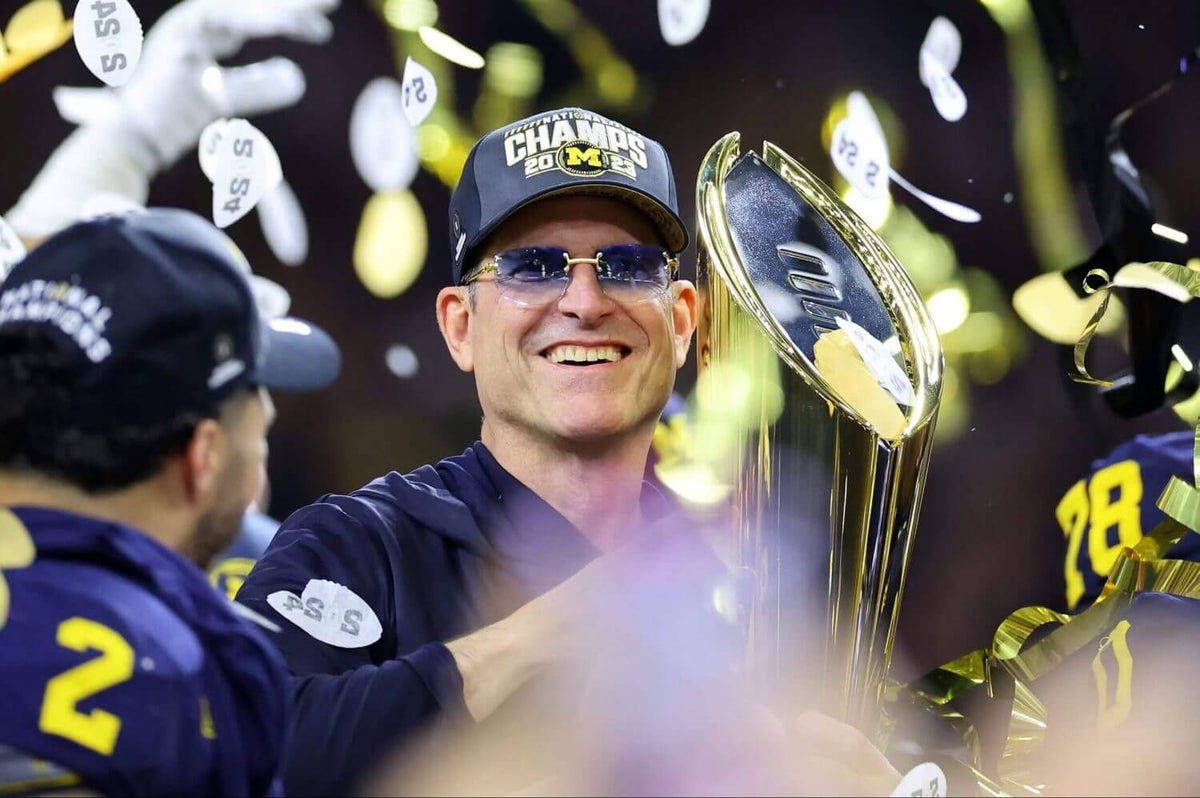
(Photo: Stacy Revere / Getty Images)