
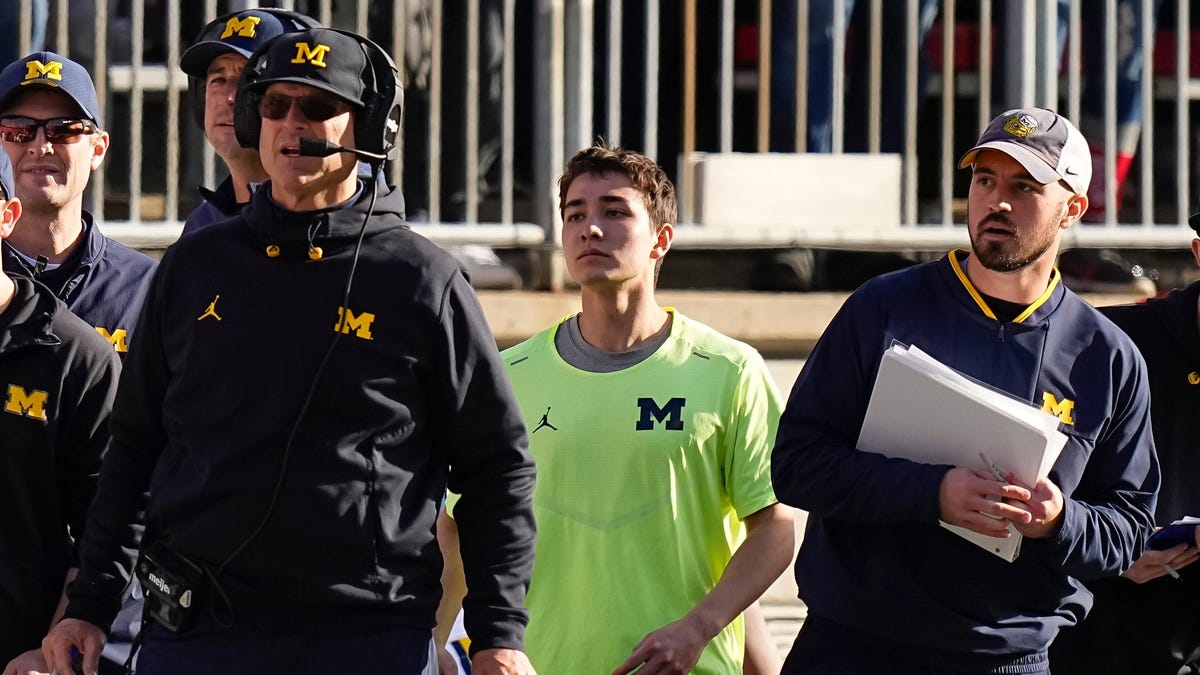


How NCAA punished Michigan football for sign-stealing scheme
NCAA released punishment for Michigan football on Aug. 15, 2025, after its investigation into sign-stealing scandal orchestrated by Connor Stalions.
The NCAA issued multiple penalties against the University of Michigan football program for a sign-stealing scheme.Punishments include probation, financial penalties, recruiting restrictions, and show-cause orders for staff members.While a postseason ban was considered, the NCAA opted against it to avoid penalizing current student-athletes.
The NCAA has handed Michigan football punishments for the sign-stealing scandal from 2021-23 after it found “overwhelming evidence” of the impermissible scouting scheme.
Although the NCAA found “sufficient grounds for a multiyear postseason ban,” the panel decided that would “unfairly penalize student-athletes for the actions of coaches and staff who are no longer associated with the Michigan football program,” and instead opted to hit Michigan with a series of other punishments.
Roughly five hours after the decision from the NCAA came down on Friday, Aug. 15, Michigan athletics announced in an email it plans to appeal the decision.
“We appreciate the work of the Committee on Infractions,” the statement from Michigan begins. “But, respectfully, in a number of instances the decision makes fundamental errors in interpreting NCAA bylaws; and it includes a number of conclusions that are directly contrary to the evidence — or lack of evidence — in the record.
“We will appeal this decision to ensure a fair result, and we will consider all other options.”
Athletic director Warde Manuel went out of his way to defend Michigan coach Sherrone Moore in his statement that was also included in the email, concurring Michigan does not agree with the ruling.
“It is never our intent to be in a position where we are accused of any rules violations,” he said. “I fully support Coach Sherrone Moore, our student-athletes and staff as they prepare for the season ahead. I appreciate Coach Moore’s continued commitment to ensuring his program operates in compliance with applicable rules.
“I acknowledge the Committee on Infractions’ decision to not penalize our current student-athletes by eliminating postseason opportunities; however, a postseason ban should never have been a consideration in this case. I fully support the university’s decision to pursue an appeal. Coach Moore and I will not have any further comment.”
Here is a full look at all of the punishments from the NCAA, which include an additional suspension for Michigan coach Sherrone Moore to start the 2026 season.
NCAA punishments for Michigan footballFour years of probation.Financial penalties:$50,000 fine, plus 10% of the budget for the football program. A fine equivalent to the anticipated loss of all postseason competition revenue sharing associated with the 2025 and 2026 football seasons. A fine equivalent to the cost of 10% of the scholarships awarded in Michigan’s football program for the 2025-26 academic year.A 25% reduction in football official visits during the 2025-26 season. A 14-week prohibition on recruiting communications in the football program during the probation period. Connor Stalions: An eight-year show-cause order, restricting him from all athletically related activities during the show-cause period. Jim Harbaugh: A 10-year show-cause order, restricting him from all athletically related activities during the show-cause period, which will begin on Aug. 7, 2028, at the conclusion of his four-year show-cause order from a previous case. Denard Robinson: A three-year show-cause order, restricting him from all athletically related activities during the show-cause period. Sherrone Moore:A two-year show-cause order, during which he is suspended from a total of three games. Michigan self-imposed a two-game suspension for Moore during the upcoming 2025-26 football season. The panel determined that a suspension for one additional game was appropriate. Therefore, Moore also will be suspended for the first game of the 2026-27 season. Apart from the three-game suspension, Moore is not prohibited from engaging in coaching or other athletically related activities during the show-cause period. Leading up to the decision
News broke Thursday, Aug. 14, that the NCAA’s committee on infractions (COI) had reached its decision and would become public Friday. The Free Press was told Manuel was expected to host a press conference to discuss the matter when the ruling came down, but given the university now intends to appeal the decision, that may be on hold.
The ruling comes 69 days after U-M staffers, members of the athletic department and the university’s legal counsel, met with the COI on June 6-7 for a hearing at NCAA headquarters in Indianapolis.
The Wolverines were facing 11 separate violations, including six of the Level I variety — deemed as the most serious of offenses.
What the NCAA found in sign-stealing scandal
The NCAA’s resolution determined that Stalions had 56 instances of off-campus, in-person scouting and spent nearly $35,000 on the scheme in 2022 alone.
As a result, the NCAA found that Michigan “failed to monitor” its program and that “Harbaugh ran a program that was largely dismissive of rules compliance. There was little, if any, emphasis on following the rules. To the contrary, his program saw compliance as the enemy, made their own decisions regarding interpreting the rules to their benefit, or outright committed rules violations.
“Over the course of three seasons, the Michigan football program committed violations involving an off-campus, in-person scouting scheme, impermissible recruiting inducements and communications, head coach responsibility rules, individuals’ failures to cooperate and Michigan’s failure to monitor, according to a decision released by a Division I Committee on Infractions panel,” the release stated. “The scouting violations orchestrated by former football staff member Connor Stalions were corroborated by interview testimonies, ticket receipts and transfer data and other evidence.
“Those violations, along with former head football coach Jim Harbaugh’s head coach responsibility violation and most of the failure to cooperate violations, are Level I.”
The process began in October 2023 when Stalions was identified as the leader of an elaborate sign-stealing scheme, in which he sent accomplices to the games of opponents and future opponents. Those people then allegedly recorded the signals given by opposing staffs and sent them back to Stalions for him to decode.
Evidence against Stalions
Stealing signs in games is not against NCAA rules, but teams are not allowed to scout opponents in advance in person or with technology, per NCAA bylaw 11.6.1. There was evidence of Stalions having purchased tickets at more than a dozen schools.
The NCAA found that Harbaugh, Moore, Robinson and Stalions all obstructed the interview process, but Stalions was particularly egregious in his determination to hide or delete evidence of the scheme.
“Their conduct ranged from destroying relevant materials to providing false and misleading information during interviews — including Stalions instructing an intern to ‘clear out’ emails, photos, texts and videos related to the scouting scheme,” the NCAA stated. “The intern complied and then instructed a friend, who attended and recorded three games as part of the scheme, to do the same. During the hearing, Stalions stated that he did not recall telling them to delete any information.
“In short, Stalions’ multiple and repeated failures to cooperate are some of the worst the COI has ever seen.”
In Week 1 of the season, Stalions is accused of disguising himself as a member of Central Michigan football’s staff, wearing head-to-toe Chippewas gear in East Lansing for CMU’s game against Michigan State. The investigation found that Stalions was attempting to help both U-M and CMU in this instance; by deciphering MSU’s signals while also helping CMU with play-calling.
As for those still on staff, Michigan coach Moore, previously suspended for one game to open the 2023 season for recruiting violations in a separate NCAA investigation (which landed U-M, as a program, on probation until April 2027), has already been handed a program-issued suspension for Weeks 3 and 4 of the 2025 season.
He made his first direct comment about the situation in Friday’s email.
“I am glad that this part of the process has been completed,” he said. “I greatly respect the rules governing collegiate athletics and it is my intent to have our program comply with those rules at all times. I will continue to focus my attention on our team and the upcoming 2025 season.”
Former coach Harbaugh, who ultimately led the Wolverines to the College Football Playoff championship in January 2024, was said to have been negligent with his program as he failed to promote an atmosphere of compliance. He already has been given a four-year show cause order and suspended from college football for a full season for the 2021 NCAA investigation that found he had impermissible contact with recruits during the coronavirus pandemic.
Michigan, as an institution, had received recruiting sanctions, a fine and probation until April 2027 for the 2021 case that stemmed from recruiting violations, including improper contact with recruits during a dead period and exceeding the number of allowable coaches evaluating players in an on-field capacity.
With this being the second infraction, Harbaugh, Moore and the program itself all fall under repeat violator status.
“As a result of Michigan’s most recent infractions case, three parties — Michigan, Harbaugh and Moore — fall within the legislated window to trigger repeat violator status,” the NCAA stated. “Michigan’s repeat violator status, coupled with its Level I-Aggravated case classification, is sufficient grounds for a multiyear postseason ban. However, the panel determined that a postseason ban would unfairly penalize student-athletes for the actions of coaches and staff who are no longer associated with the Michigan football program. Thus, the panel determined a more appropriate penalty is an offsetting financial penalty instead of a two-year postseason ban.”
Tony Garcia is the Michigan Wolverines beat writer for the Detroit Free Press. Email him at apgarcia@freepress.com and follow him on X at @RealTonyGarcia.