
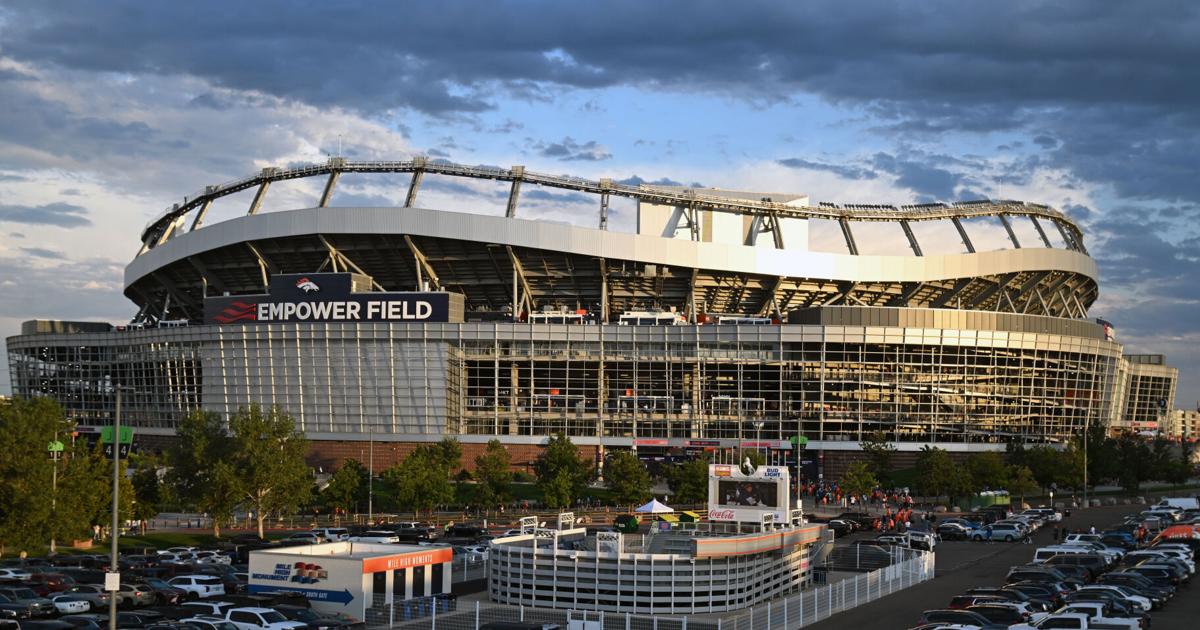
The buzz outside of Empower Field at Mile High was back with rising clouds of grill smoke, music bumping and orange jerseys descending through parking lots around the 24-year-old stadium.
On Saturday, for the preseason home opener, Broncos football finally returned to 1701 Bryant St.
But for how much longer?
“I heard they’re trying to move it,” said Robb Gray, a Broncos fan tailgating in the stadium’s north parking lot. “I personally like it down here. I think the biggest issue is the traffic and congestion. … But I think that’s all of Denver almost anymore.”
Broncos team president Damani Leech said last month there is “still no determination” on the team’s future home.
Most signs point to Burnham Yards — a historic Denver rail yard south of Colfax Avenue and east of Interstate 25 — being the most probable location for a new stadium. The purchase of at least 10 properties in the area totaling $146 million were reportedly handled by an attorney who worked with Broncos general council Tim Aragon. Several buildings at Burnham Yards were recently torn down.
However, with no formal announcement, another option is worth exploring.
“There’s nothing really wrong with this stadium,” Gray said.
Is renovating Empower Field at Mile High a realistic option for the Broncos’ long-term home?
“Our lease ends in 2030 and that’s certainly a mile marker we’re taking into account. That being said, as you know, our ownership group has done a tremendous amount of resource commitment to the stadium,” Leech said at training camp. “The Metropolitan Football Stadium District has been great partners. We feel like the stadium is really in great shape. That being said, in five more years, our lease will be up, and it’ll be a 30-year-old stadium. On a macro level, you look around the league (at) what’s happening.

A skydiver a Broncos parachute drops into Broncos Empower Field at Mile High before a preseason game on Saturday, Aug. 16, 2025.
Jerilee Bennett, The Gazette
“Stadiums built in that era, some younger, are either being built new or taking on significant renovations; you look at Carolina and Jacksonville. So that’s certainly something we’re thinking about. We’re also thinking about this in terms of the next 30 years and what we’ll need to serve our football program but also our fans.”
***
The Jaguars offer a blueprint for stadium renovation over relocation.
Last October, NFL owners unanimously approved an agreement between the city of Jacksonville and the Jaguars on a $1.4 billion remodel of EverBank Stadium — which opened in 1995, six years before Empower Field at Mile High. Early construction is underway with the anticipated re-opening in 2028.
Jacksonville and the Jaguars will each contribute $625 million to the renovation, with the city also paying $150 million over the next two seasons on maintenance and repairs amid construction. Renovation plans include a transparent protective canopy over the stadium, wider concourses, communal spaces, new seating options and an increased seating capacity up to 70,000 for special events.
“The first question we had to answer had to do with assessing the existing structural integrity of the building,” Jaguars team president Mark Lamping told The Denver Gazette. “That was a very extensive engineering study that was done, and it concluded that the basic structure of the stadium was in good shape and could support a significantly extended useful life. That said a remodel was on the table.”
Empower Field at Mile High nears NFL season after busy summer concert series
The obvious drawback to a major stadium renovation is fan relocation. The Jaguars will play with a reduced capacity of around 43,500 during the 2026 season with the upper deck closed. The team will play their entire 2027 season away from Jacksonville at still to-be-determined locations. But that did not outweigh the positives of a stadium remodel.
The Jaguars’ planning included conversations with major college football programs like Florida and Georgia, concert promoters, U.S. Soccer and the College Football Playoff system to determine stadium needs for drawing events to Jacksonville. Lamping said the team established “25 design objectives” and hired eight architects to evaluate which were possible in a renovation.
“What we found was that most of the things that were important, or would get in a new stadium, we could achieve almost all of them through a remodel,” Lamping said. “Then you have the financial reality that a remodel, while it’s probably more difficult than a new build, and it’s certainly an inconvenience for a few years, it’s significantly less expensive. We probably saved over a billion dollars doing a renovation versus a new build. And we didn’t think we were sacrificing that much in that process. … We could also achieve certain sustainability benefits. We are reusing a lot of existing materials that are already in the stadium.”
Lamping is quick to point out there is no “one-size-fits-all solution” to NFL stadium decisions. Every team has different needs based on their respective ownership group and football community they serve. But every club must address a basic need.
“In our particular case, it started with a simple question: Are we happy with the current location of the stadium?” Lamping told The Denver Gazette. “Because, if you’re not happy with it, then almost by definition you’re going to build something new.”
***
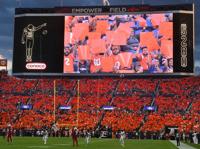
The fans under the massive television screen were given orange cards for a showy presentation at Empower Field at Mile High before a preseason game on Saturday, Aug. 16, 2025.
Jerilee Bennett, The Gazette
Maintenance and upkeep of Empower Field at Mile High is constantly ongoing.
The Metropolitan Football Stadium District (MFSD) owns the stadium and the land. It is a “political subdivision of the state of Colorado” which encompasses “all or part of the seven counties in the Denver metropolitan area,” according to its website. The MFSD collected a sales tax between 2001 and 2012 to assist in “financing the acquisition of land, construction of the stadium and the payments of debt services.”
Johnston’s State of the City address: ‘Denver stands at a turning point’
The Stadium Management Company (SMC), a Broncos subsidiary, is tasked with managing Empower Field at Mile High. In March, SMC received approval to spend up to $14,721,600 from the MFSD’s capital repairs and replacement fund in 2025, according to public records.
Projects include:
—Replacing seats and cupholders in about the first 20 rows of seats in the lower bowl.
—Structural fixes like fireproofing, traffic coating and waterproofing repairs.
—Ground repairs for parking lots and sidewalk concrete replacement.
—Security expenses for the phased replacement of security cameras and card access upgrades.
“In regard to the cupholders and seats, essentially what we did is replace a bunch this year. We didn’t replace them all. But what it did was give us stock. So, seats that are not working in other areas of the stadium, we have an inventory to fix those seats,” said Matt Sugar, MFSD director of stadium affairs. “The foundation is solid. The stadium management company goes through processes throughout the year evaluating different systems. If they find an elevator or an escalator that’s aging, it gets replaced. The past owner and the current owner have done a great job of keeping up the facility.”
The largest change in stadium expenses between 2023 and 2024, according to the MFSD’s latest year-end financial disclosure, was for “depreciation” — the cost of a tangible asset over its useful life to reflect decreasing value. Empower Field at Mile High depreciation expenses rose by $2.9 million over that span.
Beside a blighted railyard, excitement over prospect of new Broncos stadium swells
“It is a process that clearly never ends,” Sugar told The Denver Gazette. “We are joined at the hip with the SMC of the Broncos and making sure the facility is safe and up to date. Things that need replacement are getting replaced. All of that is part of our process with the lease agreement between the two entities.”
A decision whether to renovate Empower Field at Mile High also hinges on development surrounding the stadium. The newest NFL venues typically include entertainment districts with commercial and residential offerings to bring more people and revenue to the region.
In 2019, a “Stadium District Master Plan” was approved by Denver City Council to outline the proposed development of more than 50 acres of parking lots south of the stadium for a mixed-use neighborhood. But previous Broncos ownership, the Bowlen Family Trust, reportedly paused those plans in 2020 amid the pandemic. The Walton-Penner family ownership group, which purchased the team for $4.65 billion in 2022, has not advanced previous development plans.
“We haven’t ruled anything out,” Broncos controlling owner Greg Penner said in March. “We’re still looking at the current site, other sites around Denver, Lone Tree (and) Aurora. We don’t have a set timetable for making a decision. We obviously have our lease that ends (in 2030), which is a date that we could focus on. It could be something that would happen earlier than that. If we needed to, we could be in our current stadium longer.”
***

Denver Broncos cornerback Pat Surtain II (2) takes a selfie with Broncos fan Randy Emmons “DBPonchoMan” during warm ups before the Broncos game against the Carolina Panthers Sunday, Oct. 27, 2024, at Empower Field at Mile High in Denver. (The Gazette, Christian Murdock)
Christian Murdock The Gazette
Broncos fans Erika Hawley and Kieran Reddy looked out at the stadium on Saturday from lawn chairs in the west parking lot before kickoff. This place has meant a lot to the couple. One of their first dates was watching ex-Broncos quarterback Tim Tebow play in a preseason game.
“Lifelong diehard fans,” Hawley said. “Our roots are deep.”
Your daily report on everything sports in Colorado – covering the Denver Broncos, Denver Nuggets, Colorado Avalanche, and columns from Woody Paige and Paul Klee.
Success! Thank you for subscribing to our newsletter.
“When you come here, it feels like you’re in football sanctuary,” Reddy added.
They said if the Broncos decide to leave, it won’t hurt quite like it did in 2002, when the original Mile High was demolished after the new stadium opened in 2001. But Reddy has a suggestion.
“I would prefer it to be downtown,” said Reddy, wearing a No. 6 Jay Cutler Broncos jersey. “It is the Denver Broncos. Since I was a kid, you have to go downtown to see the Broncos. When you’re from out of town, it makes it all the more special.”
But a renovation might also preserve cherished memories they’ve also made inside Empower Field at Mile High.
“I’d be fine with it,” Reddy said. “I trust our ownership and I think they’re going to make a state-of-the-art facility.”
Will Broncos join NFL teams that don’t play in their named city? | Sports Business InsiderHISTORY LESSON: BRONCOS’ DECISION
TO LEAVE OLD MILE HIGH
The original Mile High Stadium — located just south of Empower Field at Mile High — first opened in 1948 as Bears Stadium for the Denver Bears minor league baseball team (Western League).
It was constructed on the site of a former landfill.
In 1960, seating capacity increased from 18,523 to 25,000 when the Denver Broncos debuted in the American Football League. The stadium underwent several expansions before a major 1986 renovation that increased seating capacity to 76,274.
The Broncos, over their next 40 seasons at Mile High Stadium, posted an overall record of 191-109-7 in the regular season and 11-2 in the playoffs. But the facility began showing its age in the 1990s with rust, structural concerns and lack of modern amenities.
In 1998, voters approved a bond to build a new stadium to include luxury and club suites to join an NFL arms race to generate more stadium revenue. The $364-million project was constructed adjacent to the original Mile High Stadium and opened in August 2001. The old stadium was demolished following the 2001 season and is memorialized in the northwest parking lot outside of Empower Field at Mile High.
OLDEST TO NEWEST NFL STADIUMS
Breaking down the age of stadiums across the National Football League as of the 2025 season (listed by date of stadium opening).
29. Soldier Field (Bears) — 1924
28. Lambeau Field (Packers) — 1957
27. GEHA Field at Arrowhead Stadium (Chiefs) — 1972
26. Highmark Stadium (Bills) — 1973
25. Caesars Superdome (Saints) — 1975
24. EverBank Stadium (Jaguars) — 1995
23. Bank of America Stadium (Panthers) — 1996
22. FedEx Field (Commanders) — 1997
21. M&T Bank Stadium (Ravens) — 1998
20. Raymond James Stadium (Buccaneers) — 1998
19. Huntington Bank Field (Browns) — 1999
18. Nissan Stadium (Titans) — 1999
17. Paycor Stadium (Bengals) — 2000
16. Acrisure Stadium (Steelers) — 2001
15. Empower Field at Mile High (Broncos) — 2001
14. Ford Field (Lions) — 2002
13. Gillette Stadium (Patriots) — 2002
12. Lumen Field (Seahawks) — 2002
11. NRG Stadium (Texans) — 2002
10. Lincoln Financial Field (Eagles) — 2003
9. State Farm Stadium (Cardinals) — 2006
8. Lucas Oil Stadium (Colts) — 2008
7. AT&T Stadium (Cowboys) — 2009
6. MetLife Stadium (Giants/Jets) — 2010
5. Levi’s Stadium (49ers) — 2014
4. U.S. Bank Stadium (Vikings) — 2016
3. Mercedes-Benz Stadium (Falcons) — 2017
2. Allegiant Stadium (Raiders) — 2020
1. SoFi Stadium (Rams/Chargers) — 2020