
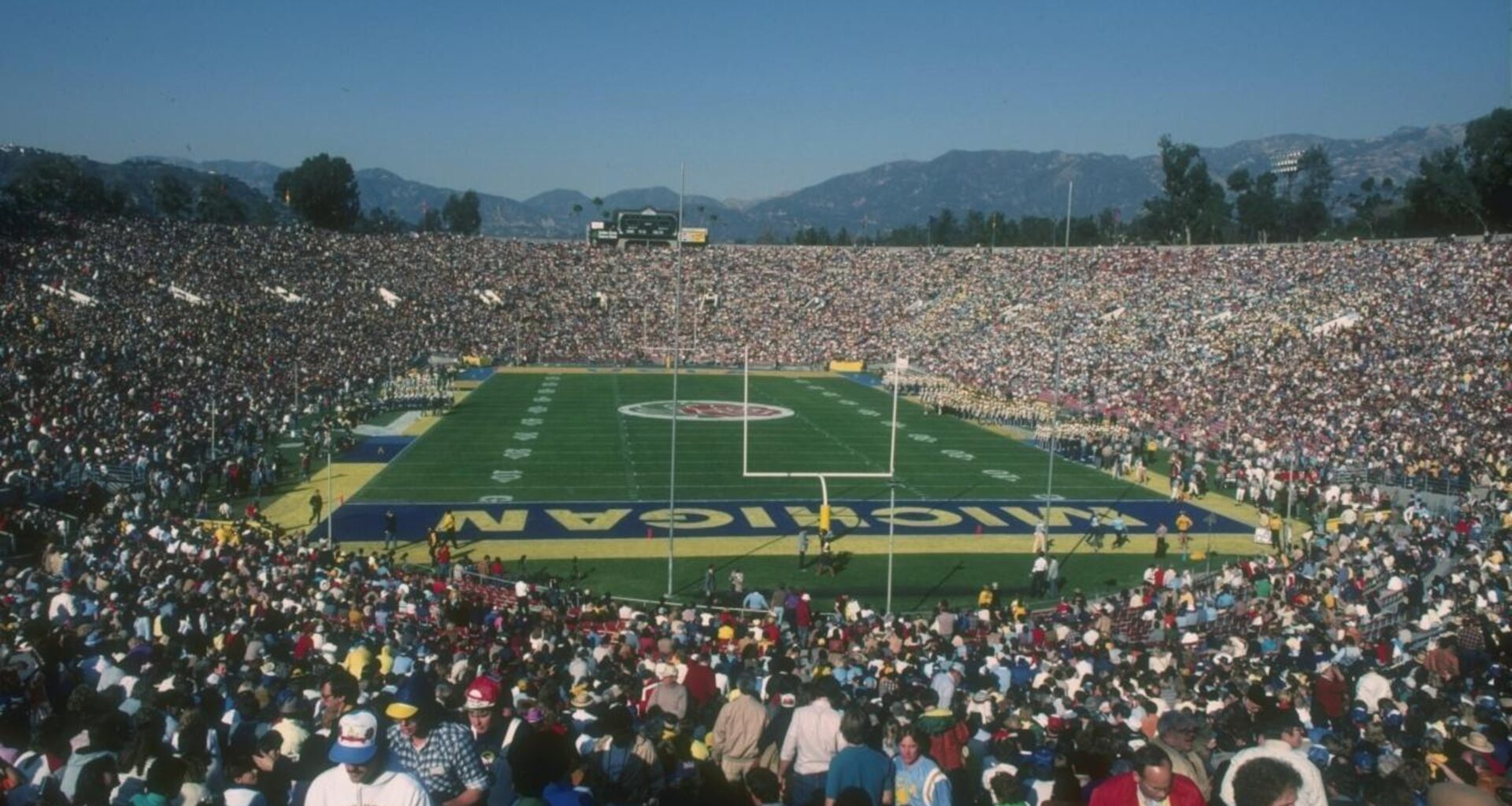
This is a quick guide to some of college football’s most notable firsts and historic moments. In 2019, the sport celebrated its 150th anniversary. First, the TL/DR version:
The first college football game was played in 1869 between Rutgers University and the College of New Jersey (now known as Princeton University).
The first college football rules were written Nov. 23, 1876, in Springfield, Mass., by representatives from Columbia, Harvard, Princeton and Yale.
The first college football game on the radio was the contest between West Virginia University and Pittsburgh University on Oct. 8, 1921, broadcast on Pittsburgh radio station KDKA-AM.
The first college football game on TV was between Fordham University and Waynesburg University on Sept. 30, 1939. The game was broadcast by NBC and aired on W2XBS.
The first use of instant replay during a college football game was in 1963 during a Dec. 7 Army vs. Navy game.
College football rankings began in 1939 with the release of the first Associated Press poll. Other notable ranking systems include the BCS (Bowl Championship Series) rankings, which started in 1998, and the CFP (College Football Playoff) rankings, which began in 2014.
The first Heisman Trophy was awarded to Jay Berwanger of Chicago University in 1935. The award was created by the New York Downtown Athletic Club.
The college football team with the most wins in history is the University of Michigan. The Wolverines have accumulated 1,011 wins since their first season in 1879.
Yale has won the most championships in college football history with 18. Alabama is second with 16 titles.
Getty
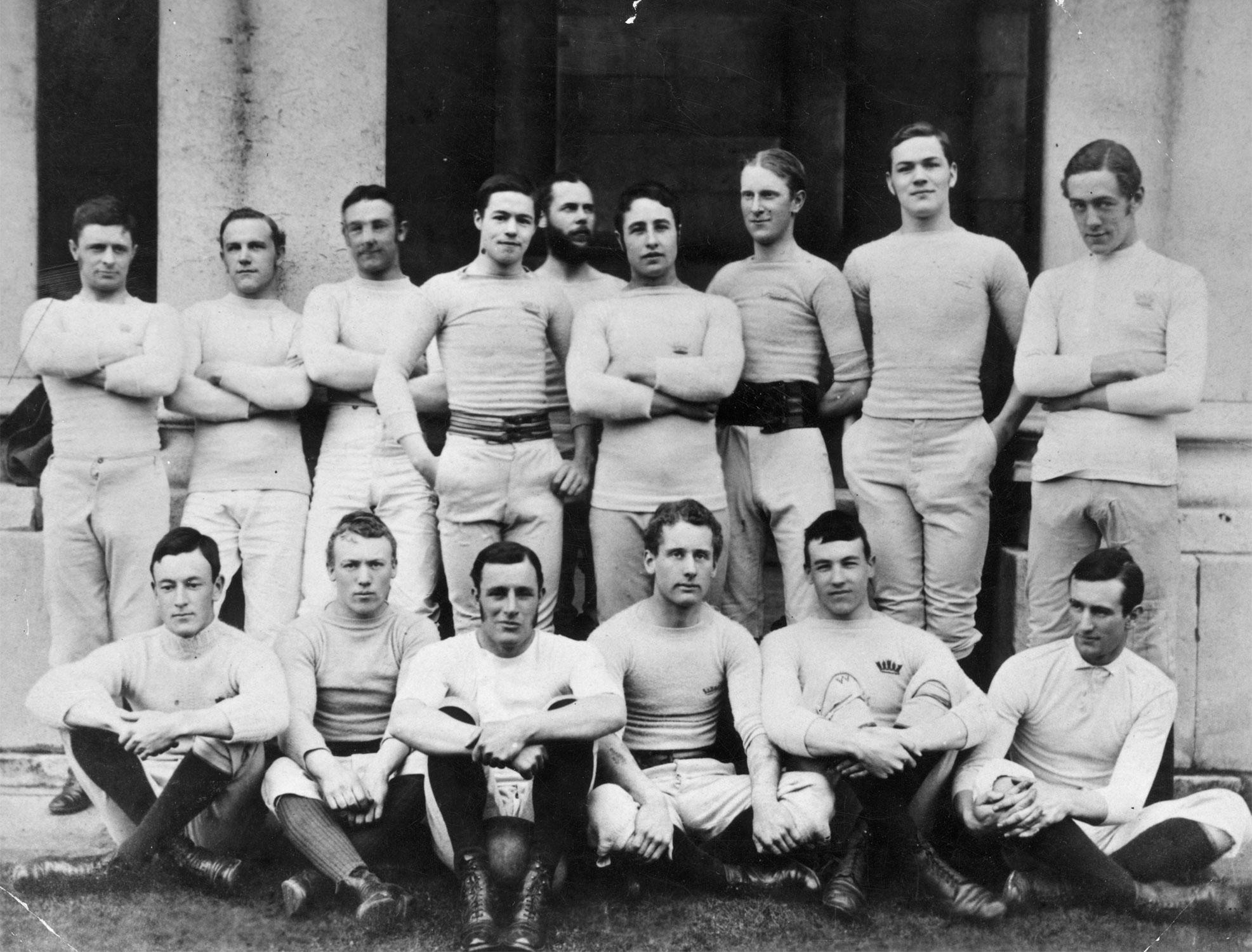
The 1883 Navy College Football team
When was the first college football game?
The birth of American football came in 1869 on College Avenue in New Brunswick, New Jersey. The game was between Rutgers University and the College of New Jersey (now known as Princeton University).
There were 25 players on the field for both teams and the rules were based on the London Football Association, which did not allow players to either pick up or throw the ball. The game resembled a form of soccer or rugby — something that if viewed in the context of football today, would look like one extended fumble with players trying to kick or hit the ball across the opposing team’s goal line.
The game resulted in a 6-4 victory for Rutgers and attracted around 100 spectators.
When were the first rules established?
Getty
“The Father of American Football,” Walter Camp
Just seven years after the first game was played, representatives from Columbia, Harvard, Princeton and Yale came together to propose the first rules of what is recognized today as American football.
THE NEW DECADE: Upcoming locations for the College Football Playoff| 2020 CFP schedule, sites
The representatives met at Massasoit House in Springfield, Mass., on Nov. 23, 1876. This is where Walter Camp emerged as the legendary father of American football. Camp created guidelines fans are familiar with today such as the line of scrimmage, the center-to-quarterback snap, a system of downs and proposed that each team should have no more than 11 players on the field.
When was the first college football game on radio?
On Oct. 8, 1921, one of the early installments of the “Backyard Brawl,” the rivalry between West Virginia University and Pittsburgh University made history, as the game was the first to be broadcast across the airwaves. The game was on the first commercial radio station in the country, KDKA-AM in Pittsburgh. Pittsburgh won the game 21-13.
When was the first college football game on TV?
The first game to shoot across television screens came on Sept. 30, 1939, when Fordham hosted Waynesburg for a season-opener. The game was broadcast by NBC on W2XBS. Fordham, a powerhouse football program at the time, won, 34-7. The number of viewers was estimated to be between 500-5,000.
LONGEST FIELD GOAL: What we know about the longest college football field goal ever
When was the first use of instant replay?
Instant replay made its debut on television screens Dec. 7, 1963, during an Army vs. Navy game. The production used a 1,300-pound machine to wind back the reel and show a touchdown over again as commentator Lindsey Nelson warned viewers, “Ladies and gentlemen, Army did not score again!”
When did college football rankings begin?
Harry How | Getty Images
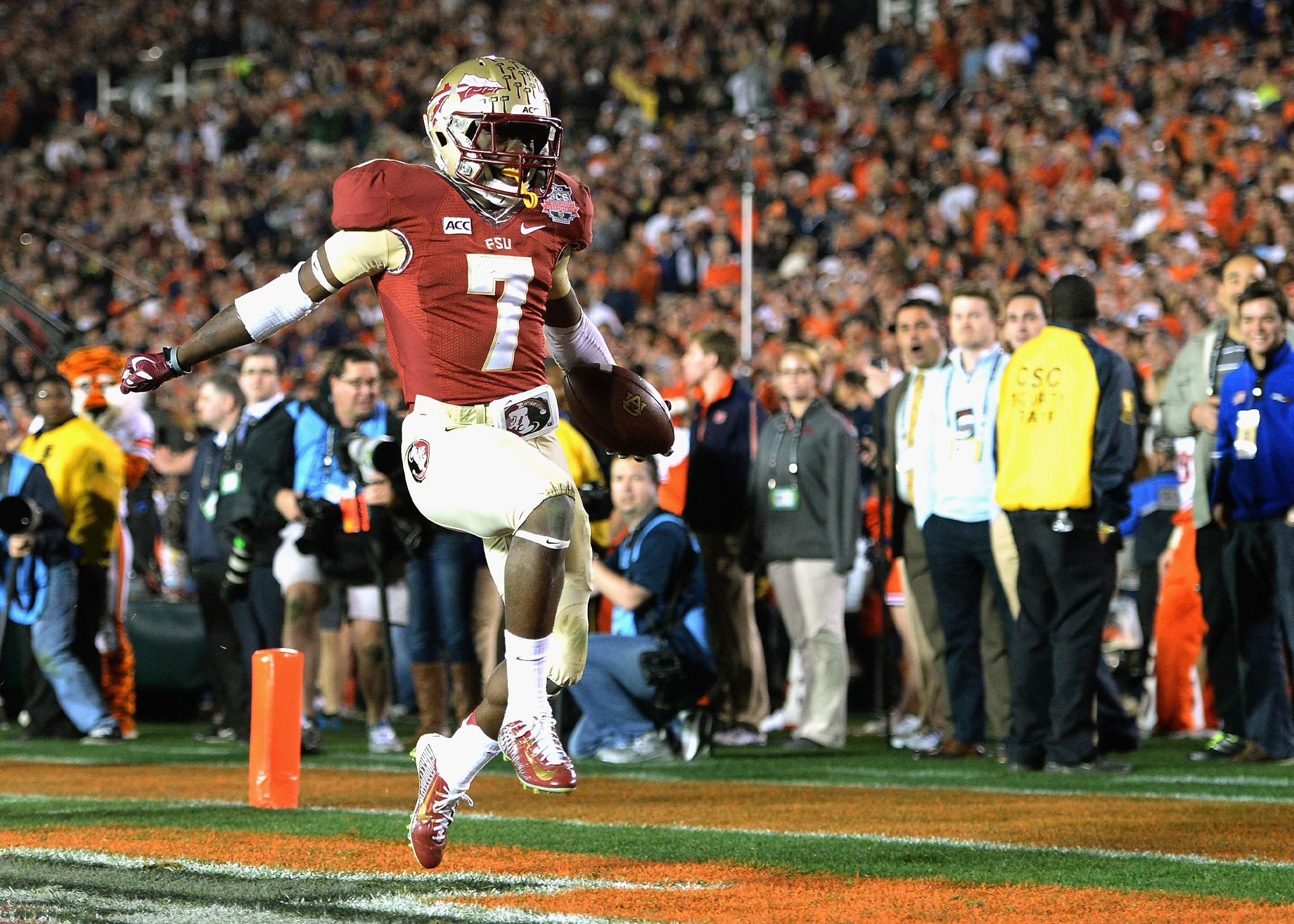
Levonte Whitfield celebrates after scoring during the final BCS National Championship in January 2014.
The first Associated Press rankings were released in 1936. The rankings included 20 teams and helped determine a college football champion. Minnesota was the first team to sit atop the AP rankings at the end of the season, becoming the 1936 college football champs.
The Bowl Championship Series (BCS) was created in 1998. The BCS integrated a system that matched top-10 teams together in marquee bowl games at the end of the season, including putting together the No. 1 and 2 teams in a the BCS national championship game. The first BCS national championship game featured Tennessee beating Florida State 23-16.
RANKINGS MADE EASY: Every college football poll explained | AP poll history
The College Football Playoff era began with the 2014 season. For the first decade, four teams were selected to the Playoff field, with two semifinal games and a national championship game. Starting in the 2024-25 season, a new expanded format was implemented.
12 teams will be selected to the Playoff field, with the five highest-ranked conference champions earning automatic bids
The four highest-ranked teams regardless of conference champion status will receive the top four seeds in the playoff and a first-round bye.
In the inaugural 12-team playoff in 2024, the four highest-ranked conference champions were seeded 1-4 and each will received a first-round bye
Teams seeded 5-12 will play each other in the first round on the home field of the higher-ranked team
The quarterfinals and semifinals rotate among six bowls: Cotton, Fiesta, Orange, Peach, Rose and Sugar. Both semifinals will be played around the New Year’s holiday with the national title game on a Monday night at least a week later. Ohio State was the first team to win the College Football Playoff in 2014 when four teams made the bracket.
Jaime Squire/Getty
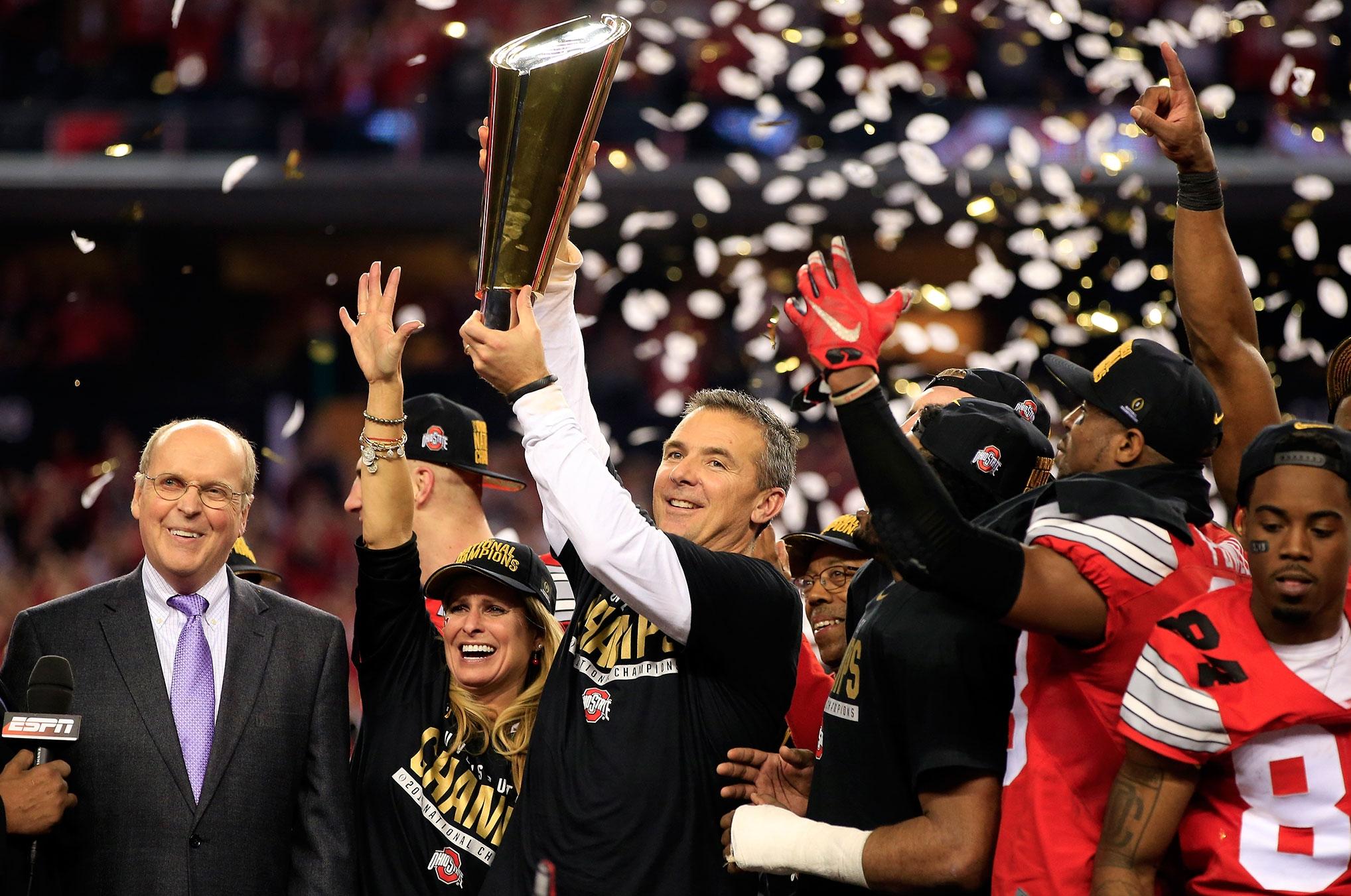
Ohio State head coach Urban Meyer lifts the CFP championship trophy after his team won the first ever College Football Playoff National Championship in January 2015.
When was the first Heisman Trophy awarded?
The Heisman Trophy award was created in 1935 and members of New York’s Downtown Athletic Club (DAC) presented the first to Jay Berwanger of Chicago University. The trophy was named after John W. Heisman in 1936. On Dec. 2, 1975, Ohio State running back Archie Griffin became the first and only player to win the Heisman Trophy in consecutive seasons.
MORE: These schools have the most Heisman Trophy winners
Heisman Trophy winners: History
YEAR
WINNER
SCHOOL
POSITION
2024
Travis Hunter
Colorado
CB/WR
2023
Jayden Daniels
LSU
QB
2022
Caleb Williams
Southern Cal
QB
2021
Bryce Young
Alabama
QB
2020
Devonta Smith
Alabama
WR
2019
Joe Burrow
LSU
QB
2018
Kyler Murray
Oklahoma
QB
2017
Baker Mayfield
Oklahoma
QB
2016
Lamar Jackson
Louisville
QB
2015
Derrick Henry
Alabama
RB
2014
Marcus Mariota
Oregon
QB
2013
Jameis Winston
Florida State
QB
2012
Johnny Manziel
Texas A&M
QB
2011
Robert Griffin III
Baylor
QB
2010
Cam Newton
Auburn
QB
2009
Mark Ingram Jr.
Alabama
RB
2008
Sam Bradford
Oklahoma
QB
2007
Tim Tebow
Florida
QB
2006
Troy Smith
Ohio State
QB
2005
Reggie Bush*
Southern California
RB
2004
Matt Leinart
Southern California
QB
2003
Jason White
Oklahoma
QB
2002
Carson Palmer
Southern California
QB
2001
Eric Crouch
Nebraska
QB
2000
Chris Weinke
Florida State
QB
1999
Ron Dayne
Wisconsin
RB
1998
Ricky Williams
Texas
RB
1997
Charles Woodson
Michigan
CB/returner
1996
Danny Wuerffel
Florida
QB
1995
Eddie George
Ohio State
RB
1994
Rashaan Salaam
Colorado
RB
1993
Charlie Ward
Florida State
QB
1992
Gino Torretta
Miami
QB
1991
Desmond Howard
Michigan
WR/returner
1990
Ty Detmer
BYU
QB
1989
Andre Ware
Houston
QB
1988
Barry Sanders
Oklahoma State
RB
1987
Tim Brown
Notre Dame
WR
1986
Vinny Testaverde
Miami
QB
1985
Bo Jackson
Auburn
RB
1984
Doug Flutie
Boston College
QB
1983
Mike Rozier
Nebraska
RB
1982
Herschel Walker
Georgia
RB
1981
Marcus Allen
Southern California
RB
1980
George Rogers
South Carolina
RB
1979
Charles White
Southern California
RB
1978
Billy Sims
Oklahoma
RB
1977
Earl Campbell
Texas
RB
1976
Tony Dorsett
Pitt
RB
1975
Archie Griffin
Ohio State
RB
1974
Archie Griffin
Ohio State
RB
1973
John Cappelletti
Penn State
RB
1972
Johnny Rodgers
Nebraska
WR/RB
1971
Patt Sullivan
Auburn
QB
1970
Jim Plunkett
Stanford
QB
1969
Steve Owens
Oklahoma
FB
1968
O.J. Simpson
Southern California
HB
1967
Gary Beban
UCLA
QB
1966
Steve Spurrier
Florida
QB
1965
Mike Garrett
Southern California
HB
1964
John Huarte
Notre Dame
QB
1963
Roger Staubach
Navy
QB
1962
Terry Baker
Oregon State
QB
1961
Ernie Davis
Syracuse
HB/LB/FB
1960
Joe Bellino
Navy
HB
1959
Billy Cannon
LSU
HB
1958
Pete Dawkins
Army
HB
1957
John David Crow
Texas A&M
HB
1956
Paul Hornung
Notre Dame
QB
1955
Howard Cassady
Ohio State
HB
1954
Alan Ameche
Wisconsin
FB
1953
Johnny Lattner
Notre Dame
HB
1952
Billy Vessels
Oklahoma
HB
1951
Dick Kazmaier
Princeton
HB
1950
Vic Janowicz
Ohio State
HB/P
1949
Leon Hart
Notre Dame
End
1948
Doak Walker
SMU
HB
1947
Johnny Lujack
Notre Dame
QB
1946
Glenn Davis
Army
HB
1945
Doc Blanchard
Army
FB
1944
Les Horvath
Ohio State
QB/HB
1943
Angelo Bertelli
Notre Dame
QB
1942
Frank Sinkwich
Georgia
HB
1941
Bruce Smith
Minnesota
HB
1940
Tom Harmon
Michigan
HB
1939
Nile Kinnick
Iowa
HB/QB
1938
Davey O’Brien
TCU
QB
1937
Clint Frank
Yale
HB
1936
Larry Kelley
Yale
End
1935
Jay Berwanger
Chicago
HB
*Vacated
Who has won the most games in college football history?
Although college football started with Rutgers and Princeton, a team from the Midwest has won the most games. Michigan leads all college football with 1,011 wins.
As for the number of National Championships, Yale tops the list, followed by Alabama and Princeton.
Programs with the most college football national titles
School
Number of titles
Yale
18
Alabama
16
Princeton
15
Notre Dame
13
Michigan
9
Southern Cal
9
Ohio State
9
Harvard
8
Oklahoma
7
Minnesota
6
Other Notable milestones in college football
HISTORY: See who has won every college football national championship ever
In 1916, Fritz Pollard became the first African American football player to participate in a Rose Bowl. Pollard went on to live a life full of football, as he would become the first African American to become an NFL head coach in 1921 (back when player-coaches were a thing), and would go on to be the first African American to play quarterback in the NFL in 1923.
On October 7, 1916, Georgia Tech launched itself into the college football history books as they knocked off Cumberland College by a whopping score of 222-0. No other game has come close to this blowout, as Georgia Tech scored 32 touchdowns and Cumberland committed 15 turnovers.
In 1958, the NCAA implemented a rule allowing two-point conversions. The rule was put into place to try and increase scoring and maintain a balance between offensive play and defensive play. The post-touchdown maneuver was tried 51.4 percent of the time during that first season.
In 1966, No.1 Notre Dame and No. 2 Michigan State famously tied 10-10 during a game at the end of the season, which ultimately determined the champion of the 1966 season. Regarded as one of the most controversial games in college football history, Notre Dame coach Ara Parseghian decided to let the clock run from 1:10 down to zero even though Notre Dame had the ball with the game tied 10-10. After the game, Notre Dame went on to defeat Southern California to finish the season 9-0-1 and were voted champion of the NCAA by a majority of polls.
In the late 1990s and early 2000s, two place-kickers made history for being the first two women to score points during a college football game. Liz Heaston, for Williamette successfully kicked two extra-points for her team in 1997. Williamette was then an NAIA school but is now apart of Division III. In 2001, Ashley Martin kicked three extra points for Jacksonville State to be the first woman to score during a Division I college football game.