

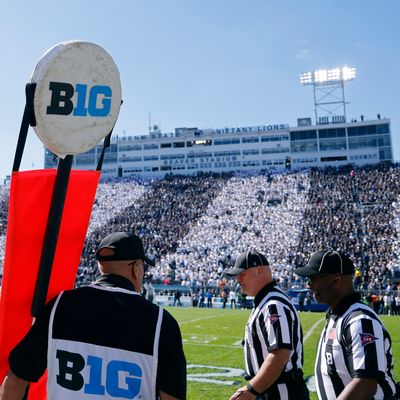
Photo: Joe Robbins/Icon Sportswire/Getty Images
The college football season begins this Saturday with a matchup between No. 17 Kansas State and No. 22 Iowa State, colloquially known as “Farmageddon.” The game will take place in Dublin, Ireland, the logical place for any college football season to begin. (Perhaps the idea is that Farmageddon will stave off any future potato famines?)
For those who have been unable to stop their head from spinning following all the dramatic changes that have landed on college football over the last half-decade — realignment, expanded playoffs, unlimited transfers, revenue sharing, Name, Image and Likeness payments to players — you may be surprised to find that college football, on the whole, looks mostly like it did last year. There are small changes, sure: they’ve tweaked the playoff seeding; teams get fewer time outs in overtime; Dave Portnoy (of all people) is going to be a part of the FOX pregame show. But college football didn’t spend the entire offseason tearing itself down to the studs the way it has done so often in recent years. But that consistency is not going to last. And the chaos ahead comes from a most unlikely source: The Big Ten Conference.
As a proud alum of a Big Ten school — someday I hope to start an Illini collective with the Hot Ones guy — I can confirm that the conference has always thought itself a little bit better than everyone else: more principled, more academic. The Big Ten is full of Michigan Men, Medill graduates and generally upstanding citizens, or at least that was its imsage. Remember, this was the conference that canceled the football season in August 2020 because “we’re going to do what’s best for the health and wellness of our student-athletes.” (They would almost immediately reverse course once the SEC went full-speed ahead.) Even as the conference expanded to a cartoonishly large 18 teams—conference mates Oregon and Rutgers are 2,460 miles from each other—it still kept that sense of removed superiority, too high-minded for those glorified legacy bootleggers down South but still more than capable of stacking together national championships. The Big Ten was seen, not least of all by itself, as the soul of college athletics, and even an avatar for the soul of America. And for years, former commissioner Jim Delaney kept the league two steps ahead of everyone else, securing big money from the Big Ten Network and its schools’ vast alumni base and geographic footprint.
But now the Big Ten has a new commissioner in Tony Petitti, who is a man of television, not college sports. And just like that, the conference is trying to blow up its whole reputation. In fact, the Big Ten appears dead set on becoming college athletics’ primary villain.
Petitti’s central organizing principle is that the only important thing in college sports is the field he understands better than anything else: television inventory. (It is, after all, why he was hired.) It has guided every move the league has made under his watch, from expansion to signing multiple contracts with multiple networks to the move that could blow up college athletics for good. Last year, Petitti proposed a new version of the College Football Playoff — which just expanded in 2024, remember — that would have specifically, and exclusively, rewarded the Big Ten and the SEC, the two largest and most powerful conferences, giving them guaranteed spots in the field unavailable to the ACC, the Big 12 and the Group of Five conferences. (Those teams would have to compete for at-large spots that the Big Ten could also swoop up.) The reasoning behind this had nothing to do with competitive balance, or even making the tournament more attractive or lucrative. Petitti wanted to do it simply so that his conference could hold play-in games for the CFP during the first weekend of December. In other words, so that there would be television inventory for his league to sell.
The plan was so brazen and self-serving that not only did the Big 12 and ACC lose their minds over it — the proposal explicitly secured their place as second-class citizens — the SEC, which would stand to benefit from it, didn’t support it either. The reason was obvious to anyone who knew more about college athletics than television production: Such a model would make the regular season (the lifeblood of college football, the soul of the whole sport) mostly pointless and render 80 percent of college football teams irrelevant. But Petitti and the Big Ten didn’t care about that. Because the proposal would make them more money.
Petitti has been rebuffed in his efforts, (for now, but he hardly seems deterred. Last week, he floated an even more expanded playoff. This one would go up to 28 teams, seven of them reserved for the Big Ten with the possibility of two more at-large bids, which would mean, conceivably, half the league would make the playoffs, a notion that is the opposite of everything college football has ever valued but very much in the spirit of professional sports, which Petitti says he wants to emulate. If it sounds like Petitti is willing to burn down all of college athletics just to make the Big Ten more money, that’s exactly what’s happening: It is, after all, what the conference hired him to do.
The reason he can do this, of course, is that no one is in charge of college football anymore. The NCAA, after years of getting beaten up in the courts, has essentially abdicated any leadership role, which leaves people like Petitti — or, more accurately, the television executives paying his league and its schools so much money — as the primary power brokers of the sport. (That SEC commissioner Greg Sankey, a longtime perceived villain to college sports fans himself, has been the primary bulwark against the Big Ten’s expansionist plans speaks to how dire the situation has become.) This is exactly how you turn college football — which is beloved precisely because it isn’t the NFL — into minor league football, and how you send the sport down a path from which it cannot return. The people with the most power in college football right now — which makes them the people with the most power in college sports — care only about getting what they can, while they can, without any regard to the possible long-term consequences. The ground is always unstable: There are always more things to blow up. Maybe the Big Ten really is the avatar for America after all.
Sign Up for the Intelligencer Newsletter
Daily news about the politics, business, and technology shaping our world.
Vox Media, LLC Terms and Privacy Notice