
I have enough to feel guilty about in this job. I’m not active enough on social media. I don’t catch enough typos in columns.
My hot takes are often warm takes.
And now football season is starting with its annually conflicted message such that my postgame walk through the locker room conjures the final scene of the classic movie “Patton.”
“I love it,’’ the imperial actor George C. Scott says, while looking over a charred World War II battlefield. “God help me, I do love it so.”
Football, of course, isn’t war. But God help us that the price of America’s favorite sport is torn bodies, mutilated minds and the probability of a player carted off with numb limbs on any given Sunday as fans solemnly applaud, Roman Colosseum-like, and move to the next play.
We love it so.
I love it so, too.
The start of football season is the happy-new-year moment of the American sports calendar. Maybe it’s the emerald chessboard of X’s and O’s that make it our top sport. Maybe it’s how it fits on television. Surely it’s the violence (and betting), too.
But once upon a time America’s sport was baseball, where the ceiling on serious injury is a pitcher’s elbow needing surgical repair. The dark side of football is regularly darker, as the Miami Dolphins unfortunately learned even in summer of controlled football that ends with Saturday’s game against Jacksonville.
Offensive tackle Bayron Matos was airlifted by helicopter from the Dolphins’ first practice of training camp and hospitalized for a week after a collision left him with little feeling in his extremities. He has since mostly recovered and wants to play again.
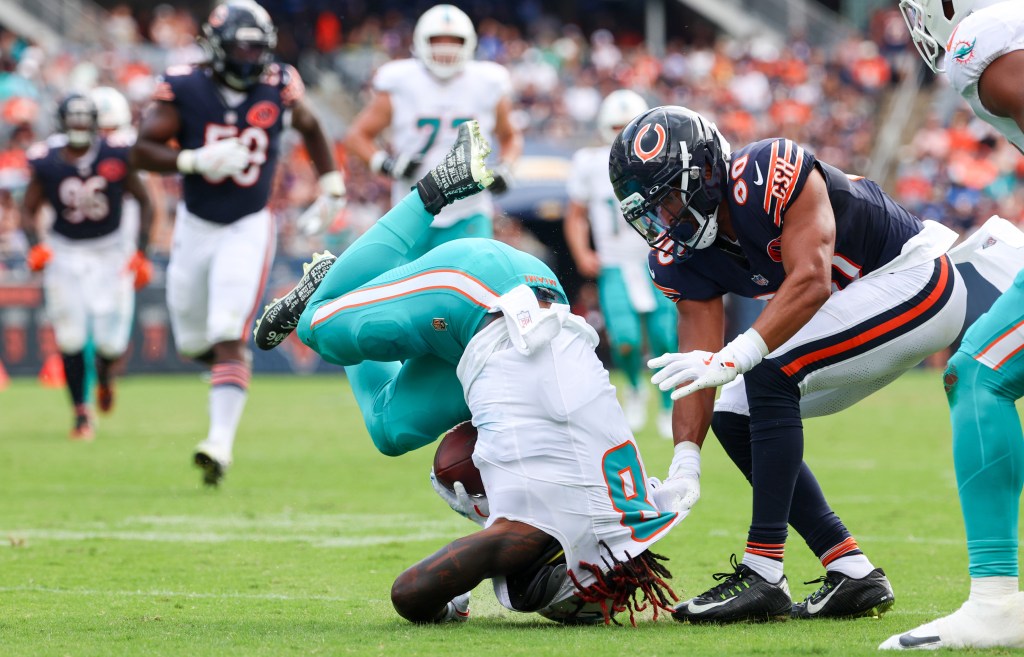
Running back Alexander Mattison had neck surgery within hours after landing on his head during an exhibition game against Chicago on Aug. 10. He’s gone for the season, if not for his full career. Knee injuries like the one suffered by cornerback Kader Kohou are an accepted part of the game. But neck surgeries?
At least that preseason game wasn’t canceled, as happened after Detroit cornerback Morice Norris suffered such a scary, head-related injury against Atlanta, so that neither team wanted to continue.
That cancelation created an odd debate: Should a game be subject to being stopped by injury?
A better question: Should the regular price of a game be a life-altering collision?
That’s asked in measured tones in South Florida, because Dolphins quarterback Tua Tagovailoa’s concussion history means any hit comes with the threat of danger.
Tagovailoa doesn’t like being the poster child of NFL concussions for obvious reason. But the phrase “fencing response,” involving contorted fingers after head trauma, wasn’t part of the national sports vocabulary before his dramatic injuries.
The conversation around him has gone from learning jiu-jitsu to fall properly to being smarter about not running the ball to basically crossing fingers and hoping nothing bad happens.
The NFL is in an uncomfortable spot of trying to make the game safe from such serious injury while never admitting it is unsafe. It reached a $1.3 billion concussion settlement last year with 1,300 former players who sued over the league concealing links between head trauma and neurological diseases.
NFL commissioner Roger Goodell sounded like a 1960s cigarette company executive at a recent Super Bowl, saying football has dangers, “but there are risks in life. There are risks sitting on a couch.” What, a couch-cussion?
Science is clear by now: Repeated hits to the head aren’t healthy. Four members of the 1972 Dolphins team had their brains examined after death for the neurological disease, Chronic Traumatic Encephalopathy. Jake Scott, Bill Stanfill, Nick Buoniconti and Jim Kiick each suffered from it. CTE can only be diagnosed after death.
Former Dolphins now in their 40s and 50s do something as common as misplace their wallet and wonder if their memory skills are deteriorating from football.
Careers are increasingly managed with known risks in mind. Detroit center Frank Ragnow did this offseason, at 29 and with four Pro Bowls, saying, “I’ve tried to convince myself that I’m feeling good, but I’m not and it’s time to prioritize my health and family’s future.”
University of Texas quarterback Arch Manning didn’t play tackle football until he was 13. That followed the family’s protocol involving NFL uncles Peyton and Eli. Young bodies aren’t ready for football until then, decided grandfather Archie Manning, another NFL quarterback.
Football kicks off for real this week in college, followed the next week in the NFL. It’s become an annual column to mark this moment, because it’s always fun to see another season arrive. It’s a conflict, too. God help us, we love it so.
Originally Published: August 22, 2025 at 12:57 PM EDT