
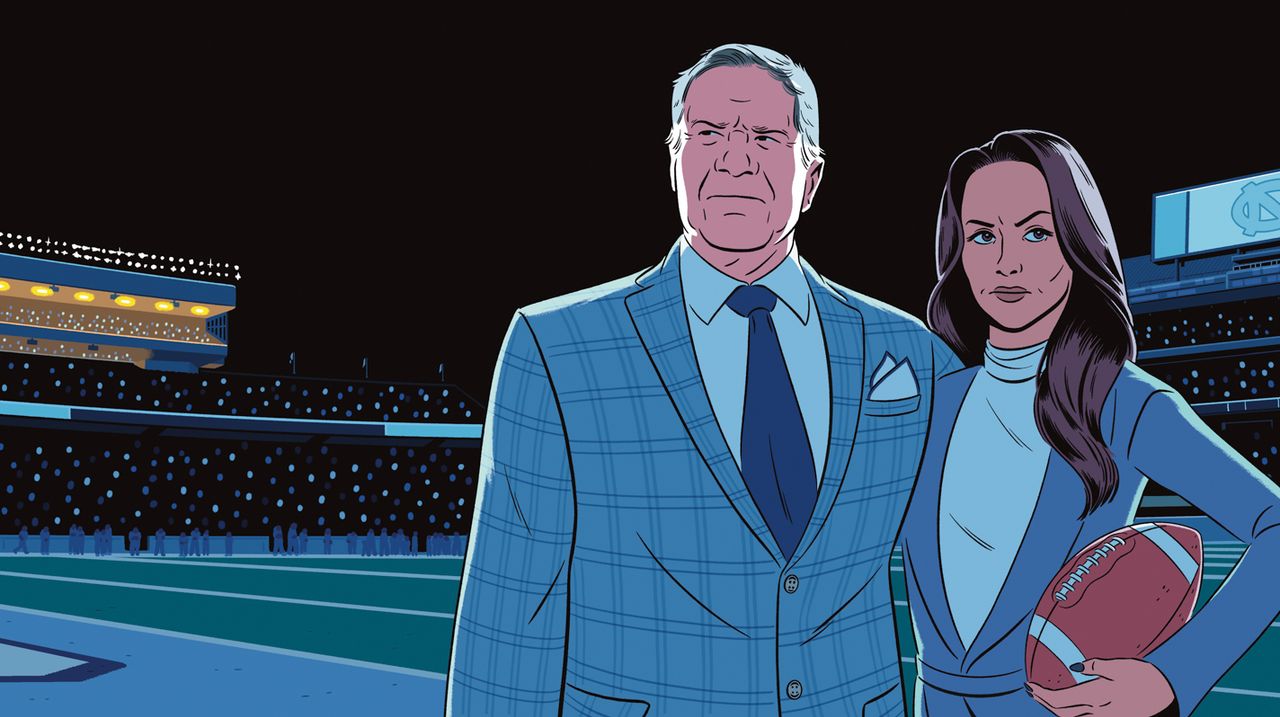
On the morning of December 12th, Bubba Cunningham, the athletic director at the University of North Carolina, in Chapel Hill, sent the football team’s equipment manager to pick up a U.N.C. sweatshirt with removable sleeves. He asked his wife to go to Goodwill and buy a suit jacket. Cut the sleeves off, he texted her, then added, “(Seriously).”
Sixteen days earlier, U.N.C. had announced the retirement of its football coach, Mack Brown. This had come as news to Brown. Cunningham was now preparing to reveal his replacement: Bill Belichick, who led the New England Patriots to a record six Super Bowl victories before leaving the team in January, 2024, fifteen wins shy of breaking Don Shula’s record as the winningest head coach in N.F.L. history. Colleges had hired former N.F.L. coaches before (Pete Carroll, at U.S.C.; Nick Saban, at Alabama), but there was no coach quite like Belichick, a brilliant tactician with an introvert’s appetite for granular detail, a shabby habit of wearing the sleeves of his sweatshirts cut off near the elbow, and the delicacy of a junk-yard dog. As far back as 1993, during Belichick’s first head-coaching job, with the Cleveland Browns, Sports Illustrated described him as “an automaton who offers no positive motivation and sees players only as faceless cogs.” At press conferences, he delivered curt non-answers or sometimes simply walked out of the room. Observers, including colleagues, called him “robotic,” “gray,” “flat,” “the Kremlin,” “Sominex,” “Asshole,” “Doom and Gloom,” “a potted palm,” and “the greatest enigma in sports.” After two Patriots cheating scandals—Spygate (2007) and Deflategate (2015)—Shula started calling him “Belicheat.”
The split with the Patriots and the team’s owner, Bob Kraft, was characterized as mutual. No one believed that. According to ESPN, the Atlanta Falcons came close to hiring Belichick; then Kraft warned the Falcons’ owner that Belichick, whom he’d worked with for a quarter century, was arrogant, untrustworthy, domineering, cold. Belichick got no offers. For the first time in forty-nine years, he spent football season not on the field but as a TV commentator—a member of the media, which he’d always seemed to despise.
U.N.C., a twenty-eight-sport school that plays in the Atlantic Coast Conference, calls its athletic teams the Tar Heels, a reference to the distinctive footprints made by Colonial laborers who worked in turpentine distilleries. Carolina is a basketball school, and Chapel Hill is a basketball town. The men’s team has won as many national championships as Belichick has Patriots-era Super Bowl rings. Shelby Swanson, a recent U.N.C. grad who was the sports editor for the Daily Tar Heel, Carolina’s student newspaper, recently told me, “I’m from here. Both of my parents went to U.N.C. I just graduated from U.N.C. Basketball is the national brand.” Football has always been “sort of an afterthought,” she said, adding, “I mean no disrespect to the great players who’ve come through here, but literally for the entirety of my life I don’t think U.N.C. football has been nationally relevant.”
Carolina’s football team has never won a national championship, and last won a conference title in 1980, when Lawrence Taylor played linebacker. Fans have been known to arrive at games late and leave early, if they come at all. Yet U.N.C. football has repeatedly, and wishfully, been called a “sleeping giant,” as if all the team needed were a jolt.
At two o’clock on the day that Cunningham sent his wife to Goodwill, Belichick’s hiring was announced at a standing-room-only press conference on campus. U.N.C.’s chancellor gave Belichick the sweatshirt; Cunningham got a laugh by putting on the mutilated jacket. Belichick calmly answered reporters’ questions. When one asked whether he was biding his time until he could get back to the N.F.L., Belichick, without ripping the guy’s head off, replied, “I didn’t come here to leave.”
Hours after the announcement, an enterprising U.N.C. alum trademarked the nickname Chapel Bill. It zipped into circulation in the shops on Franklin Street, the backbone of Chapel Hill’s historic core, where one need only step over a low stone wall to be on campus. U.N.C., the oldest public university in the United States, opened in 1795, predating the town that grew up around it. Chapel Hill, which is closer to Virginia than to South Carolina, sits midway between the Blue Ridge Mountains and the Atlantic Ocean, in forests so dense that, this time of year, one can lose sight of the horizon amid a disorienting spectrum of sun-soaked green. In June, Thad Dixon, a new Carolina defensive back and a Los Angeles native, referenced the “culture shock” of moving to Chapel Hill by saying, “There’s a lot of trees out here, bro.”
The men’s basketball team plays in the Dean Dome, which is named for Dean Smith, U.N.C.’s most revered coach, who led the team from 1961 to 1997, winning two championships and thirteen A.C.C. tournament titles. Smith integrated Carolina basketball, and helped integrate Chapel Hill. He stressed team over self, a philosophy that became known as the Carolina Way. There is never any question of filling the Dean Dome. Cunningham decided to present Belichick there, on December 14th, at halftime of a game against La Salle.
The equipment manager had made another stop, at Julian’s, a men’s clothier that has been on Franklin Street since 1942. The store occupies a long ground-floor space fragrant with polished wood and good wool. The owner, Bart Fox, often works at a desk in the rear, where a muted television shows whatever Carolina game happens to be on. The equipment manager asked for sports jackets, shirts, and ties, telling Fox, “You have five minutes. He’s gonna be on camera.”
Fox assessed Belichick to be just shy of six feet tall, barrel-chested, and still “mostly muscle,” with none of the stooping that begins to happen to men in middle age. He selected a lightweight wool jacket in a hopsack weave that featured a tight pattern of light blue, medium blue, and eggshell, which together created the appearance of the official school color, Carolina blue, a color that must never be called baby blue or powder blue. Fox described it to me as the blue that a Chapel Hillian sees when looking up at the sky on a nice day. (But don’t call it sky blue, either.) U.N.C. had tinkered with Carolina blue over the years, arriving at a slightly richer shade for uniforms: Pantone 542. Older alums griped, but optics prevailed—the new version popped on television.
At the Dean Dome, the court cleared for halftime, and an m.c. stepped out with a mike. After congratulating the U.N.C. women’s soccer team for its twenty-third national title, he introduced Belichick as “one of, if not the, best ever.” Belichick joined him and said, “Can’t wait to get started.” He often mumbles and speaks so inaudibly that Swanson, the former Daily Tar Heel sports editor, told me she once had to borrow audio from someone who’d placed a recording device directly beneath his mouth at a presser.
The crowd cheered, but I wouldn’t say wildly. Julian’s framed a photo of Belichick’s appearance, pairing it with a mannequin outfitted in the clothing that Fox had selected, and added a sign: “Dress like coach!” The sign was leaned against a larger framed image—of Dean Smith, on the cover of Sports Illustrated, shown triumphantly cutting down a championship net.
“And then she opened Instagram, anticipating fresh new content—only to realize that she’d just closed it two seconds ago!”
Cartoon by Yinfan Huang
In Chapel Hill, all kinds of things get painted Carolina blue: fences, buildings, hair, fire trucks. About twelve years ago, a contractor named Geary Blackwood hauled a massive flint rock to one of his properties, on a busy highway, to mark a row of mailboxes that kept getting mowed down. He decorated the rock with some leftover paint, which turned out to be “kind of a darker blue,” he told me. “In this part of the country, that doesn’t sit too well with a lot of people.” Dark blue is the color of U.N.C.’s archrival, Duke, a private university in Durham, one town over.
Blackwood recently went to a hardware store where an employee had become known for her ability to mix a proper Carolina blue, and bought new paint. At Walmart, he bought bucketloads of industrial glitter. While the paint was wet, he used a leaf blower to bedazzle the rock. “When the sun hits it, it’s beautiful,” Blackwood told me. We were standing within sight of the rock on a nuclear afternoon in July; the surface did have the twinkling depth of a star-choked sky. I asked him why he’d decided to repaint it now. He said that it was to honor Belichick’s predecessor, Mack Brown—“a beautiful man.” Blackwood, and a lot of others I met in Chapel Hill, felt that the university had treated Brown harshly at the end of his tenure. When I asked what he thought of Belichick, he said, “I really like Mack Brown a lot.”
Blackwood climbed onto a front loader and drove it off the back of a flatbed truck. He and a crew had spent the morning working on a refurbishment project at Kenan Stadium, where the football team has played since 1927, and where the Belichick era will formally begin, on the evening of September 1st, when the Tar Heels host Texas Christian University. Season tickets sold out, even with a price hike of twenty-five per cent. Individual tickets have sold out, too. Gabe Feldman, a sports-law professor at Tulane, told me, “The attention on those first few games is going to be unlike anything we’ve ever seen in college sports. It’s something people still can’t quite wrap their heads around.” Carolina football is being called “the thirty-third N.F.L. team” before the first snap.
The author and sportswriter Art Chansky grew up in Newton, Massachusetts, near Boston. He moved to Chapel Hill in the seventies, to attend U.N.C., and stayed. As a longtime Patriots fan, he considered Belichick a “hero,” he told me this summer. We were sitting on the patio at a chain restaurant called First Watch, eating from a hot skillet of blueberry-lemon cornbread. “He’s a genius of the nuances of football,” Chansky told me. “But can he get the players—and enough of them? That’s the big question. And can he coach them?” Belichick has spent his entire career focussing on experienced, peak-conditioned professionals, not teen-agers weeks out of high school. Chansky wondered what might happen when Belichick inevitably “gets tough on them.” In recent years, the N.C.A.A. has streamlined the transfer process, making it relatively easy for a player who feels slighted to change schools in a huff. As a sports psychologist at U.N.C. once pointed out, the football players often present as grown men, but beneath the uniform “they’re still college students.”
Or at least they’re supposed to be. Student athletes are expected to balance competition with scholastics, a once sacrosanct ideal that’s getting overshadowed as intercollegiate sports increasingly resembles the pros. A player who fails classes may lose a scholarship or a spot on a roster—a coach is supposed to monitor academic performance—but at this point all you hear about is money. In June, a federal court in California finalized a settlement, in House v. N.C.A.A., allowing colleges, for the first time, to share a certain percentage of athletic revenue with their players. U.N.C. athletics brought in a hundred and fifty-one million dollars in 2023-24, about half of which came from television rights and ticket sales. Per the House settlement, the school can now spend $20.5 million paying athletes, with an allowable annual increase of four per cent. (Football and men’s basketball are expected to receive most of the money, because they earn the most.) Allocating a fixed amount of cash up and down a roster involves weighing the dollar value of each position; overspend on your quarterback and you’ll have less money to attract the players necessary to support him. Belichick had to make such calculations constantly in the N.F.L., which has a salary cap.
College sports was already being transformed by the “name, image, and likeness” rule, or N.I.L., which took effect in 2021, allowing student athletes to be compensated for appearances, autographs, and endorsements—the kind of thing that used to result in penalties. That first year, the N.I.L. market was worth an estimated nine hundred and seventeen million dollars; it’s now worth an estimated $2.3 billion. Star players have landed million-dollar deals with brands like Bose and 7-Eleven. Shedeur Sanders (of the Cleveland Browns) reportedly had an N.I.L. value of $4.8 million at the University of Colorado, where he played for his father, Deion. The U.N.C. quarterback Drake Maye (now of the Patriots) had deals with Jimmy’s Famous Seafood and Zoa Energy, which is owned by Dwayne (The Rock) Johnson, and with Mitchell Heating and Cooling. In 2022, Maye, addressing rumors about courtship from other teams, told a reporter, “Sadly, I think money is becoming a reason why kids go places,” and “I think college football is going to turn into a mess.”