
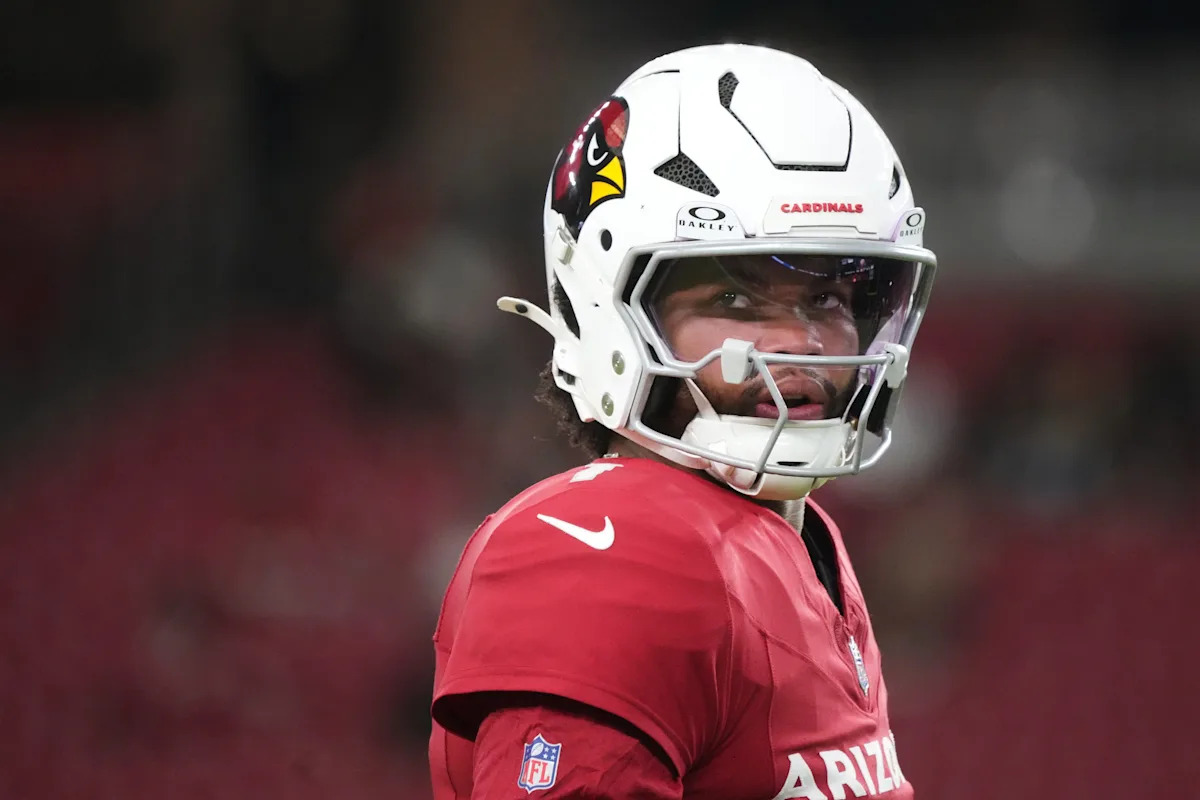
The Arizona Cardinals have spent the past six months turning a transitory roster into one that they believe is now ready to compete.
After aggressively addressing their weaknesses through both free agency and the draft, their final 53-man roster looks quite different from a year ago. This is no longer a team with two or three glaring red flags. It’s a team that can push for a playoff spot in a wide-open NFC West.
Advertisement
So, with nine days before the season opener in New Orleans, here are the Cardinals’ position groups, ranked from most encouraging to most concerning:
1. Tight end
Trey McBride, Tip Reiman, Elijah Higgins, Travis Vokolek
McBride is — for now — the only Cardinal who can stake a legitimate claim to being the best player in the NFL at his position. Among tight ends over the past two seasons, he ranks first in receptions (192), second in targets (154) and second in yards (1,971). His presence tilts the field and dictates how defenses construct their game plans.
Beyond McBride, the Cardinals have the personnel to lean on multiple tight end sets, which they used 44.8% of the time last year, a top-five rate in the NFL. Tip Reiman, now in his second year, excels as a physical blocker. And Elijah Higgins, a converted wide receiver, offers them a capable outlet in the passing game. He has 34 catches for 335 yards and three touchdowns over the past two seasons.
Advertisement
2. Safety
Budda Baker, Jalen Thompson, Dadrion Taylor-Demerson, Joey Blount, Kitan Crawford
As with tight end on the offensive side, the Cardinals’ defensive identity relies on their safeties. Not only is Baker the focal point of everything they do schematically, but they use a steady dosage of three safety looks, often using cornerback Garrett Williams in one of those roles.
Defensive coordinator Nick Rallis deploys those schemes because of the Cardinals’ talent. Baker, a seven-time Pro Bowler and four-time All-Pro, is their best defensive player. Thompson isn’t far behind. And Taylor-Demerson led all rookie safeties in Pro Football Focus grade last season. He looks like a steal of a fourth-round pick and could enable them to lean even further into their three-safety coverages this season.
Advertisement
3. Running back
James Conner, Trey Benson, Emari Demercado, Zonovan Knight
At age 30, Conner remains a crucial part of the Cardinals’ entire operation. He’s the type of player who’s easy to forget about over the offseason. There’s never any drama, never any headlines. But when he steps on the field, he makes things happen.
Even in his three preseason carries, he provided a reminder of how his physical running style consistently enables him to pick up yardage that didn’t seem available. Last season, he added 0.48 rush yards over expectation per attempt, per Next Gen Stats. That metric measures how a running back performed based on the blocking in front of him. Conner is consistently among the league leaders.
Advertisement
Now, he should have a capable backup in second year back Trey Benson. Benson hasn’t yet proven himself at the NFL level, but he’s earned nonstop offseason praise and seems poised to ease Conner’s workload.
4. Interior defensive line
Calais Campbell, Dalvin Tomlinson, Darius Robinson, Dante Stills, L.J. Collier, P.J. Mustipher
What a difference a year makes. Last year, this may have been the Cardinals’ least talented position group.
Now? Campbell led all interior defenders in PFF run grade last season. Tomlinson ranked 11th in pressure rate (minimum 300 pass rush snaps). Those two are known qualities, and they give the Cardinals a steady duo in the middle.
Advertisement
Robinson is still more of a projection after missing his rookie season to injury, but he had a strong training camp. Plus, first-round pick Walter Nolen should be ready to debut at some point in October. He’ll need to adapt to the NFL level after missing all of training camp, but he has explosive potential.
Campbell and Tomlinson give this unit a high floor; Robinson and Nolen give it a high ceiling.
5. Offensive line
Paris Johnson Jr., Evan Brown, Hjalte Froholdt, Isaiah Adams, Jonah Williams, Kelvin Beachum, Josh Fryar, Will Hernandez, Jon Gaines
The Cardinals’ offensive line — outside of Johnson — might not draw much national attention. These are not household names. But last year, the group was solidly above average.
Advertisement
Per ESPN, they ranked 16th in pass-block win rate and 11th in run-block win rate. Per PFF, they ranked fourth in pass protection and 14th in run blocking. They were 11th-best at avoiding pressure and fifth-best at avoiding sacks.
This year, there’s a clear path to improving at three of the five spots. After a strong second season, there’s an internal belief that Johnson could become a star at left tackle. Adams is entrenched at right guard after an excellent training camp, steadying a position that was a rotating door last year. And Williams is healthy at right tackle after missing 11 games in 2024.
6. Specialists
Chad Ryland, Blake Gillikin, Aaron Brewer
The Cardinals have a nice group of specialists. Ryland made 28 of 32 field goals after signing off the street midseason, including all four of his attempts over 50 yards. Gillikin ranked third in the NFL with 44.2 net yards per punt. Brewer is in his ninth season as a steady long snapper.
Advertisement
7. Quarterback
Kyler Murray, Jacoby Brissett
The Cardinals’ season rests squarely on the shoulders of their quarterback. They know that. Murray knows that. The world knows that.
At his best, Murray is a transcendent talent who makes eye-popping plays. At his worst, he leaves fans scratching their heads with wayward throws and poor decision-making.
Before the Cardinals’ bye in 2024, he ranked ninth in expected points added. He was a playoff-caliber quarterback. After the bye, he ranked 16th, helping end their season.
Brissett is a nice upgrade as the backup, but he doesn’t move the needle. The Cardinals’ hopes rely on Murray being both more consistent and more explosive.
Advertisement
‘We’re gonna look real good’: Arizona Cardinals players react to new uniforms
8. Edge rusher
Josh Sweat, Baron Browning, Zaven Collins, Jordan Burch, Xavier Thomas
The addition of Sweat gives the Cardinals a proven, reliable pass rusher — something that they have lacked for the entirety of Jonathan Gannon’s tenure. Sweat, though, is more good than elite. He ranked 26th among edge rushers in sacks and 20th in pressure rate.
Browning and Collins, meanwhile, are nice complementary pieces, but neither has ever finished a season with more than five sacks.
For this group to truly be above average, they’ll need a breakout from one of their young players. B.J. Ojulari is still on the shelf from a torn ACL 13 months ago and will begin the season on the PUP list, but third-round pick Jordan Burch flashed some dominant traits in preseason. He could be the key to elevating the entire unit.
Advertisement
9. Cornerbacks
Max Melton, Will Johnson, Garrett Williams, Kei’Trel Clark, Denzel Burke, Elijah Jones
If this ranking were purely based on starters, the cornerbacks would be a few slots higher. Williams became one of the better nickel corners in the league last year and offers valuable versatility. Melton and Johnson are both young and relatively unproven, but they were second-round picks for a reason. Their ceiling is immense. By the second half of the year, in particular, that trio could be a strength of this defense.
The concern — beyond the lack of experience on the outside — is with the depth. With Starling Thomas V and Sean Murphy-Bunting both out for the season, the Cardinals cannot afford an injury at corner. None of their backups has yet proven to be a reliable option at the NFL level.
Advertisement
10. Wide receiver
Marvin Harrison Jr., Michael Wilson, Greg Dortch, Zay Jones, Xavier Weaver
So much of this group’s output relies on Harrison. As a rookie, he flashed encouraging signs but finished just 34th in receiving yards, one spot behind Jonnu Smith. For the Cardinals’ passing game to improve, he’ll need to take that next step, providing the statistical output expected of a fourth overall pick.
Beyond him, there’s limited dynamism in this group. Wilson has shown some flashes in his career, but he was a non-factor for much of training camp and has not hit 600 receiving yards in either of his first two seasons. Dortch is what he is — a shifty slot receiver who is best as a third or fourth option. Jones and Weaver are both just solid depth options.
Advertisement
11. Inside linebacker
Mack Wilson Sr., Akeem Davis-Gaither, Cody Simon, Owen Pappoe
The first thing to note here: The Cardinals’ inside linebackers aren’t bad. That, in itself, is a welcome change.
A year ago, three or four groups could have laid a claim to this spot. Now, it feels as if no group on the roster is deserving of ranking last.
Some group, though, has to fill this spot. And while Wilson had an excellent season after joining in free agency last year, the rest of the group is filled with question marks. None of the three had a strong preseason and none has ever played a major defensive role at the NFL level.
Advertisement
Fortunately for the Cardinals, they’ll use plenty of single-linebacker looks, minimizing the impact of those roster limitations.
This article originally appeared on Arizona Republic: Ranking Arizona Cardinals’ best position groups