
It happened gradually. Organically. It wasn’t something Kirk Herbstreit and Lee Corso even had a conversation about, at least not directly.
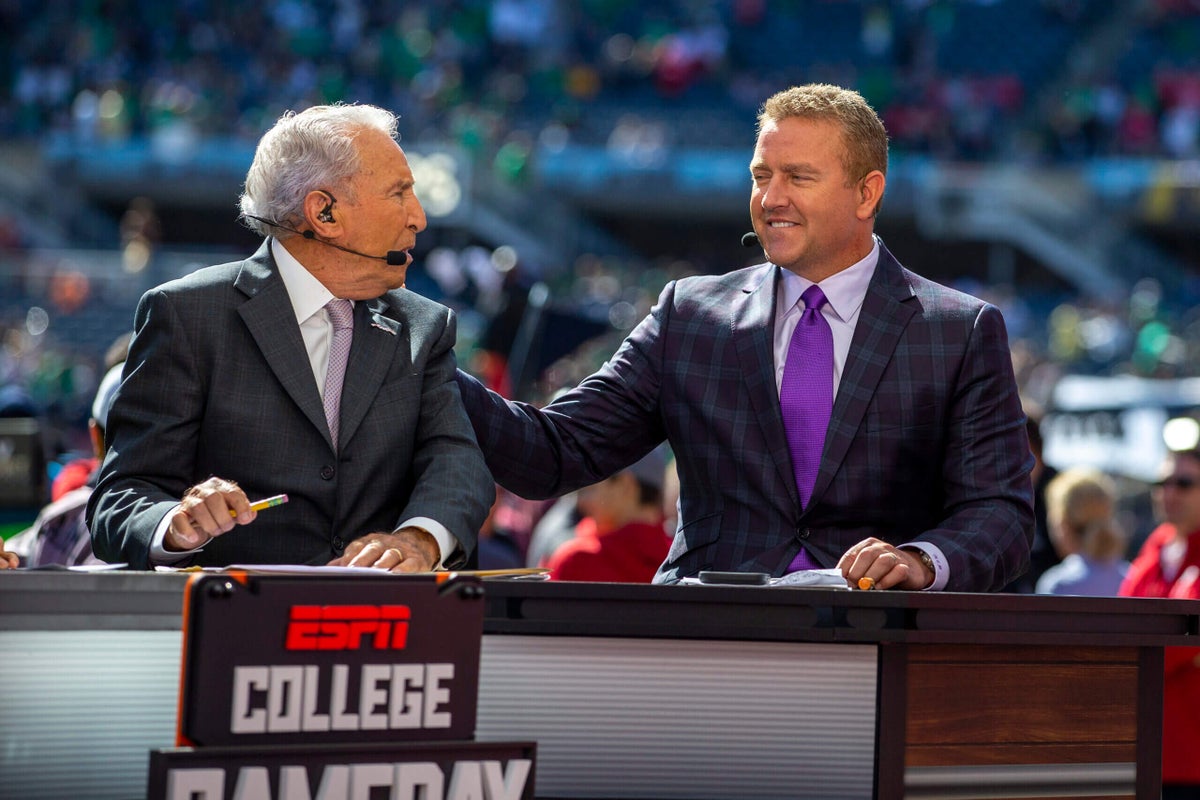
“I don’t remember it being as if Lee was my mentor, I was his pupil, so now I’ve got to help him out,” said Herbstreit, the longtime analyst on ESPN’s “College GameDay.” “I just sat next to him, and felt like if he ever got stuck, I would try to subtly interrupt him or put my hand on his.”
“I didn’t have a game plan,” added Herbstreit. “I just felt that was my role.”
In May 2009, Corso suffered a stroke at his home in Lake Mary, Fla., near Orlando, after going out to fetch his morning newspaper. The affable, rabble-rousing elder statesman of the popular college football pregame show was a still-sprightly 73 at the time. GameDay ended each episode with Corso donning a mascot head to signify his winning pick for that day’s marquee matchup.
Corso, of course, would recover and return, and 16 years later, his headgear pick remains the signature moment of Saturday mornings in the fall. But Corso’s legendary run is finally coming to an end. At 90, the former college player and coach is set to retire following this Saturday’s show in Columbus, Ohio, for No. 1 Texas against No. 3 Ohio State, signing off after a remarkable 38-plus seasons on “College GameDay.”
It’s the latter half of that run, after the stroke, that resonated with fans in unexpected ways. When Corso’s continued presence — and particularly his relationship with Herbstreit — evolved into the vulnerable, endearing subplot to the show’s made-for-TV football chatter and celebrity guest pickers.
“The relationship between Kirk and Coach and how much he was by his side, helping guide Coach through those shows, I always thought that was really beautiful,” said Maria Taylor, who contributed to GameDay from 2017-20 and is now with NBC.
GameDay was well-established by 2009, a weekly, three-hour, traveling celebration featuring Herbstreit, Chris Fowler, Desmond Howard and rowdy hordes of fans. But “Coach” was the show’s center of gravity, the lone constant since it started in 1987, and the driving force of celebrating the pageantry and outlandishness of the sport in defining fashion.
Yet when news of Corso’s stroke circulated to the roughly 150 people who traveled with GameDay and others at ESPN, Corso’s broadcast career became a secondary concern.
“I immediately start wondering: Can he speak? Is he paralyzed at all?” said Howard, who joined GameDay as an analyst in 2005. “I wasn’t even thinking about the show.”
Corso’s speech was hindered, and the long-term impact on his overall health wasn’t immediately obvious. But Corso’s motivation was always clear.
“He made it his goal to get back on the show,” said Chris “Bear” Fallica, a longtime GameDay researcher now with Fox’s “Big Noon Kickoff.” “Whenever we would hear updates from him, what kept him going every day in therapy was being on that set for the first weekend of the season.”
Corso achieved that goal, clawing his way back to the GameDay desk to kick off the 2009 season. And Herbstreit, seated to Corso’s left since the former Ohio State quarterback joined the show in 1996, steadily adopted the unspoken role of Corso’s safety net.
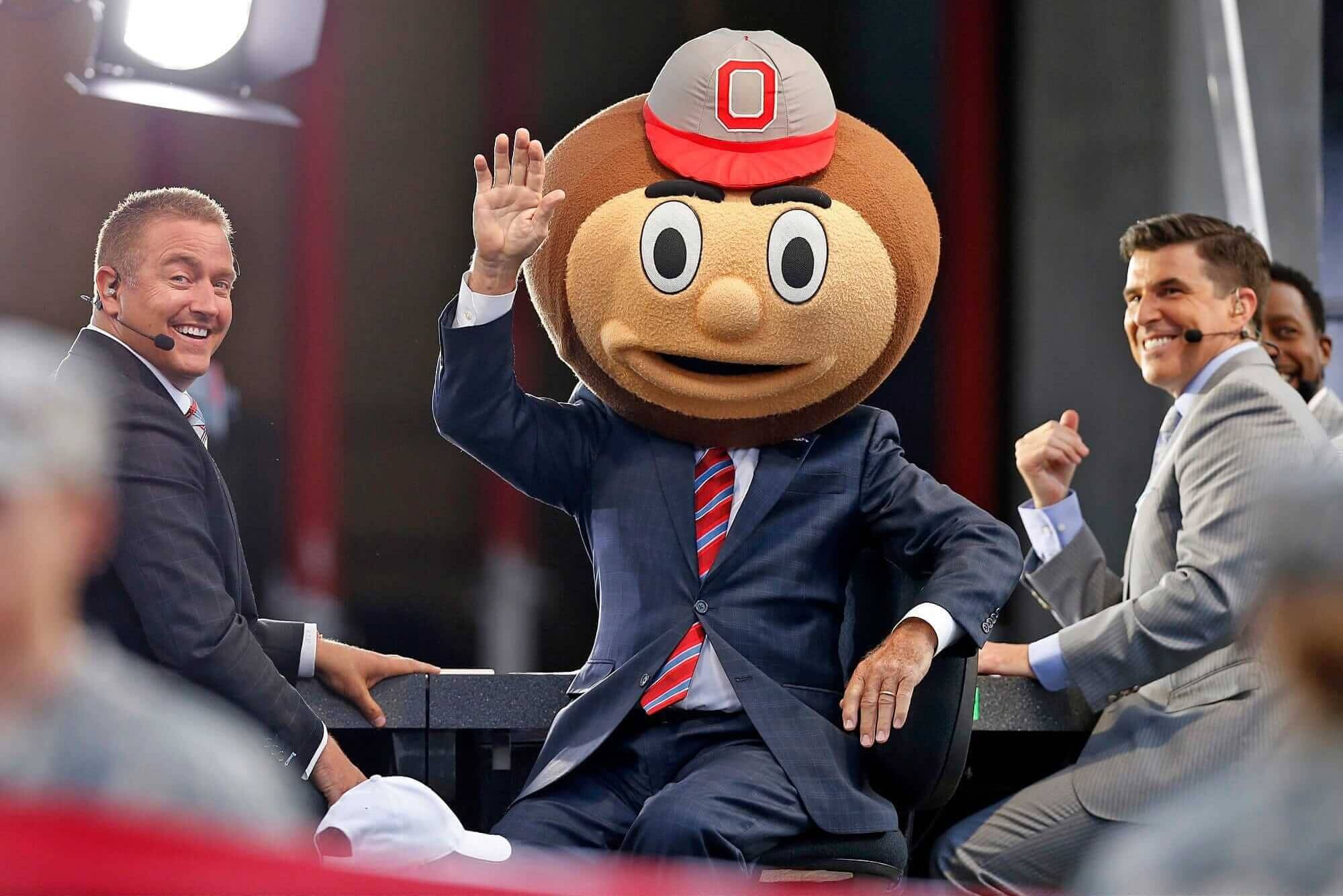
Lee Corso continued on ESPN’s “College GameDay” pregame show 16 years after suffering a stroke, thanks in part to his colleagues. (Barbara J. Perenic / Columbus Dispatch / USA Today via Imagn Images)
“In the early years, Coach really taught Herbstreit a lot about being on TV, but their relationship obviously went way beyond that. Especially when Kirk’s father passed away (in 2016), Lee was really there for him,” said GameDay producer Jim Gaiero. “After Lee’s stroke, you could see how Kirk was always super protective of Coach, and everyone took their cues from that.”
If the on-air conversation started bouncing around and Herbstreit could sense Corso wanted to jump in, Herbstreit would make eye contact with Fowler or Rece Davis, who took over as host in 2015, to have them give Corso some runway. Or Herbstreit might end one of his points with an easy set up, saying, “Coach, I know you felt pretty passionate about this as well.”
If Corso got stuck on a word or thought, Herbstreit would casually jump in and finish the sentence, or gently put his hand on Corso’s to ease his nerves and let him know he was there if needed.
“Some weeks he might not need my help. Other weeks he did,” Herbstreit said. “So I just tried to stay incredibly alert to him.”
It was the most visible piece of a broader, staff-wide effort. Corso built his broadcasting reputation on spontaneous responses, interrupting the conversation with his patented “Not so fast, my friend!” interjections and huffy defiance of any take he disagreed with. But the stroke made those quick-witted jabs far more challenging.
Corso worked hard to overcome it. He trained with a speech therapist, scripted and rehearsed more of his lines, and would duck into a bathroom or supply closet to practice his speaking exercises before each show. But he found solace in the amount of effort poured into the prep.
“A less-confident person, a person that had doubts and worried what people thought, would really struggle in that role,” said former “College GameDay” analyst David Pollack. “Coach is the perfect personality to be able to handle something like that, because if he messes up his words, he doesn’t care. He is forged differently.”
The cast and crew adjusted, too. Corso used to write out meticulous notes with different colored Sharpies before each show; Fallica started typing and color-coding the notes instead. Producers worked with Corso on which of his lines would cue them to roll to video for a specific segment, or how the conversation on a certain topic might flow, literally writing out “C” to “L” to “K” with arrows to signify that host Fowler would throw it to Corso, who would throw it to Herbstreit.
“The one thing I learned very quickly is how the family of GameDay put this protective cocoon around coach Corso,” said ESPN senior writer Pete Thamel, who joined GameDay as an insider in 2022. “It’s this unspoken thing that everyone in the family is there to help him, keep eyes on him.”
It’s easy to forget now, after two decades as the lovable grandpa, but Corso was a sharp-tongued pot-stirrer back in the day.
“As good as he was at analyzing the game, he was better at getting your attention, no gray areas, a willingness to be wrong and not worry about it,” said Tim Brando, the show’s original host from 1987-88. “The younger generation has no concept of the broadcaster that Lee Corso was in his early years.”
Corso’s headgear pick was part of that small-screen allure, and had already become the show’s signature, climactic moment prior to 2009. But Corso and GameDay both leaned fully into the tradition after his stroke, building each episode to the spectacle of that final selection.
“He instinctively knew how to get other people on set going, and I think that’s what has been tough in recent years. I’ve said this to Lee, and he knows it, ‘Your mouth doesn’t work as well as you want it to,’” said Fowler. “If you look back at those days pre-stroke when he was as sharp and quick and as funny as anybody out there, that’s what built the legend of the picks segment.”
As Corso aged, he didn’t have the same stamina across the show’s three-hour marathon, but he was always ready for the grand finale, and to give the fans what they wanted, whether watching at home or in the crowd.
“If he has a couple moments during the show where a comment doesn’t come out the right way or he stumbles over a word, that’s fine. That final segment with the picks and the headgear, if that’s gold, that’s all that really matters,” said Fallica, who worked on the show from 1996-2022. “That’s the way the show was built: Give Lee whatever help, breaks, preparation he needs so that he’s peaking at 11:59 a.m.”
His role continued to adapt in recent years. During the pandemic-shortened season in 2020, Corso stayed home in Lake Mary, where a remote production team turned his backyard into a GameDay satellite set, beaming him into the show each Saturday and filming content for social media during the week. Corso also missed multiple shows each of the past two seasons due to minor health issues. But he could never stay away for too long.
“Even as we tried to protect him, wanted to make sure he was healthy, he was so competitive he wanted back in the game. He wanted to be part of everything,” said Davis. “That speaks volumes about how important the show is to him, and gives some insight into why he is such an iconic figure in television.”
Whether Corso was absent or seated at the desk, the impact of the stroke and the effects of aging over the years at times could be uneasy for viewers. The cheeky entertainer who sparred with Beano Cook and Craig James in the show’s early days and chided a wet-behind-the-ears Herbstreit still flashed through in glints and glimpses, whether riding with the Oregon Duck on the back of a motorcycle, dueling with Katy Perry at Ole Miss or wagging his No. 2 Dixon Ticonderoga pencil.
It was similar off camera. Thamel recalled being in the airport a couple of years back, traveling with GameDay to Oregon. He noticed Corso walk by their gate and continue down the terminal, so Thamel quickly jogged after him.
“I’m like, ‘Hey, Coach, I think you passed up our gate for the flight,’” said Thamel. “And he looks at me, kind of puts his hand on my shoulder and says, ‘I know, Pete. I’m going to the bathroom.’”
Even as those moments became fewer and farther between on-air, there was something comforting about simply having Corso on the show. For many, watching Herbstreit grow into that caretaking role pierced through the occasional awkwardness.
It wasn’t always perfect, but it was real, and Corso embraced that.
“He’s working in the most unforgiving medium you can imagine. Live television exposes your every flaw,” said Gene Wojciechowski, a former ESPN writer and GameDay contributor. “There is such courage when you’ve had a stroke and are going to sit on a live television set and power your way through, and he did that.”
Saturday’s edition of “College GameDay” will be an emotional celebration of Corso and a career spent hoisting college football into the mainstream. But it also will be one final acknowledgement of the pluck Corso tapped into over the past 16 years — and the GameDay family that ensured it never ran out.
“He is such an important figure, not only on the show, but just in college football — period. And nothing was more inspirational than his comeback,” said Howard. “He’s like Rocky. He was our Italian Stallion, and the stroke was Clubber Lang. It ain’t knock my man out, it just showed what he’s been able to fight through.”
(Photo of Lee Corso and Kirk Herbstreit: Dan Sanger / Icon Sportswire via Getty Images)