
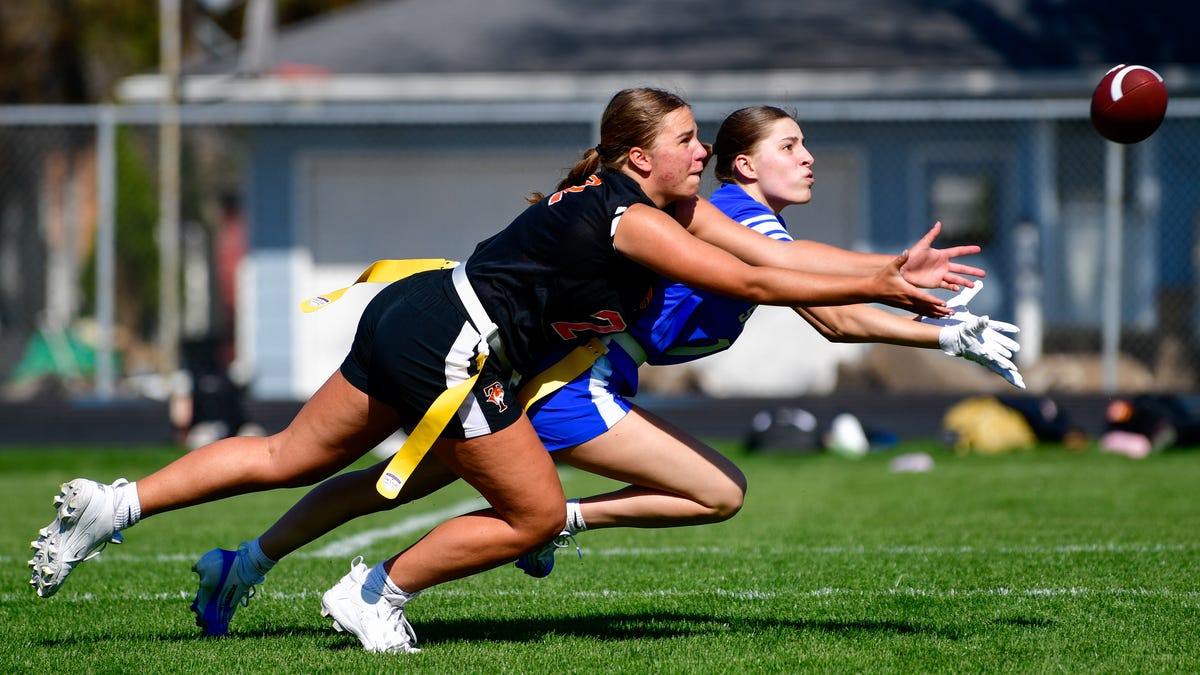
SARTELL — High school spring football has kicked off in Minnesota.
Instead of stadium lights, shoulder pads and helmets, athletes play under Sunday afternoon sun and wear flags at their waist. Oh yeah, one more thing is different — the league is dedicated for girls to snap, throw, catch the ball and score the touchdowns.
Sartell-St. Stephen and St. Cloud Tech are fielding teams in Minnesota’s first statewide high school girls flag football league. The Sabres and Tigers played in mid-Minnesota for the first time this past Sunday, May 4, at Riverview Stadium in Sartell. There are 51 teams across the state playing independent from the Minnesota State High School League.
Tech beat Sartell 35-14, but lost its second game to Melrose 16-12. The Sabres beat Monticello 42-12 in the doubleheader.
Sartell (2-2) and Tech (3-1) travel to Big Lake next Sunday, May 11, to play the Hornets (2-2) and Anoka (4-0), then Tech hosts the final games of the regular season on May 18. Leading the District 1 Gold Division, Tech is in position to make the playoffs, which start June 1 with the state title game June 9 at TCO Stadium.
In addition to hosting the championship at the Vikings practice facility, the NFL has gone to great lengths promoting flag football in Minnesota and across the country. The Vikings committed $600,000 to get Minnesota’s high school league off the ground, covering some costs for uniforms, coaches, officials and other operations. Earlier this year, the NFL also announced a partnership with seven NCAA institutions in Minnesota, South Dakota and Wisconsin for a three-week regional league. Wisconsin-Stout triumphed over Augustana in the championship game April 26.
“It’s just a chance to expose football to another group of athletes, and you can see we’ve got a lot of different athletic girls,” Sartell coach Scott Hentges said after the games Sunday. “We’ve got soccer players, swimmers, volleyball players, softball players.”
Hentges’ daughter, Maya Hentges, is a senior on the team. He said her love for football inspired him to don a whistle in the spring.
There are 14 state-sanctioned high school leagues across the country with 18 more states, including Minnesota, hosting pilot leagues. The MSHSL requires a pilot league have two years with at least 20 schools competing for it to consider granting the sport “emerging status.” The activity has five years to have 32 competing teams, and the MSHSL board of directors will determine status thereafter. The MSHSL adopted boys volleyball as a varsity sport for the spring 2025 season with Tech fielding a team.
Sunday is not the first time a high school girl has played varsity football in St. Cloud. Even last season, girls were rostered on football rosters across the state. But this new league gives athletes who did not grow up with the sport the chance to be introduced to the game competitively with opponents at a similar level.
Sabre junior Brynn Darling is a Vikings fan and attends a lot of high-level Division III games at St. John’s University where her dad, Matt Darling, assistant coached a defense that played into the round of 16 in last year’s national tournament.
“I watched a lot of football growing up, but I’ve never actually played,” Darling said. “It’s been cool. It’s been different than I expected. I don’t know what I was expecting but I didn’t expect how the plays flow — just how similar some plays can be — you can get such different results.”
Darling explained learning Sartell’s systems on offense and said the Sabres implemented new defenses and were able to adjust their coverage better in Week 2.
“We’ve cleaned up some things,” Darling said. “There’s still some areas, obviously, to improve because we haven’t played a ton.”
Many Sabres and Tigers play varsity sports for their schools, including during the spring season. Darling starts in center field for the 8-3 Sabre softball team. Practice is twice or three times a week before school.
Learning curve with a new sport
Flag and touch football have been around nearly as long as the tackle version. In 2028, the sport will be a discretionary event at the 2028 Los Angeles Olympics, the first time football of any kind will be played at the event. Instead of downing an offensive ballcarrier with a tackle, in flag football, a player is downed when a defender detaches a flag from her belt.
Compared to 11-player tackle football, the game is played on a much narrower, shorter field with five players to a side. One player hikes the football to a quarterback, which can be rushed after a “five Minnesota” count. Rushing plays are legal, but with no blocking and the center and three receivers running routes, passing can yeild larger gains.
Teams are allowed four downs to reach midfield and another four to score. The results are downfield plays with leaping and diving catches by receivers and defenders in coverage. The cost of an interception can be especially heavy with fewer offensive players near the line of scrimmage to prevent a pick-six.
Hentges and Tech’s coach Jon Benson coached the varsity boys Sabre and Tiger teams in the fall, and most of the officials suit up in stripes for tackle football too. On Sunday, they occasionally had to confer penalties and rules for flag football. QBs aren’t allowed to run within five yards of the goal line even when blitzed and all passes must be forward — no laterals.
“We’re still learning the tweaks of the rules,” Hentges said. “I was unsure of the rules on when the quarterback can run and it cost us in that Tech game. (Picking up the rules) has been hard. There’s a rulebook, but there’s exceptions to it for Minnesota, so we’re still learning.”
Sartell ran the ball more often than Tech, trying different fake handoff combinations and flipping between Maya Hentges and sophomore Lauren Morse at quarterback. Tech mostly stuck with Shamla out of the shotgun, though junior Reese Ruska was tapped at the end of halves to heave the ball 20 or 30 yards downfield to Shamla or one of her other, taller teammates.
“I’m going to readjust now that I’ve seen it play out for two weeks,” Hentges said. “There won’t be major changes, but there’s a couple things I think we can add.”
Hentges has used YouTube, Google and other resources to study before and during the season. The way the athletes have taken to the lingo, learned football moves and made internal adjustments has been impressive, he said.
Ruska is one of Tech’s best all-around athletes, coming off a 20-goal, 18-assist hockey season for the St. Cloud Crush. She and Shamla said they were surprised by the amount of contact during games, saying the hits are comparable to hockey. They added that previous understanding of athletic schemes have been helpful even transferring from skates on ice to cleats on turf.
“It’s a lot of quick-thinking and concepts where not everything’s determined and you just need to adapt to what’s given,” she said.
Shamla said Benson emphasized playing different sports, even in the spring, so that the Tigers can focus less on conditioning in morning practices and more on implementation and skillwork. The goal of the season, according to her, is to get better every day.
But Ruska added going to state, winning and being invited to the national tournament in June at the Pro Football Hall of Fame in Canton, Ohio would be “really fun.”
Contact reporter Reid Glenn at rglenn@gannett.com.