
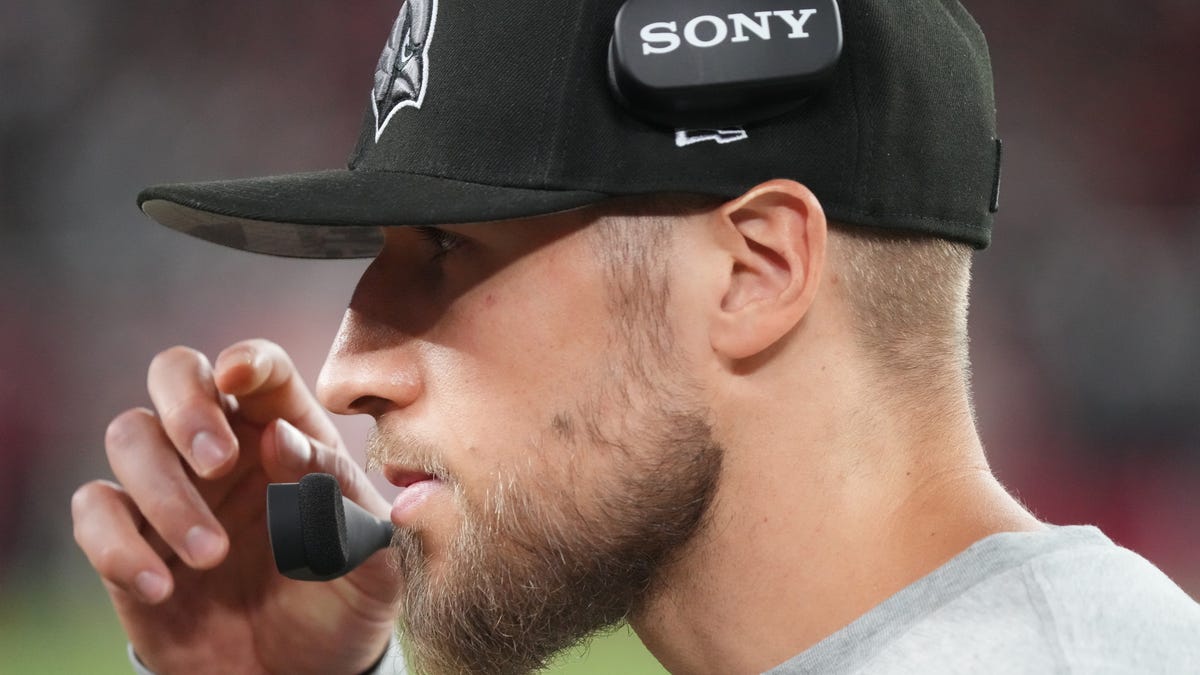
There’s not much that fazes Nick Rallis.
It was two years ago now that the Arizona Cardinals defensive coordinator was handed the keys to a unit with significant challenges and lacking in results. His best returning edge rusher was a converted linebacker; his best cornerback is now unemployed. The remains of the Kliff Kingsbury era, by the time it crashed and burned, were a broken culture, a franchise quarterback with a torn ACL and only a few scattered building blocks.
When last summer arrived, the picture wasn’t much rosier. A year into Jonathan Gannon’s overhaul, the Cardinals were projected for 6.5 wins, the fourth-fewest in the NFL. In a preseason ranking of NFL defenses from The Ringer, theirs placed dead last.
The description in that piece read: “I look at the depth chart and just have a hard time seeing anything other than one of the NFL’s worst defenses.”
Five months later, that same unit had become a sort of cult figure for the people who spend their days studying these things. They ranked 15th in points per game and 14th in defense-adjusted value over average, results that felt remarkable given the expectations.
You don’t need geeky numbers to describe the Cardinals’ success. George Kittle, a nine-year veteran, praised them for running “a very different defense than anything I’ve ever experienced in the NFL.” Miami Dolphins head coach Mike McDaniel, one of the league’s best offensive minds, highlighted Gannon as “a guy who doesn’t get enough credit” for the defense his staff put together.
“They’ve built a unique system that isn’t off any particular format that I’ve seen in the NFL,” McDaniel said in an interview with ESPN this spring.
But if you ask Rallis to explain all of this, he’ll need a second.
Sitting in a black rolling chair at the Cardinals facility one day last week, Rallis leaned back, cracked open a bottle of water, took a quick swig and began.
“It’s not like a super clear answer,” Rallis told The Arizona Republic.
Over the next half hour, that’s the answer he would unspool, piece by piece.
Gannon, Cards eager to see impact of ‘high-level’ Rallis
The Cardinals defense, as McDaniel noted, is defined by its unique nature. Rallis doesn’t like the word “weird,” but he’ll allow for “different.”
Last season, they introduced a steady diet of three-high safety structures, as opposed to typical looks that place one or two safeties at the top of the defense. That gives Rallis’ unit more flexibility to rotate into different coverages — at the expense of bigger bodies on the interior.
It’s an innovation some expect to begin spreading across the league, at least on teams with the personnel to make it work.
In part because of those structures, the Cardinals also rely heavily on “penny” looks, which feature just one traditional inside linebacker. And up front, they hit teams with all sorts of bizarre pressure packages. Anyone is a threat to rush the passer.
Combine it all, and the Cardinals’ secret is in the confusion they create. What they show before the snap bears little relation to what they do after the snap. On one play last season, Zaven Collins — nominally an edge rusher — lined up at defensive tackle, then dropped all the way to free safety, where he manned up with Tyreek Hill. It was just one snap, but it symbolized Rallis’ defense.
This is not what anyone expected when Gannon was hired. As the Eagles’ defensive coordinator — with Rallis as his linebackers coach — Gannon ran a fairly traditional defense. The team’s elite talent enabled them to play that style.
But even then, both coaches were intrigued by some of these more creative concepts.
“A little bit (is) from JG and having a big-picture vision back when we were in Philly,” Rallis said. “He was kinda telling me what he wanted to be.”
That meshed with the ideas that had long been percolating in Rallis’ head.
One thing to understand about Rallis is that he learns more by watching than by asking. In 2018, when he landed his first NFL job as a defensive quality control coach with the Vikings, the league’s approach to offense was being revolutionized by Kyle Shanahan and Sean McVay. Rallis set out to study those new systems, as well as those built by more established schematic wizards like Sean Payton and Josh McDaniels.
“Figure out why they’re beating people, why they’re gashing people,” Rallis said. “Some of that stuff comes from my own wounds, going against those guys. And then it’s, you’re able to see who has some success against them. And then that can lead to some defensive studying.”
Gradually, through that process, Rallis began identifying specific aspects that he liked about defenses across the league.
The three-safety idea came from some creative elements of how multiple Super Bowl-winning coach Bill Belichick deployed his defensive backs. Many of the Cardinals’ coverage principles originate from Mike Zimmer, the former Vikings head coach who once hired both Gannon and Rallis.
The “penny” looks were a creation of Vic Fangio, whom Rallis began studying on a recommendation from Drew Petzing, now the Cardinals’ offensive coordinator. Brandon Staley later refined those designs when he was the Rams’ defensive coordinator, providing further inspiration.
These were the threads that Rallis would eventually stitch together to form the quilt that he produced in Arizona last fall.
“It’s completely morphed and grown as you just problem-solve offenses,” Rallis said. “And so it was never like a, ‘This is it’ (moment).”
In Philadelphia, Gannon saw these gears turning in Rallis’ brain in real time.
When he was hired as the Cardinals head coach, Gannon knew he wanted to delegate playcalling duties — he just needed a defensive coordinator he could trust. In Rallis, who was just 29 years old at the time, Gannon had his answer.
“Well, in my opinion, he’s brilliant,” Gannon said. “And then nobody works harder than him. So yes, he had a lack of experience, but I was very comfortable with him doing the job at a high level.”
It’s not, though, as if Rallis arrived for his first day on the job with a playbook already written.
“I had an idea,” Rallis said. “But nothing was set in stone.”
Cardinals’ Rallis: Budda Baker a scheme-changer
When asked whether it’s more important to build the scheme around the players or the players around the scheme, Rallis doesn’t hesitate.
“Scheme around the players,” he says, jumping in mid-sentence.
This was not a quick process in the spring of 2023.
Rallis had a concept of what he wanted his defense to look like, but he had to build a foundation to get to that end point. In his office and at home, he would rack his brain, searching for those answers.
“That first offseason, the players are in the building (in a month), we have about 50% of the foundation as a staff laid down,” Rallis said. “And (the coaches) are like, ‘Are we gonna talk about pass downs yet? Are we gonna talk about red zone yet?’ And I’m like, ‘I don’t know yet what I want it to look like.’”
This is where Rallis points out that building out a defense is no solo mission. “I am not a mad scientist holed in my office,” he says.
Conversations with the coaching staff helped formulate what the defense would look like. So, too, did seeing their players in action. Really, one extremely important player.
“It had been in the makings for years,” Rallis said. “But then Budda definitely changed how it evolved and how it gets called.”
Three years into Rallis’ tenure, Budda Baker is still the player around whom the system revolves. But that first season, he added a crucial sidekick, nickel Garrett Williams. As soon as Williams, then a rookie, started practicing in his recovery from a torn ACL, Rallis said he “could see the intelligence and the reliability.”
This is how the defense morphed into its second iteration in 2024. Now, the Cardinals had the players to lean into the three-safety looks that emphasize their defensive backs.
“I look back at some of the tape from 2023,” Rallis said, “I’m like, ‘Why did we have Budda right there? We should’ve had him right here.’ And then once you saw him go to work within the initial foundation, you started to create stuff for him.”
That type of evolution is a constant for Rallis.
Throughout the season, the Cardinals’ coaching staff keeps an Excel spreadsheet of new problems that offenses are posing. During the season, Rallis wants to change as little as possible. “I don’t want to add to our toolbox, but I do want to bring out some different tools week to week,” he says.
The offseason, then, is the time for reflection. So each winter, the coaches return to that spreadsheet and come up with solutions. These are the tiniest of details, like a new type of motion at the snap that the 49ers and Dolphins popularized in 2023.
To be at the forefront of an ever-changing league, the Cardinals need all the answers they can find.
“The first year you’re doing something that’s innovative isn’t necessarily gonna be what that final product will look like,” Rallis said. “I mean, it never is a final product.”
Entering 2025, that’s where the excitement lies. Last season, outperforming all expectations meant being average. Now, for the first time, Rallis has genuine talent to work with beyond a few scattered pieces.
Some of that has been finding players who fit what Rallis does. The Cardinals signed Mack Wilson at linebacker because of his ability to align all over the front of the defense. They traded for Baron Browning at edge rusher in part because he excels dropping into coverage. Those players mesh with Rallis’ preference for versatility.
Most of their moves, though, have simply been about acquiring good players.
Josh Sweat, Calais Campbell, Dalvin Tomlinson and Walter Nolen have bolstered the defensive line. Will Johnson is immediately their most talented outside cornerback. Each of those players creates new schematic possibilities.
“There’s some tools that have been in there that haven’t gotten pulled out,” Rallis said. “Like what’s that tool that this guy needs? There’s new pieces. What do those guys do well? Hey, let’s pull this tool out of the toolbox this year because of him.”
Rallis, of course, won’t say what those tools are. You’ll just have to watch and see what he comes up with next.