
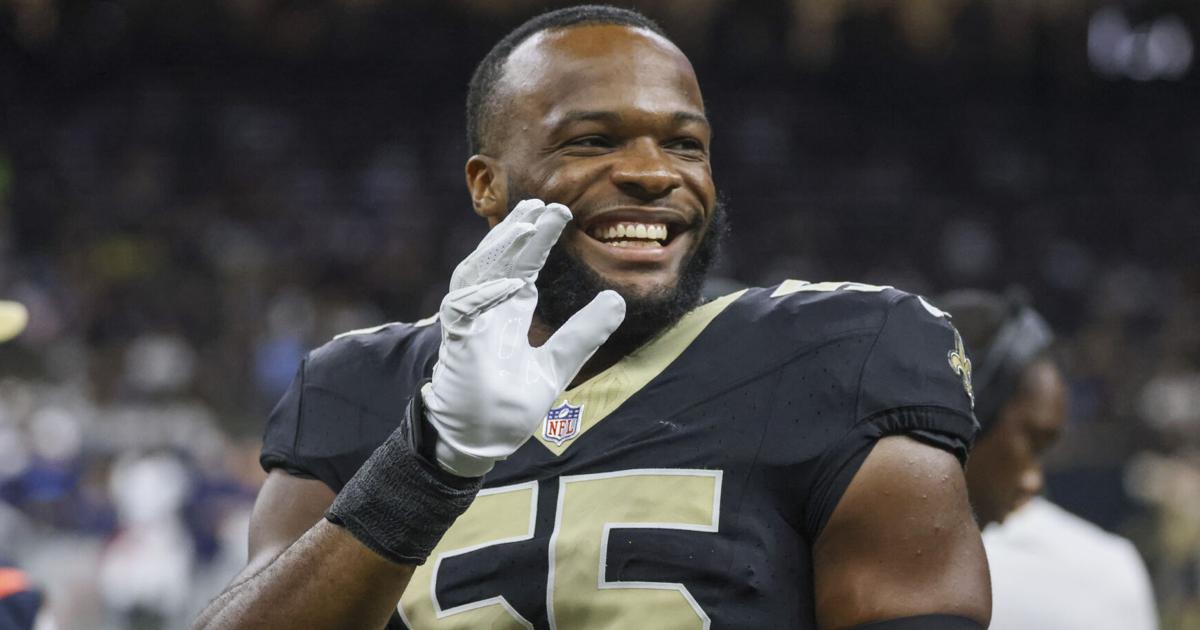
The New Orleans Saints’ decision to cut edge rusher Isaiah Foskey last week raised eyebrows and fueled wild discussion about his infamous place in the club’s draft history.
Foskey never cracked the starting lineup and failed to record a single sack in 27 career games. His best contributions were on special teams. Not what the Saints expected when they selected him with the No. 40 overall pick in the 2023 draft. That no NFL team has taken on a flyer on him yet is telling.
To be fair, Foskey was drafted to fit a different scheme and the 2023 draft looks like a decidedly weak one. Few of the second rounders that year have made an impact in the league, tight end Sam LaPorta and safety Brian Branch being the exceptions.
Still, there’s no sugarcoating it. Foskey was a miss — and a big one, given previous swings-and-misses on Marcus Davenport and Peyton Turner.
Still, Foskey is far from the biggest bust in Saints’ history. In fact, he wouldn’t even rank in the top 10, which says something about the Saints’ ignominious draft history.
Let’s take a look at the list of infamous Saints draft picks:
No. 10 FB-LB Les Kelley, 1967, R1 (No. 26)
Future Hall of Famers Willie Lanier and Lem Barney were still on the board, but the Saints decided to go for the burly Alabama fullback-linebacker with the first draft pick in franchise history. The dubious decision would haunt the Saints and set the tone for the club’s grim early seasons.
Kelly battled the measles and a knee injury as a rookie and played in just two games. He moved to linebacker a year later and started just one game. He was cut in 1969. His career production: one interception and one kickoff return for 20 yards.
No. 9 DT Kevin Hardy, 1968, R1 (7)
An asterisk applies here. Hardy never played a down for the Saints. He was sent to the San Francisco 49ers by NFL commissioner Pete Rozelle as punishment for the club illegally signing tight end Dave Parks before free agency was implemented.
Hardy went on to play for three teams and never made a mark. He was a rotational player and finished his five-year career with five sacks and 12 starts. Not the way you want to rebound from the whiff on Kelley a year earlier.
No. 8 OG Royce Smith, 1972, R1 (8)
Smith started 10 games as a rookie but fell out of the starting lineup in Year 2 and was traded to the Falcons in 1974. Worse, the two players taken directly after Smith – tight end Jerome Barkum and linebacker Jeff Siemon – started for 10 seasons and became Pro Bowlers.
No. 6 LB Rick Middleton, 1974, R1 (13)
Middleton was supposed to be the face of the Saints defense but he never developed into an impact player. He started just one season and made his greatest contributions on special teams. He was dealt to the Chargers after two years.
The Saints took the wrong Ohio State linebacker. One pick after their selection of Middleton, Denver took Randy Gradishar, a franchise cornerstone and future Hall of Famer.
No. 6 DT Johnathan Sullivan, 2003, R1 (6)
Sullivan was a disaster from the start. He reported late to camp and showed little initiative other than at the buffet line. In three impact-less seasons, Sullivan started just 16 games and recorded 78 tackles, 1.5 sacks and a forced fumble. The Saints traded him to the Patriots in 2006 for a backup receiver. The Patriots waived him four months later.
The decision to draft Sullivan was compounded by the price they paid to trade up with Arizona to select him — two first-round picks and a second-rounder – and the fact that the Vikings selected future All-Pro defensive tackle Kevin Williams three picks later. Arizona used the second-round pick to select future star receiver Anquan Boldin.
The 2003 draft was truly a boom-or-bust proposition. Six of the top 10 players selected went on to be multi-time Pro Bowlers. Four, including Sullivan, receiver Charles Rogers and quarterback Byron Leftwich, failed to make an impact and were out of the league after a few seasons.
No. 5 DE Joe Campbell, 1977, R1 (7)
The Saints raved about Campbell’s mean streak when they selected him with the No. 7 overall pick out of Maryland. What they didn’t know was that it didn’t have an off switch. His emotional outbursts led to countless fights, penalties and sidelines eruptions at games.
Campbell recorded eight sacks in three-and-a-half seasons, before he was traded to the Raiders five games into the 1980 campaign.
No. 4 OG Kurt Schumacher, 1975, R1 (12)
The Saints took Schumacher one pick after the Rams selected guard Dennis Harrah. Harrah started 144 games and went to six Pro Bowls. Schumacher started 16 games and was out of the league after four years.
No. 3 WR Larry Burton, 1975, R1 (7)
If the Schumacher pick wasn’t bad enough, the Saints doubled their whammy by reaching for Burton five picks earlier in Round 1. The Saints hadn’t had a true No. 1 receiver since they traded Ken Burrough in 1971. The little-known Burton was an Olympic track standout with sprinter’s speed. Unfortunately, he couldn’t catch or stay healthy. He was injured for much of his career and caught just 35 passes in three seasons. In 1978, he was waived and was out of football two years later.
In reaching for Burton and Schumacher, the Saints bypassed several future Pro Bowlers, including Harrah, Gary “Big Hands” Johnson, Russ Francis and Louis Wright.
No. 2 DE Shawn Knight, 1981, R1 (11)
The Saints were prepared to select Purdue cornerback Rod Woodson with the No. 11 pick but the Steelers took him at No. 10. The top three players on the Saints’ board were receiver Haywood Jeffires, tackle Harris Barton and defensive end Shawn Knight. The Saints took Knight. How bad was Knight? He reported to training camp late and fell out of favor with the coaching staff. After his rookie season, the traded him to Denver. In three career NFL seasons, he started just one game and failed to record a single stat. He was out of the league in three years. Jeffires and Barton, meanwhile, went on to stellar careers. Each was a Pro Bowler and All-Pro.
No. 1 P-PK Russell Erxleben, 1987, R1 (11)
The pick that will live in infamy.
Head coach Dick Nolan fell in love with the strong-legged Texas kicker-punter while coaching the South team at the Senior Bowl. Against the wishes of personnel director Harry Hulmes, he made him the second highest drafted punter-kicker in NFL history.
Erxleben was a bust from the start. He complained about back and leg problems during training camp and was beaten out for the starting placekicker job by Rich Szaro. In his first game, his desperation pass after an errant snap was intercepted for the game-winning touchdown in an overtime loss to the archrival Falcons.
In his second season, he missed a potential game-tying 34-yard field goal attempt in a 26-23 home loss to the 49ers. He converted only four of eight fields goal in five seasons.
In the 38 drafts since the Saints’ dubious selection, only one specialist has been selected in Round 1 (Sebastian Janikowski, Raiders, 2000).